
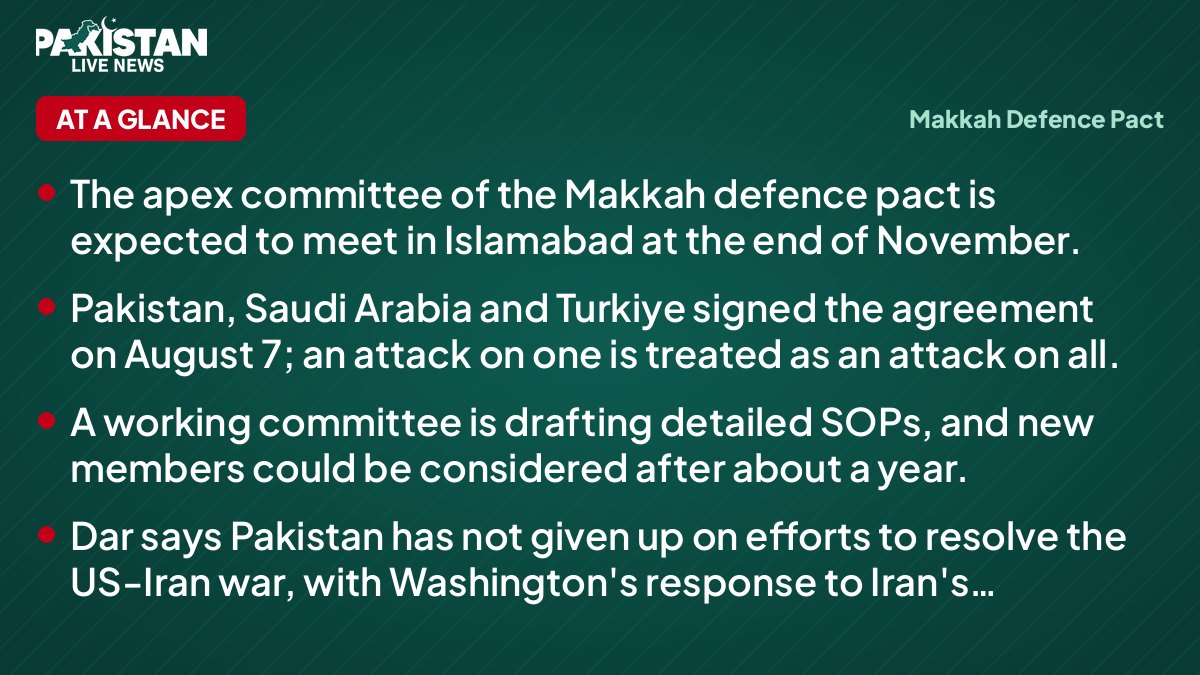
- The apex committee of the Makkah defence pact is expected to meet in Islamabad at the end of November.
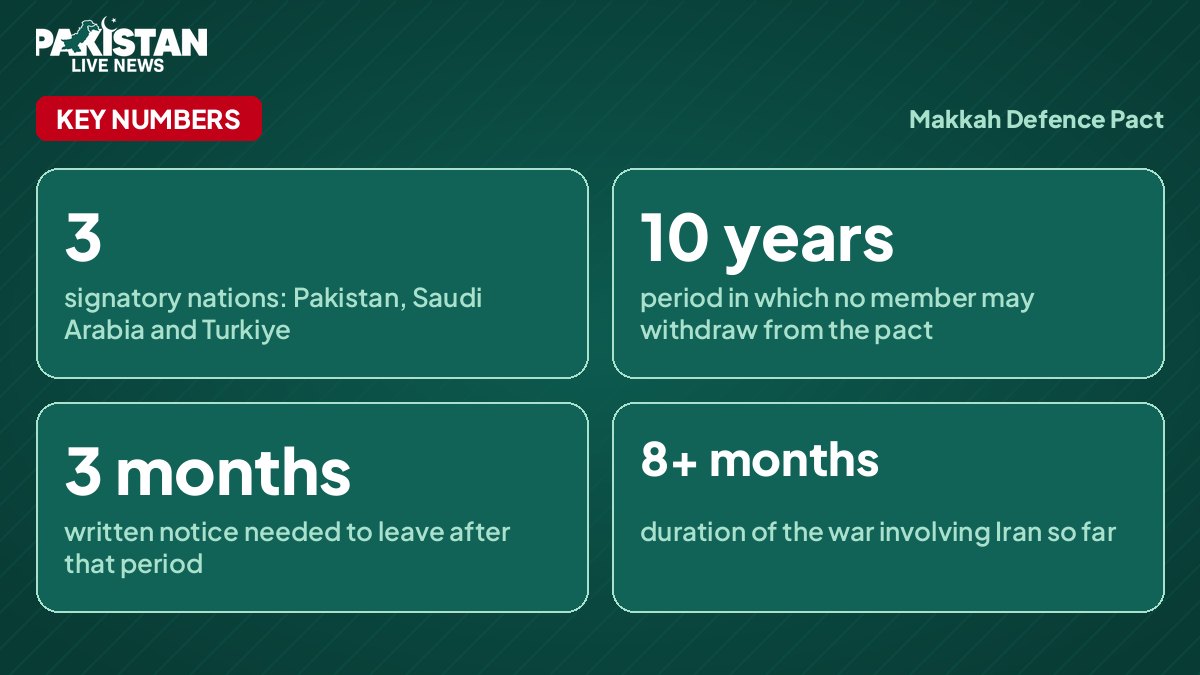
- Pakistan, Saudi Arabia and Turkiye signed the agreement on August 7; an attack on one is treated as an attack on all.
- A working committee is drafting detailed SOPs, and new members could be considered after about a year.
- Dar says Pakistan has not given up on efforts to resolve the US-Iran war, with Washington's response to Iran's Hormuz proposal pending.
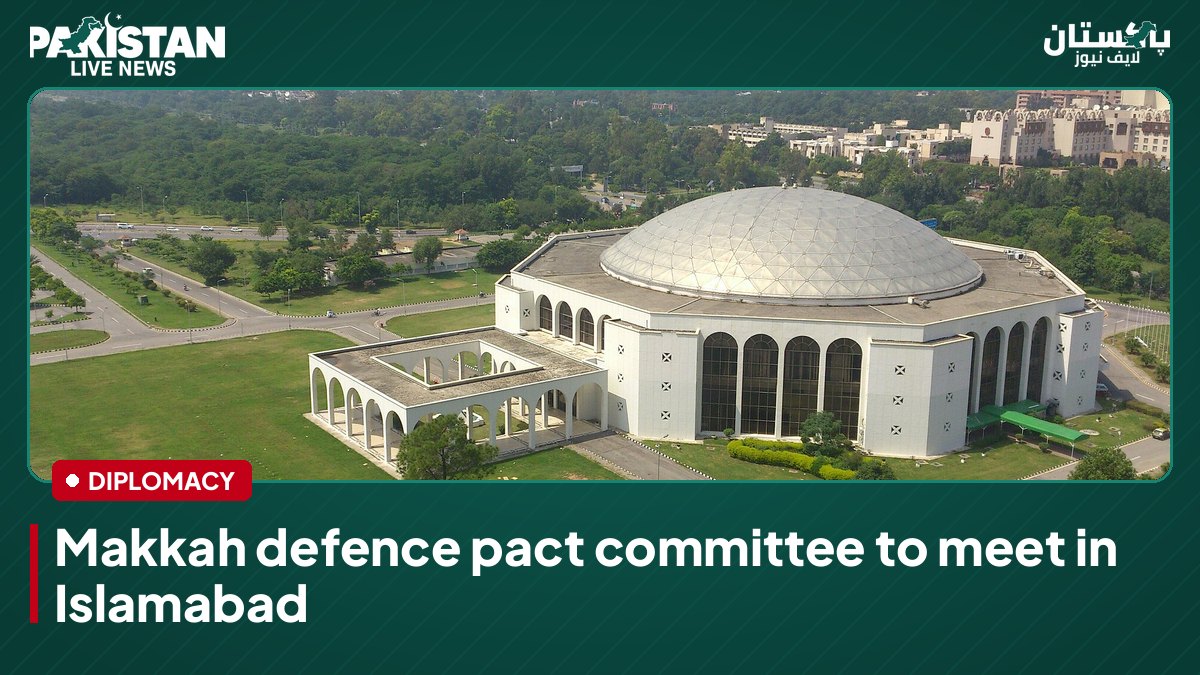
The top-level committee of the Makkah defence pact is expected to meet in Islamabad later this month, Deputy Prime Minister and Foreign Minister Ishaq Dar said on Monday. Pakistan will host the session alongside Saudi Arabia and Turkiye, the other two signatories.
In this article
Dar was speaking at a press briefing after the Economic Cooperation Organisation (ECO) ministerial meeting in Islamabad. He said the apex body would be meeting "hopefully, end of this month".
How the Makkah defence pact is taking shape
The apex body is called the Strategic Political and Defence Committee (SPDC). It comprises the foreign and defence ministers of the three countries, as well as their top military officials.
Dar said Pakistan had offered at the inaugural meeting to host the next formal session in Islamabad, and that everyone accepted. The inaugural meeting was held in Istanbul on August 31. An emergency SPDC meeting was also held in Riyadh amid Houthi attacks on Saudi Arabia.
He described the present phase as a "transition time of setting up the infrastructure". Decisions so far include arrangements for a secretary general's office and a permanent secretariat in Riyadh.
A working committee, with representatives from the foreign, defence and military offices of the three countries, has held a few sessions. Dar said its final meeting is hoped for in November, when it will settle detailed standard operating procedures.
On membership, he said the alliance is not restricted to the three founders. New members who agree to its principles will be entertained once it is established, in about one year.
In other words, this region should have its own security architecture. Maybe this is a beginning.
Ishaq Dar, Deputy Prime Minister and Foreign Minister
What the agreement provides
Under the pact, signed in Makkah on August 7, an armed attack on any one of the three countries is treated as an attack on all. The signatories pledge mutual assistance against external aggression.
The first article requires the parties to use "all necessary means" to address threats to one another's territorial integrity, sovereignty and internationally recognised borders. The second says that if a member faces armed attack or military aggression, the others must immediately help through available measures of mutual support.
The agreement invokes Article 51 of the UN Charter, which recognises the right of individual and collective self-defence. The nature and extent of assistance will be decided after an objective assessment of requirements, with each party contributing within its resources, including military capabilities.
No member may withdraw during the first 10 years after the agreement enters into force. After that, a party wishing to leave must give at least three months' written notice through diplomatic channels. Amendments need consultation and unanimous approval from the core parties.
The text also envisages cooperation in the defence industry, intelligence sharing, logistical support and counterterrorism, as well as joint military training and joint research. Turkiye's formal approval remains subject to parliamentary ratification.
Timeline
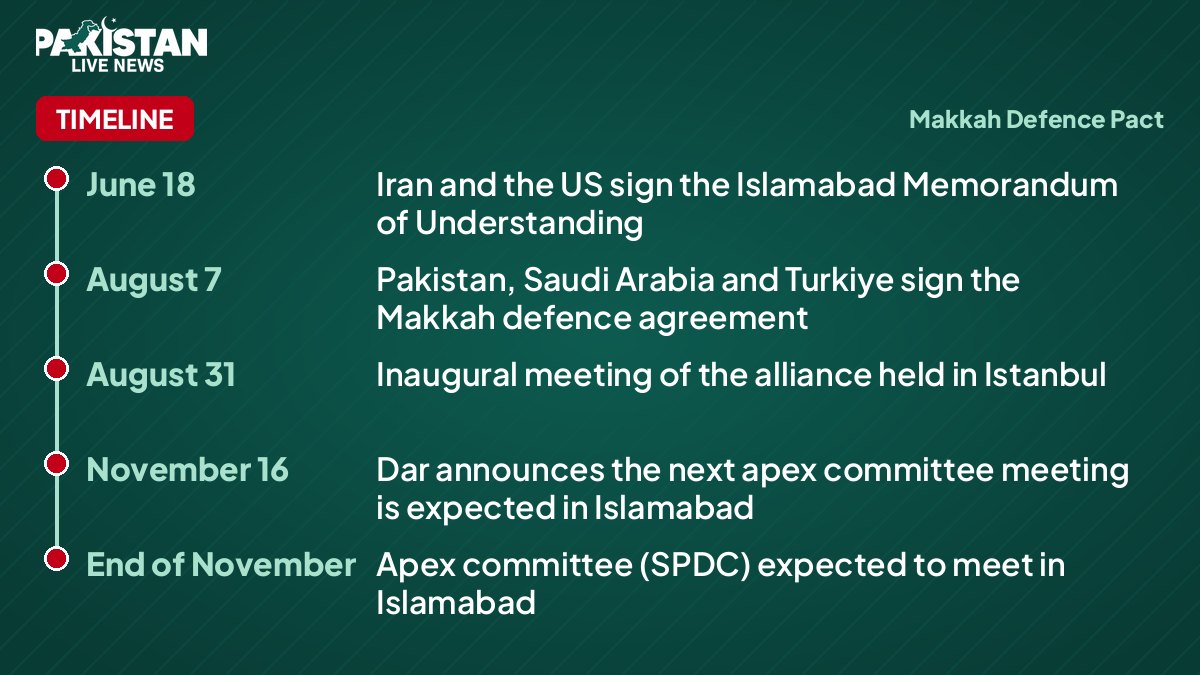
- June 18Iran and the US sign the Islamabad Memorandum of Understanding
- August 7Pakistan, Saudi Arabia and Turkiye sign the Makkah defence agreement
- August 31Inaugural meeting of the alliance held in Istanbul
- November 16Dar announces the next apex committee meeting is expected in Islamabad
- End of NovemberApex committee (SPDC) expected to meet in Islamabad
Regional security and the Houthi attacks
Dar said the pact rests on self-defence and does not violate the UN Charter. He stressed it should not be read as a sign that the three countries seek confrontation with others.
Asked about regional security architecture, he said the region should have its own system and that a collective mechanism was essential for peace and stability. He noted that global security institutions "were not created in one day".
The Saudi context is pressing. Saudi Arabia has faced repeated Houthi attacks on cities, oil facilities and shipping since fighting in Yemen's civil war intensified in July. At the Riyadh emergency meeting, the three countries agreed to ensure the rapid deployment of military forces and capabilities in Saudi Arabia.
Turkiye has condemned the attacks, offered support for Riyadh's military technology needs and agreed to join a Saudi-led coalition safeguarding navigation in the Red Sea.
Pakistan 'not given up' on US-Iran diplomacy
Dar also said Pakistan has not given up on efforts to end the US-Iran war. He described "very candid, very frank, very brotherly, very comprehensive discussions" with Iranian Foreign Minister Abbas Araghchi on the sidelines of the ECO meeting.
According to Dar, Iran has fast-tracked a seven-day proposal to reopen the Strait of Hormuz into a two-day plan. He said Washington's response is pending and hoped it would come "very soon" now that the US midterm elections are over. Both proposals, he said, were drawn from the Islamabad Memorandum of Understanding signed between Iran and the US on June 18.
The Foreign Office said the two ministers reaffirmed ties and agreed to stay in close contact. Dar stressed that "dialogue and diplomacy remain the only viable means of addressing outstanding issues, preventing escalation and achieving lasting peace and stability".
The war began with US-Israeli strikes on Iran in February that killed Supreme Leader Ayatollah Ali Khamenei. Over more than eight months, Iran has restricted shipping through Hormuz and targeted infrastructure and US assets across the Middle East. Bahrain faced a second Iranian drone attack in three days on Sunday.
The Strategic Political and Defence Committee is expected to meet in Islamabad at the end of November, and the working committee's final meeting on detailed SOPs is hoped for in November. Washington's response to Iran's two-day Hormuz proposal is still awaited.
Questions and answers
What is the Makkah defence pact?
It is a defence agreement between Pakistan, Saudi Arabia and Turkiye, signed in Makkah on August 7. It treats an armed attack on any one of the three as an attack on all and commits them to mutual assistance.
When will the apex committee meet in Islamabad?
Ishaq Dar said the Strategic Political and Defence Committee would meet "hopefully, end of this month" in Islamabad.
Can other countries join the alliance?
Dar said membership is not restricted to the three founders. New members who agree to its principles will be entertained once the alliance is established, in about one year.
Image: Humza Ahmed / Wikimedia Commons, CC BY-SA 3.0