
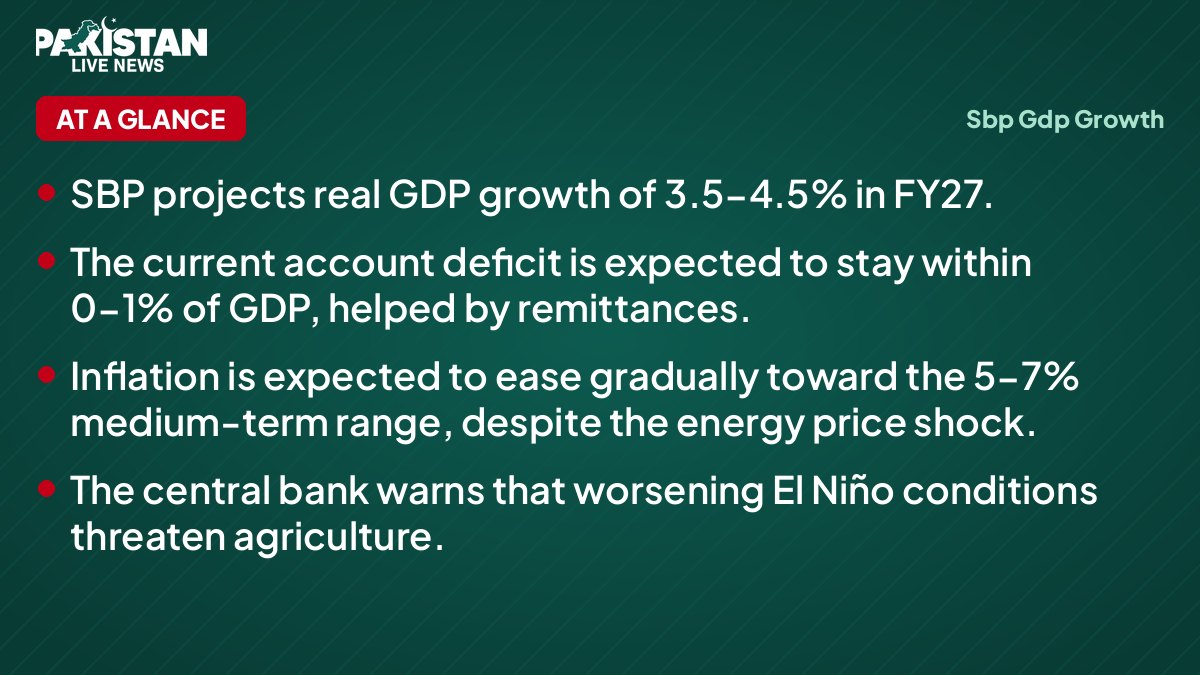
- SBP projects real GDP growth of 3.5-4.5% in FY27.
- The current account deficit is expected to stay within 0-1% of GDP, helped by remittances.
- Inflation is expected to ease gradually toward the 5-7% medium-term range, despite the energy price shock.
- The central bank warns that worsening El Niño conditions threaten agriculture.
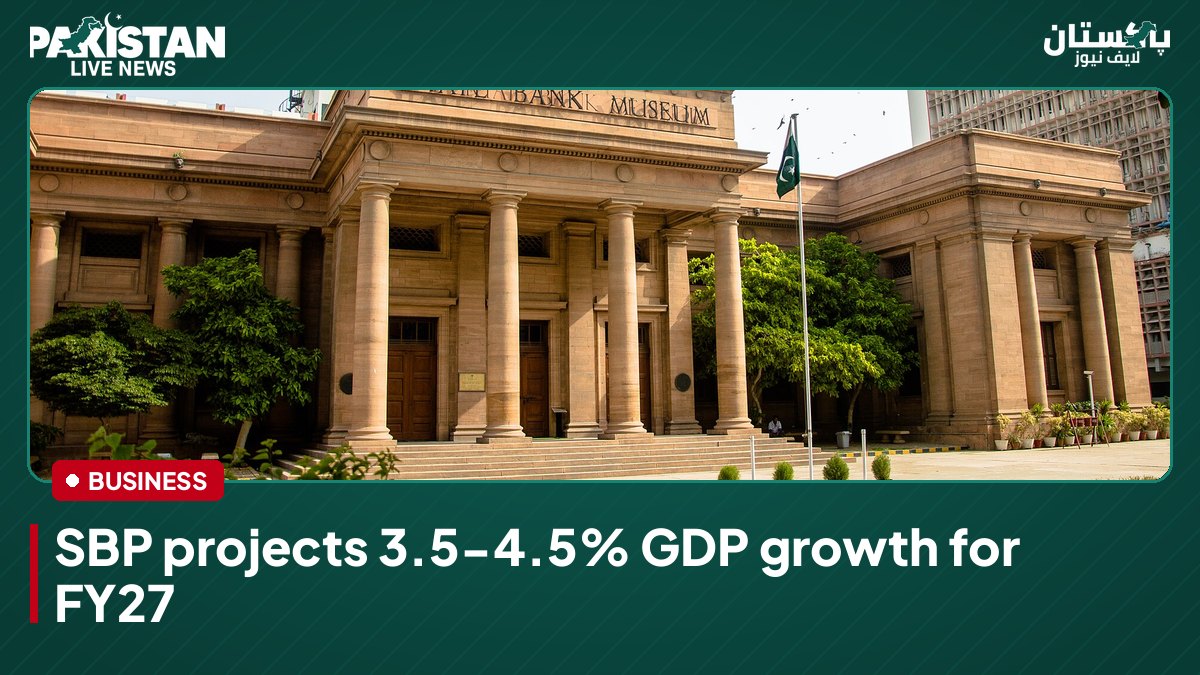
The State Bank of Pakistan (SBP) expects the economy to expand by 3.5-4.5% in the current fiscal year, FY27, as domestic demand recovers and output improves in agriculture and industry. The SBP GDP growth projection appears in its annual report on the state of the economy for 2025-26, released on Monday.
In this article
According to the report, the country entered FY27 on relatively firmer macroeconomic footing. The steady improvement in key indicators has also led to an upgrade in Pakistan's sovereign credit ratings.
SBP GDP growth outlook for FY27
The central bank says the gradual recovery in domestic demand is expected to continue, with recent fiscal measures adding further momentum. Better performance in commodity-producing sectors is expected to carry over into the services sector.
The report does flag a risk. Worsening El Niño conditions threaten the agricultural outlook, although the latest information points to higher output of key kharif crops, including sugarcane, rice and maize, than last year.
On prices, the global energy price shock is expected to add upward pressure on inflation. The SBP expects inflation to ease gradually toward its medium-term target range of 5-7% during FY27.
Hence, SBP projects real GDP growth to remain in the range of 3.5 – 4.5% in FY27.
State Bank of Pakistan, Annual Report on the State of Pakistan's Economy
External accounts and reserves
Economic expansion, tariff rationalisation and higher global commodity prices are expected to push imports up. Exports are expected to recover moderately, supported by policy incentives and a slight rise in global demand.
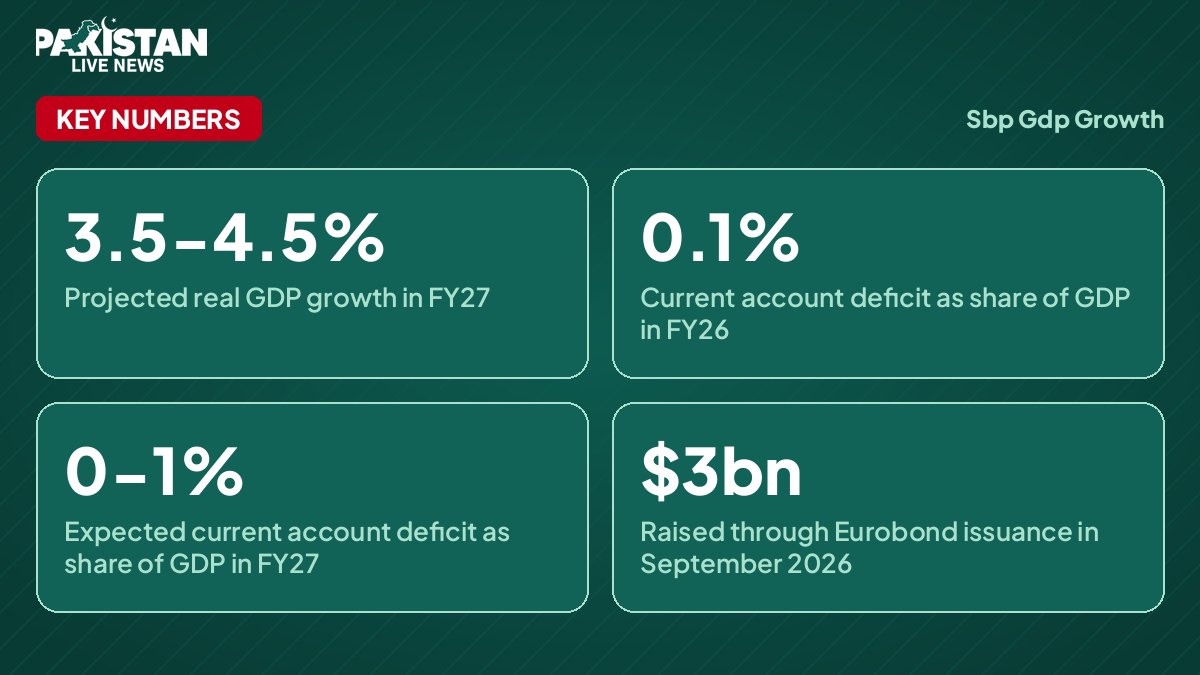
Even so, continued momentum in workers' remittances is likely to hold the current account deficit within 0-1% of GDP in FY27, according to the report.
The central bank also expects foreign exchange reserves to keep building toward four months of import cover. It points to $3 billion raised through a Eurobond issuance in September 2026, SBP foreign exchange purchases and projected official inflows.
| Indicator | FY26 | FY27 outlook |
|---|---|---|
| Real GDP growth | Increased, led by large-scale manufacturing | 3.5-4.5% |
| Current account deficit (% of GDP) | 0.1% | 0-1% |
| Inflation | Average near upper end of 5-7% target range | Gradual easing toward 5-7% range |
| FX reserves | Notable improvement in SBP buffers | Further build-up toward four-month import cover |
How FY26 played out
The report describes the economy as resilient in FY26, despite domestic and global shocks and an increasingly uncertain geopolitical climate. It credits a prudent monetary stance, continued fiscal consolidation and reforms under the IMF programme for protecting hard-earned macroeconomic stability.
That stability was maintained despite shifting US trade tariff policies, monsoon flooding at the start of the year and the outbreak of the Middle East conflict in late February 2026.
Real GDP growth rose, led by a rebound in large-scale manufacturing. Imports expanded in volume as activity recovered, while unfavourable global trends held back exports. Strong remittance growth kept the current account deficit at 0.1% of GDP.
SBP's foreign exchange buffers improved notably, helped by significant central bank purchases and a reduction in forward liabilities. Official inflows, Eurobond and Panda bond issuances, and steady inflows into Roshan Digital Accounts also supported reserves.
On the fiscal side, continued consolidation and a substantial fall in interest payments brought considerable improvement. Average national CPI inflation stayed close to the upper end of the 5-7% target range, even though year-on-year inflation moved into double digits from April 2026 because of the energy price shock.
Timeline
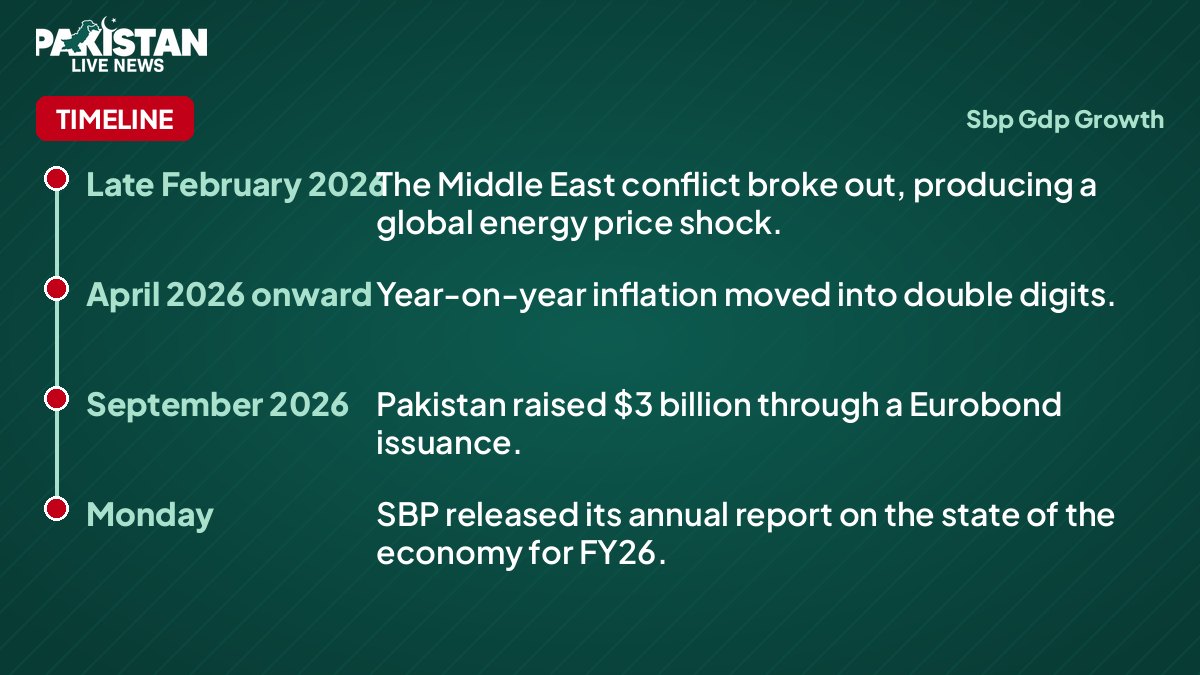
- Late February 2026The Middle East conflict broke out, producing a global energy price shock.
- April 2026 onwardYear-on-year inflation moved into double digits.
- September 2026Pakistan raised $3 billion through a Eurobond issuance.
- MondaySBP released its annual report on the state of the economy for FY26.
Structural challenges and job creation
The SBP cautions that better macroeconomic conditions are not enough. Deep-rooted structural reforms are needed to put Pakistan on a sustainable high-growth path that can absorb its expanding working-age population.
A special chapter, 'Structural Challenges to Job Creation in Pakistan', names weak and volatile GDP growth and slow structural transformation as key obstacles, amid signs of premature deindustrialisation. Low female labour force participation, high youth unemployment and sizeable informal employment compound the problem. Industry 4.0, the green transition and geoeconomic fragmentation add further challenges.
The report suggests encouraging private investment by closing infrastructure gaps and supporting technology and skills development. It also calls for rationalising taxes, simplifying tax administration, adopting rules-based frameworks for fiscal and regulatory decisions, and ensuring long-term macroeconomic stability.
Given the rising frequency of climate shocks and extreme weather, the SBP urges early preparedness measures to protect agricultural output. It also suggests that next-generation solar energy strategies in farming could balance renewable power generation with food security and environmental sustainability.
These efforts, the SBP says, are likely to unlock public, private and foreign investment, support job creation and reduce Pakistan's vulnerability to global supply chain disruptions.
Questions and answers
What GDP growth does the SBP expect in FY27?
The State Bank of Pakistan projects real GDP growth in the range of 3.5-4.5% in FY27, driven by recovering domestic demand and better performance in agriculture and industry.
What risks does the SBP highlight?
The report warns that worsening El Niño conditions threaten agricultural output, and that the global energy price shock will add upward pressure on inflation. It also notes that climate shocks are becoming more frequent.
What does the SBP expect for inflation and the current account?
Inflation is expected to ease gradually toward the 5-7% medium-term target range during FY27. The current account deficit is expected to stay within 0-1% of GDP, supported by continued strong workers' remittances.
Image: Asim Iftikhar Nagi / Wikimedia Commons, CC BY-SA 4.0