

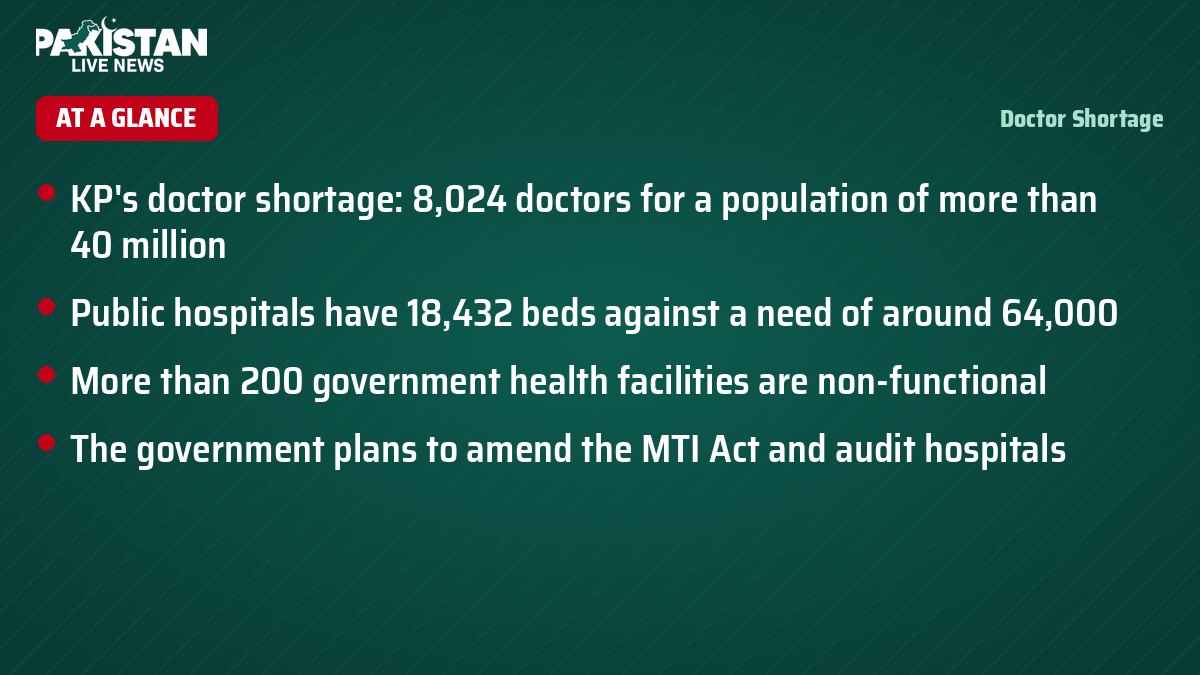
- KP’s doctor shortage: 8,024 doctors for a population of more than 40 million
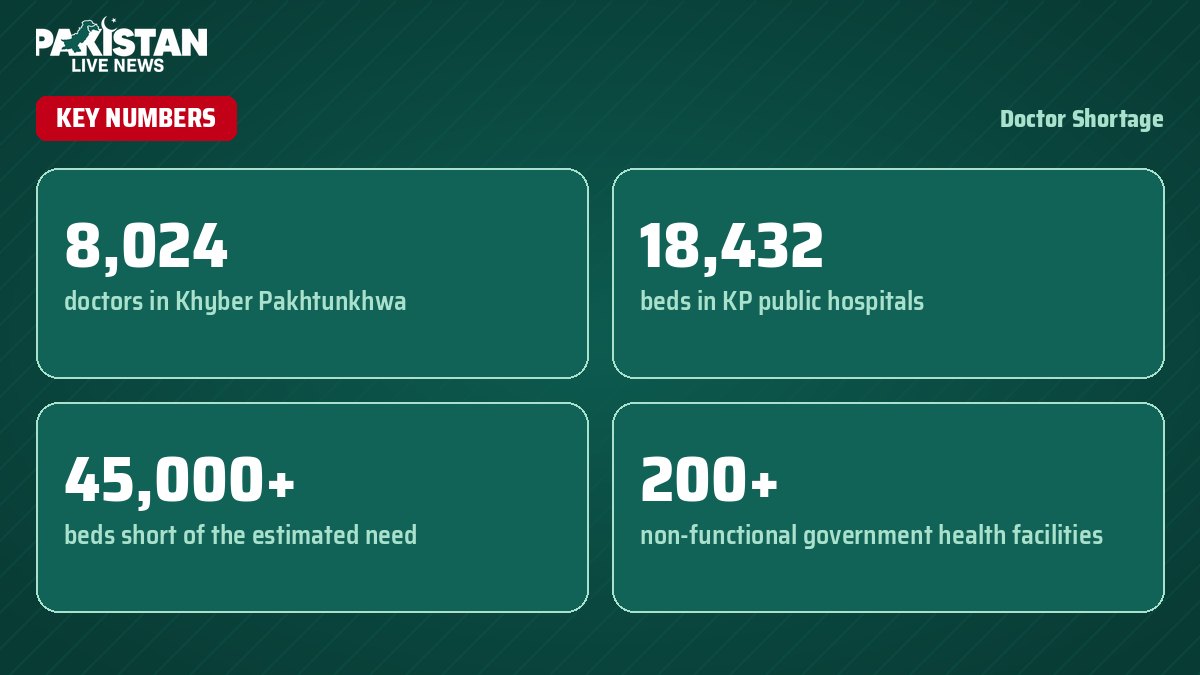
- Public hospitals have 18,432 beds against a need of around 64,000
- More than 200 government health facilities are non-functional
- The government plans to amend the MTI Act and audit hospitals
Khyber Pakhtunkhwa is facing a serious doctor shortage, with just 8,024 doctors for a population of more than 40 million. More than 200 government health facilities of various types are also lying non-functional across the province.
In this article
The figures work out to roughly one doctor for every 5,000 to 6,000 people. That ratio sums up the scale of the problem in the province. It comes alongside a shortage of hospital beds and a large number of government facilities that are not working.
The latest figures show that the doctor shortage is only one part of a wider gap between what patients need and what the public health system can currently offer.
Doctor Shortage Comes With a Hospital Bed Gap
The problem goes beyond the number of doctors. Public hospitals in the province have 18,432 beds, while the population requires around 64,000.
That leaves a shortfall of more than 45,000 beds. In other words, existing hospitals offer less than a third of the capacity that is needed.
Put simply, the province faces both a doctor shortage and a bed shortage at the same time. Doctors are few in number, and the beds available in public hospitals cover only a fraction of the estimated requirement.
| Resource | Currently available | Estimated requirement |
|---|---|---|
| Doctors | 8,024 | Around 40,000 (WHO benchmark) |
| Public hospital beds | 18,432 | Around 64,000 |
Doctor Shortage Against the WHO Benchmark
The World Health Organization recommends one doctor for every 1,000 people. Measured against that standard, KP would need around 40,000 doctors.
This is about five times the current number of 8,024. The doctor shortage is therefore large when measured against the benchmark, because the province has about one-fifth of the doctors that the benchmark implies.
The estimate of around 40,000 doctors matches a population of more than 40 million, since the benchmark works out to one doctor per 1,000 people. By contrast, the current figures show one doctor for every 5,000 to 6,000 people.
The Doctor Shortage Explained
The figures can be read in three parts. First, doctors: 8,024 are available against around 40,000 needed under the WHO benchmark. Second, beds: public hospitals have 18,432 against around 64,000 needed. Third, facilities: more than 200 government health facilities of various types are non-functional.
Each of these points to the same pattern. The doctor shortage, the shortfall of more than 45,000 beds and the non-functional facilities all show a province where the supply of care is well below demand.
The bed figures show the gap in another way. With 18,432 beds against a need of around 64,000, existing hospitals offer less than a third of the capacity that is needed. The doctor figures are starker still, at about one-fifth of the number implied by the WHO benchmark.
Non-Functional Health Facilities
Alongside the doctor shortage, more than 200 government health facilities of various types are lying non-functional across Khyber Pakhtunkhwa.
Non-functional facilities add to the pressure created by the doctor shortage and the lack of beds. They are part of the government health infrastructure that is not working at present, at a time when the province already has far fewer doctors and beds than it needs.
What the Government Plans
KP Health Adviser Lt. Gen. (R) Nigar Johar said during a briefing that the government has decided to amend the Medical Teaching Institutions (MTI) Act. It will also carry out an audit of hospitals.
The two measures announced during the briefing are therefore an amendment to the MTI Act and an audit of hospitals.
She added that the Sehat Card programme will not be scrapped. Instead, the government intends to fix its flaws and improve the scheme.
The province recently decided to put the Sehat Card programme through a financial audit.
In short, the government’s current plans centre on the MTI Act, an audit of hospitals and a financial audit of the Sehat Card programme, with the flaws of the programme to be fixed.
Building New Hospitals
Earlier, the provincial government also ordered fast-track work on new hospitals. However, the latest figures show how wide the gap remains between the demand for care and what is currently available.
The gap is visible in every set of figures: 8,024 doctors against around 40,000 needed, 18,432 beds against around 64,000 needed, and more than 200 facilities not working. The doctor shortage and the bed shortfall therefore remain large in the latest figures.
The government has decided to amend the MTI Act, audit hospitals and put the Sehat Card programme through a financial audit while fixing its flaws.
Questions and answers
How many doctors does Khyber Pakhtunkhwa have?
The province has 8,024 doctors for a population of more than 40 million, which is roughly one doctor for every 5,000 to 6,000 people.
How big is the doctor shortage compared with the WHO benchmark?
The World Health Organization recommends one doctor for every 1,000 people. On that basis KP would need around 40,000 doctors, which is about five times the current number of 8,024.
How many hospital beds is KP short of?
Public hospitals have 18,432 beds, while around 64,000 are needed. This is a shortfall of more than 45,000 beds, so existing hospitals offer less than a third of the capacity that is needed.
How many government health facilities are not working?
More than 200 government health facilities of various types are lying non-functional across the province.
What has the government decided to do?
KP Health Adviser Lt. Gen. (R) Nigar Johar said during a briefing that the government has decided to amend the Medical Teaching Institutions (MTI) Act. It will also carry out an audit of hospitals.
Will the Sehat Card programme be scrapped?
No. KP Health Adviser Lt. Gen. (R) Nigar Johar said the programme will not be scrapped. Its flaws will be fixed and the scheme improved, and the province has also decided to put it through a financial audit.
Has the government ordered new hospitals?
Earlier, the provincial government ordered fast-track work on new hospitals. The latest figures, however, show how wide the gap remains between the demand for care and what is currently available.
Image: Zarghun11 / Wikimedia Commons, CC BY-SA 4.0