
- President Zardari and PM Shehbaz met in Islamabad on Thursday and agreed to resolve all matters through dialogue.
- The meeting followed PPP Chairman Bilawal Bhutto-Zardari's sharp remarks on new provinces, a referendum and the 27th Amendment.
- PML-N's Tallal Chaudhry said big decisions cannot be taken without consensus.
- The leaders also discussed the Middle East situation.
President Asif Ali Zardari and Prime Minister Shehbaz Sharif have agreed that all outstanding issues will be settled through dialogue and mutual consultation, the Presidency said on Thursday. The talks came just days after PPP Chairman Bilawal Bhutto-Zardari's hard-hitting remarks put fresh strain on the ruling coalition.
In this article
The Zardari Shehbaz meeting took place in Islamabad. Interior Minister Mohsin Naqvi, about whom Bilawal had made pointed remarks, was also present.
This is the appropriate way and this is what mature political parties do.
Tallal Chaudhry, Minister of State for Interior
What the Presidency said after the meeting
According to the Presidency, the two leaders reviewed the "current political situation" in detail. They also discussed the Middle East conflict and the wider regional picture.
The leadership decided it would "sit down together on all matters and resolve them through consultation". The leaders also agreed to keep up consultations and to tackle challenges jointly through dialogue.
The Presidency's statement added that earlier constitutional amendments had been passed through mutual consultation among all allied parties.
Timeline
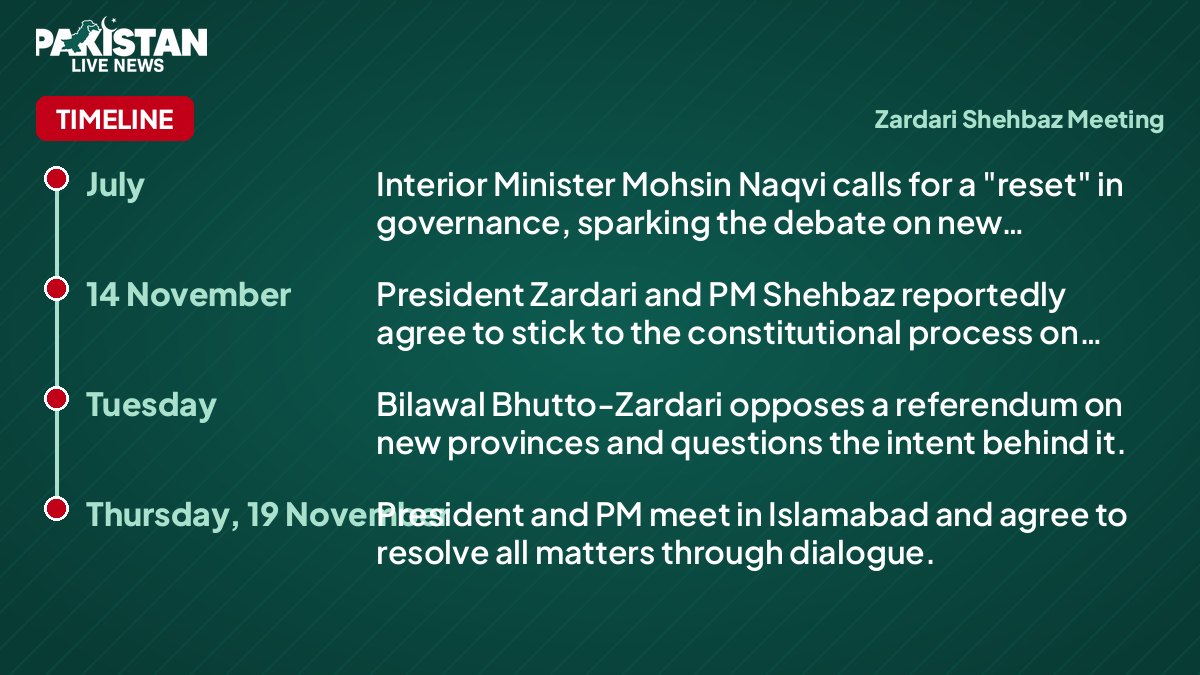
- JulyInterior Minister Mohsin Naqvi calls for a "reset" in governance, sparking the debate on new administrative units.
- 14 NovemberPresident Zardari and PM Shehbaz reportedly agree to stick to the constitutional process on any new provinces.
- TuesdayBilawal Bhutto-Zardari opposes a referendum on new provinces and questions the intent behind it.
- Thursday, 19 NovemberPresident and PM meet in Islamabad and agree to resolve all matters through dialogue.
Why tensions between the coalition partners rose
The friction between the PML-N and the PPP comes amid a debate over creating new administrative units. Naqvi sparked the debate in July, when he called for a "reset" in governance.
The PPP, which governs Sindh, has consistently opposed carving new provinces out of the province. It has repeatedly pointed to a unanimous Sindh Assembly resolution against its division. President Zardari has not commented publicly on the matter.
The two leaders had already met on 14 November. According to official sources, they reached an understanding then on sticking to the constitutional process for any new provinces.
Bilawal's remarks and the reaction
Speaking at an event in Karachi on Tuesday, Bilawal voiced strong opposition to a referendum on new provinces. The idea was first floated by Naqvi and later endorsed by Information Minister Attaullah Tarar. Bilawal questioned the "intent" behind it. He said his party's lawmakers were facing "pressure" but would not give in to it.
He claimed no one from the government had raised the issue with him or with President Zardari, even though some federal ministers have backed more provinces. He also feared that any "forced" division of Sindh would lead to bloodshed.
Bilawal also questioned whether the judiciary enjoyed public confidence after the 27th Amendment, which he had strongly advocated when it passed a year ago. He said it was passed with a "brute majority" rather than consensus. In a later interview he clarified that he was not "disowning" the amendment but wanted greater consensus on key legislation.
His speech drew a strong reaction from PML-N leaders and from the Muttahida Qaumi Movement-Pakistan, another coalition ally.
PML-N: no big decisions without consensus
After the Zardari Shehbaz meeting, Minister of State for Interior Tallal Chaudhry said in a television interview that major decisions would be taken by consensus. He said a matter concerning the people would be decided democratically, and that neither major nor minor parties could be excluded.
Asked whether efforts were under way to reduce tensions, he said the dialogue approach was what mature political parties do. He said Bilawal, as a young politician, had made a passionate speech and had later "kept trying to explain it". Chaudhry described the Presidency's statement as "the best".
On the new provinces, he stressed that the discussion concerned the whole country, not one province. He said the process would proceed in a political, democratic and constitutional manner. He added that a committee presents every legislative matter, including constitutional amendments, to all coalition partners before it goes to Parliament.
Responding to Bilawal's suggestion on returning reserved seats, Chaudhry said, "You cannot clap with one hand". He recalled PTI's actions, including the May 9 riots, protests in the capital and mass resignations from assemblies.
On talks with PTI over governor's rule in Khyber Pakhtunkhwa, he said the government had made clear it had no political aims behind the measures. "If they agree, then why would we object, but these things cannot be settled in a day or immediately," he said.
The Presidency said the leaders will continue consultations on all matters and work together to address challenges through dialogue. No dates for further talks have been announced.
Questions and answers
What did President Zardari and PM Shehbaz agree on?
They agreed that all matters will be resolved through dialogue and mutual consultation, with all stakeholders sitting together to find solutions by consensus, the Presidency said.
Why were PPP-PML-N relations under strain?
Tensions rose amid a debate over new administrative units, which the PPP opposes in Sindh. Bilawal Bhutto-Zardari's remarks on Tuesday, including his opposition to a referendum, drew a strong reaction from PML-N and MQM-P leaders.
What did the PML-N say after the meeting?
Minister of State for Interior Tallal Chaudhry said major decisions cannot be taken without consensus and that any move on new provinces would be political, democratic and constitutional.
Image: Zacharie Grossen / Wikimedia Commons, CC BY-SA 4.0