
- Talal Chaudhry says the PPP has governed Sindh for 17 years without solving people's problems.
- He claims the PPP holds about 70 percent of governing power and still speaks like an opposition party.
- He says talk of new administrative units is about better services, not linguistic divisions.
- He also alleged that Imran Khan's lawyers are using delaying tactics in the £190 million case.
Minister of State for Interior Talal Chaudhry has launched a sharp attack on Pakistan Peoples Party (PPP) chairman Bilawal Bhutto Zardari. He questioned the party's governance record and its opposition to discussions on new administrative units.
In this article
Speaking at a press conference on Wednesday, Talal Chaudhry was reacting to Bilawal's recent remarks on democracy, constitutional matters and the proposed units. He said the PPP chairman had made a forceful political speech but that the party's record did not match its claims.
PPP's governance record under scrutiny
Chaudhry said Bilawal often presents himself as a champion of the Constitution and democracy, and claims credit for constitutional achievements on behalf of his party and family. In his view, there is a significant difference between advocating democracy in theory and practising it.
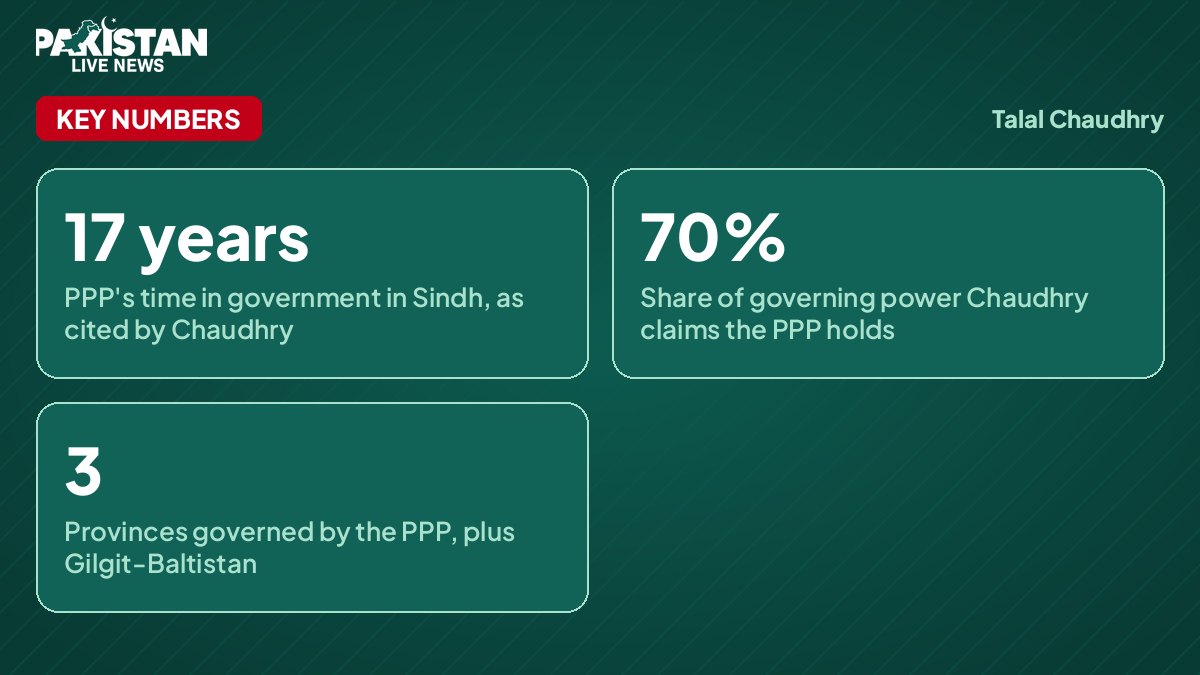
He pointed to the PPP's place in the political system. The party governs three provinces and Gilgit-Baltistan, he said, and both the President of Pakistan and the Chairman of the Senate belong to it.
Despite this, he argued, Bilawal makes statements as though he were an opposition leader. Chaudhry claimed the PPP holds around 70 percent of governing power in the country.
Turning to Sindh, he referred to the party's 17 years in power there. He alleged that the provincial government had failed to address people's problems and had neglected public welfare despite controlling provincial resources.
Bilawal has always maintained that decisions should be made through the ballot, not the bullet,
Talal Chaudhry, Minister of State for Interior
Talal Chaudhry on new administrative units
On the central issue, Chaudhry said the discussion was about improving governance, not creating divisions on linguistic grounds. He said such talks were taking place across the country, and that areas lacking adequate healthcare, education and other essential services needed better administrative arrangements.
He stressed that no province should become a target because of anyone's personal wishes. He also criticised what he called political manoeuvring over the issue, saying administrative reforms should focus on public services.
He pointed to what he described as a contradiction in the PPP's stance. The party claims credit for the 1973 Constitution and the 18th Amendment, he said, yet opposes talk of further administrative restructuring.
Chaudhry also referred to Bilawal's use of the term "brute force" when discussing the possibility of dividing Sindh. He said political and constitutional differences should be settled through democratic processes, and asked whether voting could lead to bloodshed. He also questioned why Bilawal credited his party for the Constitution but appeared afraid of votes.
Fazlur Rehman, the coalition and the Constitution
Commenting on Bilawal's remarks about JUI-F chief Maulana Fazlur Rehman, Chaudhry said the PPP chairman should direct his criticism at his own party's governor in Khyber Pakhtunkhwa. He alleged that the governor was the first to hold a press conference against the Maulana and had criticised him repeatedly.
He added that questions about the rule of law and the sources of assets can be put to any political leader, whatever their religious appearance or public standing. Asking such questions, he maintained, is not a personal attack.
Chaudhry also claimed that the PPP and the Pakistan Muslim League-Nawaz have a long-term agreement concerning the government, and that the PPP could not leave the ruling coalition under any circumstances. He gave no further details of the arrangement.
On the Constitution, he said it has been amended over time as circumstances changed, and that further changes could be considered as the country progresses. Decisions on the administrative structure, he added, should reflect national requirements and prevailing conditions.
Remarks on the £190 million case
Chaudhry also turned to the £190 million case. He said former prime minister Imran Khan is serving a sentence in connection with it.
He accused Khan's lawyers of using delaying tactics in court, alleging that they know they cannot win the corruption case through arguments. These remain the minister's allegations, and the reports carried no response from Khan's legal team.
The exchange adds to the continuing political sparring between government figures and their critics over governance and accountability. The reports did not say whether the PPP has responded to Chaudhry's latest remarks.
Questions and answers
What did Talal Chaudhry say about new administrative units?
He said the discussion is about improving governance in areas with weak healthcare, education and other services, not about creating linguistic divisions. He also said no province should become a target because of anyone's personal wishes.
Why did Talal Chaudhry criticise the PPP's record in Sindh?
He pointed to the party's 17 years in power in the province. He alleged that the provincial government had failed to address people's problems and had neglected public welfare despite controlling provincial resources.
Did Chaudhry say the PPP could leave the ruling coalition?
He claimed the PPP and the PML-N have a long-term agreement concerning the government and that the PPP could not leave the coalition under any circumstances. He gave no further details.