
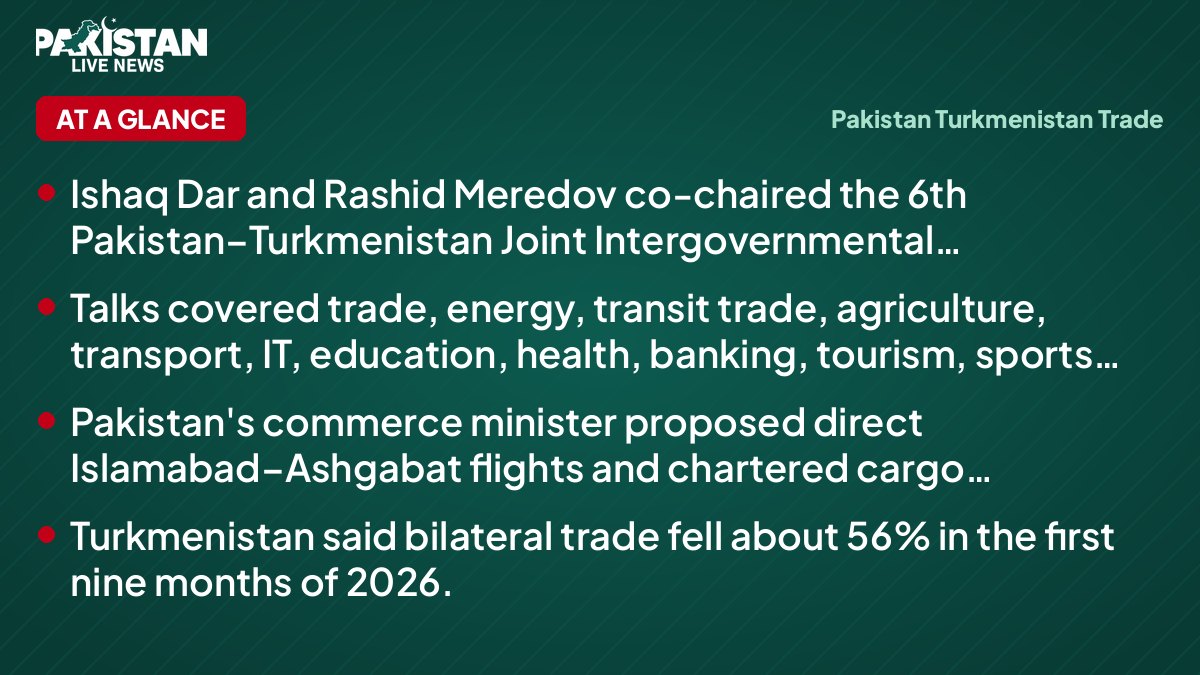
- Ishaq Dar and Rashid Meredov co-chaired the 6th Pakistan–Turkmenistan Joint Intergovernmental Commission in Islamabad on Tuesday.
- Talks covered trade, energy, transit trade, agriculture, transport, IT, education, health, banking, tourism, sports and culture.
- Pakistan's commerce minister proposed direct Islamabad–Ashgabat flights and chartered cargo services for perishable goods.
- Turkmenistan said bilateral trade fell about 56% in the first nine months of 2026.
Pakistan and Turkmenistan have discussed ways to strengthen cooperation in trade, energy and regional connectivity. The talks took place in Islamabad on Tuesday, during the 6th session of the Pakistan–Turkmenistan Joint Intergovernmental Commission (JIC).
In this article
The session was co-chaired by Deputy Prime Minister and Foreign Minister Senator Ishaq Dar and his Turkmen counterpart, Rashid Meredov, who is also Deputy Chairman of the Cabinet of Ministers. A parallel commerce meeting put Pakistan Turkmenistan trade, and its recent decline, at the centre of discussion.
Foreign ministers hold one-on-one meeting
Before the formal session, Mr Dar held a tête-à-tête with Mr Meredov at the Foreign Office. According to a Foreign Office statement, they reviewed the longstanding and fraternal relations between the two countries.
They discussed strengthening cooperation in trade, investment, energy, regional connectivity and people-to-people exchanges, and exchanged views on regional developments. Mr Dar stressed that dialogue and diplomacy were the only viable means of resolving outstanding issues and achieving lasting peace and stability in the region.
Mr Meredov appreciated Pakistan's constructive role and its continued diplomatic efforts to promote regional peace and stability.
Joint Intergovernmental Commission covers wide agenda
At the JIC session, the two sides reviewed the full range of bilateral cooperation. They discussed opportunities in power, transit trade and regional connectivity, along with agriculture and food security, transport and communications, industry, IT and telecommunications, education, health, banking and finance, tourism, sports and culture.
In his opening remarks, Mr Dar said Pakistan attached great importance to its relations with Turkmenistan. He described them as based on mutual respect, historical ties and shared interests in regional prosperity. Mr Meredov called Pakistan an important partner in strengthening economic links between Central and South Asia and expressed confidence that both sides could expand cooperation through mutually beneficial projects.
Mr Dar said the commission offered a framework for reviewing earlier agreements, assessing progress and identifying practical steps to expand economic ties. He stressed that agreed outcomes should be implemented through Joint Working Groups, close institutional coordination and regular follow-up. The aim, he said, was to turn longstanding friendship into tangible benefits.
The session was attended by the federal ministers for power, commerce and petroleum. The ministers of state for federal education and professional training and for national heritage and culture also took part, along with senior officials.
Pakistan Turkmenistan trade: concern over decline
Separately, Federal Minister for Commerce Jam Kamal Khan met Turkmenistan's Minister of Trade and Foreign Economic Relations, Dortguly Suleymanov. They discussed expanding trade, improving market access and promoting business cooperation.
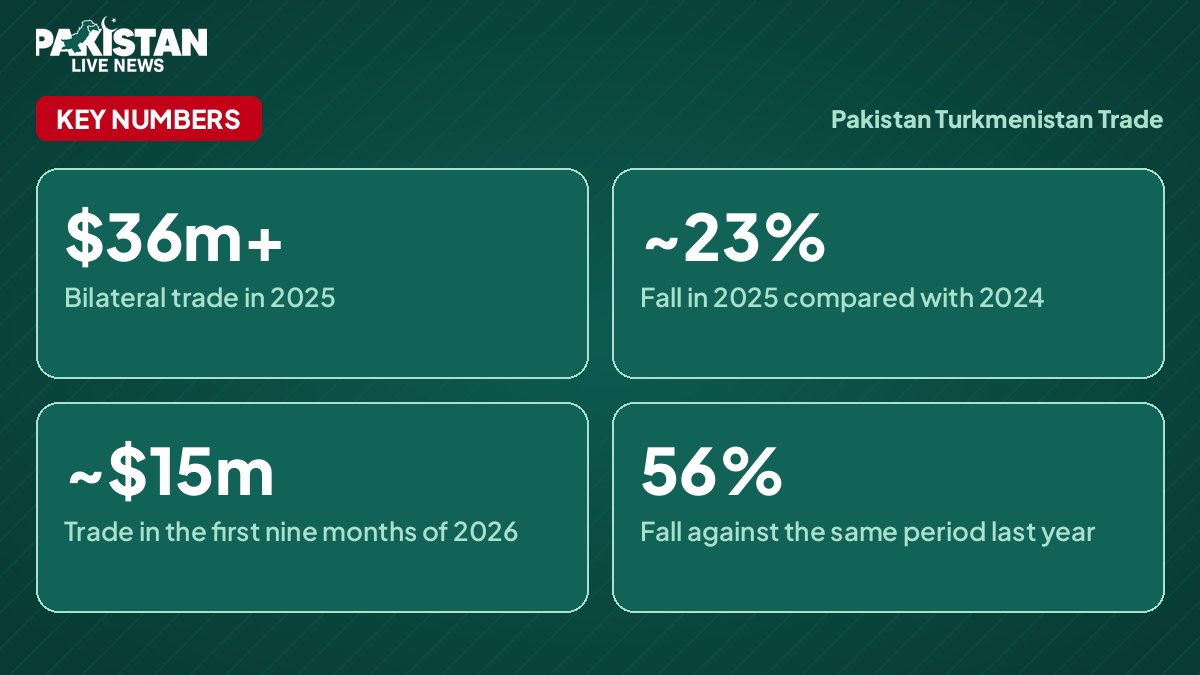
Mr Suleymanov expressed concern over the recent decline in bilateral trade and called for measures to restore volumes. He said trade exceeded $36 million in 2025, a fall of nearly 23% compared with 2024. In the first nine months of 2026 it stood at about $15 million, down 56% from the same period a year earlier.
He attributed the decline mainly to reduced textile exports. He said Turkmenistan wished to restore traditional trade volumes while diversifying its exports to Pakistan, and proposed exchanging updated lists of exportable products and information on import requirements.
Flights, corridors and business links
Mr Khan urged turning strong bilateral relations into practical commercial partnerships, particularly in textiles, agriculture, food processing, manufacturing and logistics. He said rising international freight costs and disruptions to traditional trade routes had raised the importance of regional economic integration. He added that Pakistan and Turkmenistan were well placed to benefit from trade opportunities linking South Asia, Central Asia and the Middle East.
He proposed exploring direct flights between Islamabad and Ashgabat, along with chartered cargo services for perishable agricultural and food products. The short distance between the two capitals, he said, could be a significant advantage for time-sensitive exports. Mr Suleymanov acknowledged the importance of better air links and indicated the idea could be discussed further with relevant aviation authorities.
Mr Khan also pointed to the growing operations of Pakistan's National Logistics Corporation in Central Asia and the need to ease cross-border transportation. The ministers discussed alternative trade corridors, including possible routes for Pakistani marble and other exports. Mr Khan also stressed easing business visa requirements for traders and investors.
Both ministers agreed to nominate focal persons for regular coordination on trade matters. Joint Secretary Maria was named as Pakistan's focal person, and Turkmenistan also nominated a counterpart. Mr Khan briefed his counterpart on Pakistan's five-year tariff rationalisation programme and its online trade information portal. The two sides also discussed closer links between chambers of commerce and greater Turkmen participation in Pakistan's international exhibitions, particularly in food, agriculture and textiles.
Mr Dar stressed that agreed outcomes should be implemented through Joint Working Groups and regular follow-up. Trade focal persons have been nominated, and the direct-flight and cargo proposal may be taken up further with the relevant aviation authorities.
Questions and answers
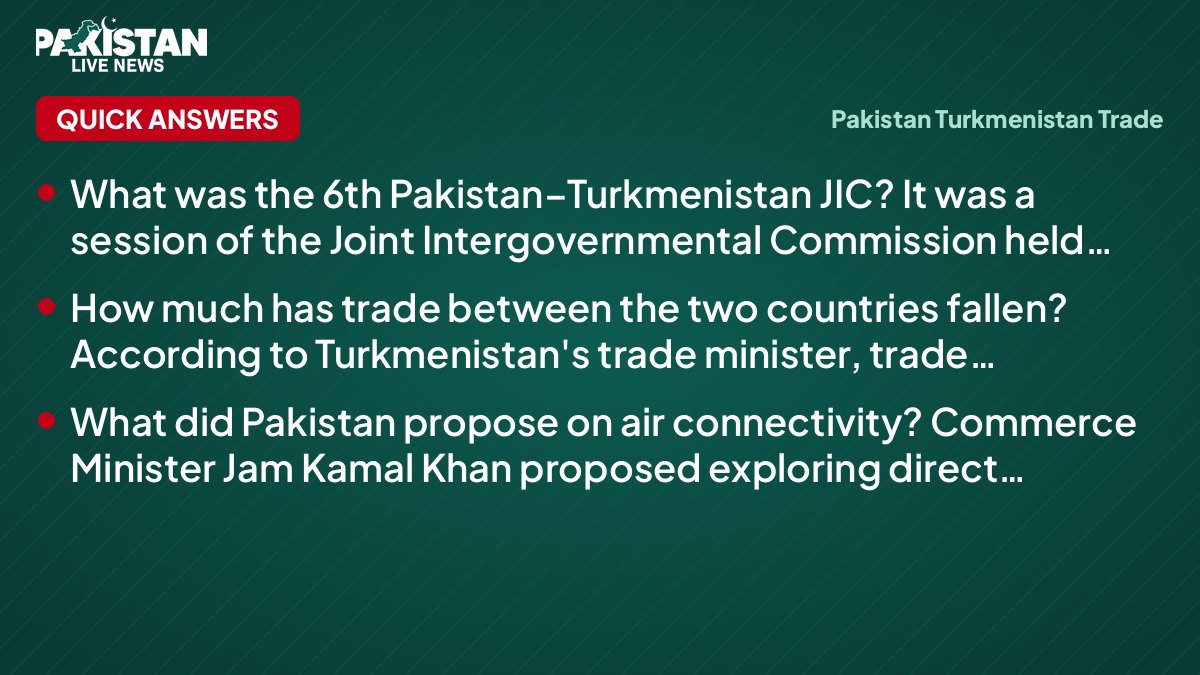
What was the 6th Pakistan–Turkmenistan JIC?
It was a session of the Joint Intergovernmental Commission held in Islamabad on Tuesday. It was co-chaired by Ishaq Dar and Rashid Meredov, and the two sides reviewed cooperation in trade, energy, connectivity and other sectors.
How much has trade between the two countries fallen?
According to Turkmenistan's trade minister, trade exceeded $36 million in 2025, nearly 23% lower than in 2024. In the first nine months of 2026 it was about $15 million, down 56% year on year.
What did Pakistan propose on air connectivity?
Commerce Minister Jam Kamal Khan proposed exploring direct Islamabad–Ashgabat flights and chartered cargo services for perishable agricultural and food products. The Turkmen minister said the idea could be discussed further with aviation authorities.
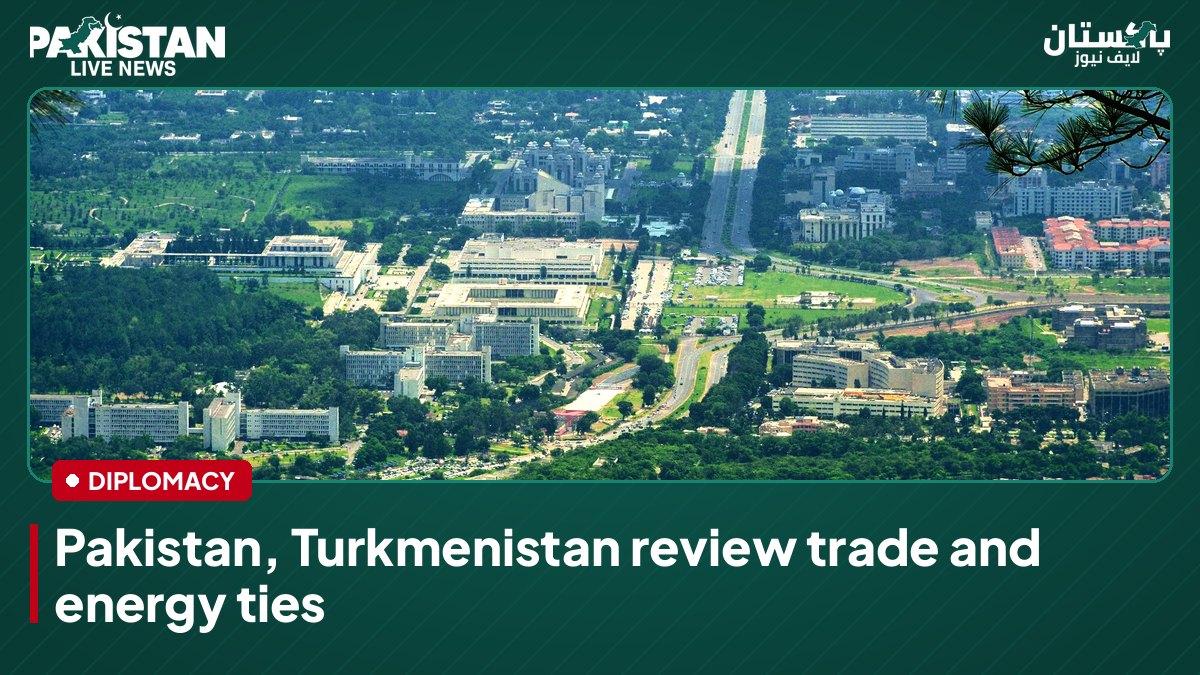
Image: Zacharie Grossen / Wikimedia Commons, CC BY-SA 4.0