
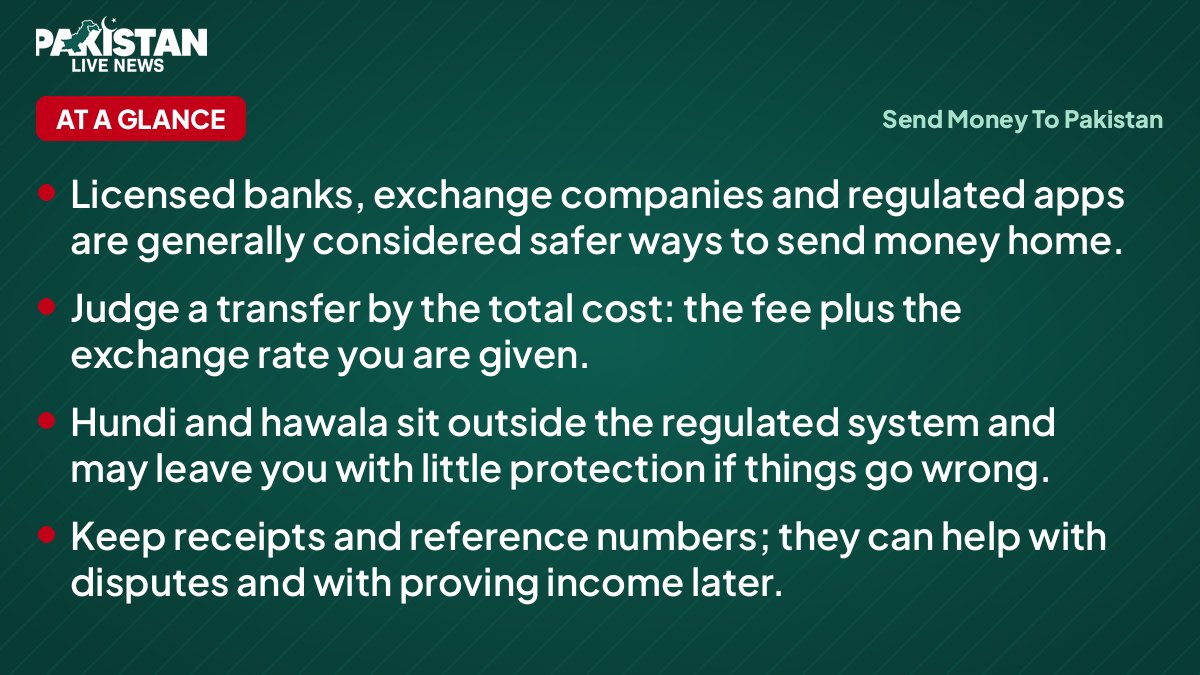
- Licensed banks, exchange companies and regulated apps are generally considered safer ways to send money home.
- Judge a transfer by the total cost: the fee plus the exchange rate you are given.
- Hundi and hawala sit outside the regulated system and may leave you with little protection if things go wrong.
- Keep receipts and reference numbers; they can help with disputes and with proving income later.
If you live and work abroad, deciding how to send money to Pakistan is a regular financial choice. The money may cover rent, school fees, medical bills or savings for a family home, so a delay or a hidden charge really matters.
In this article
Remittances simply mean money earned overseas and sent home. For Pakistan they are an important source of foreign currency, which is why the State Bank of Pakistan and successive governments have encouraged people to use formal channels. This guide explains the main routes, how they work and what to check before you hit 'send'.
| Channel | How the money arrives | Best suited to | Key thing to check |
|---|---|---|---|
| Bank transfer | Credited to a Pakistani bank account | Larger or regular amounts | Total charges and exchange rate used |
| Exchange company or money transfer operator | Cash pickup or bank deposit | Recipients without a bank account | Agent licence and pickup ID requirements |
| Digital remittance app | Bank account, wallet or cash pickup | Convenient, trackable transfers | Regulation in your country and the Pakistan partner |
| Mobile wallet | Credited to a wallet account | Relatives comfortable with phone banking | Whether the provider supports wallet deposits |
The main formal channels
Most overseas Pakistanis use one of four routes. Each suits a different situation, and many families use more than one.
Banks. You can send money from your bank account abroad to a Pakistani bank account, usually through an international transfer. This works well for larger or regular amounts, and the money lands directly in an account. Some banks also offer dedicated remittance services for overseas customers. Check the latest official fees and limits with your own bank.
Exchange companies and money transfer operators. These are licensed businesses with agent networks in many countries. You pay in cash or by card at a branch or agent, and your family collects cash or receives a bank deposit. They are popular when the recipient has no bank account or lives in a smaller town.
Digital remittance apps. Regulated online services let you send from your phone or laptop, often with tracking and notifications. They can be convenient, but always confirm that the service is licensed in the country you send from and has an established partner in Pakistan.
Mobile wallets and accounts. In Pakistan, many people use mobile wallets and branchless banking accounts. Some remittance services can credit these directly, which helps relatives who find it easier to use a phone than to visit a bank.
Timeline
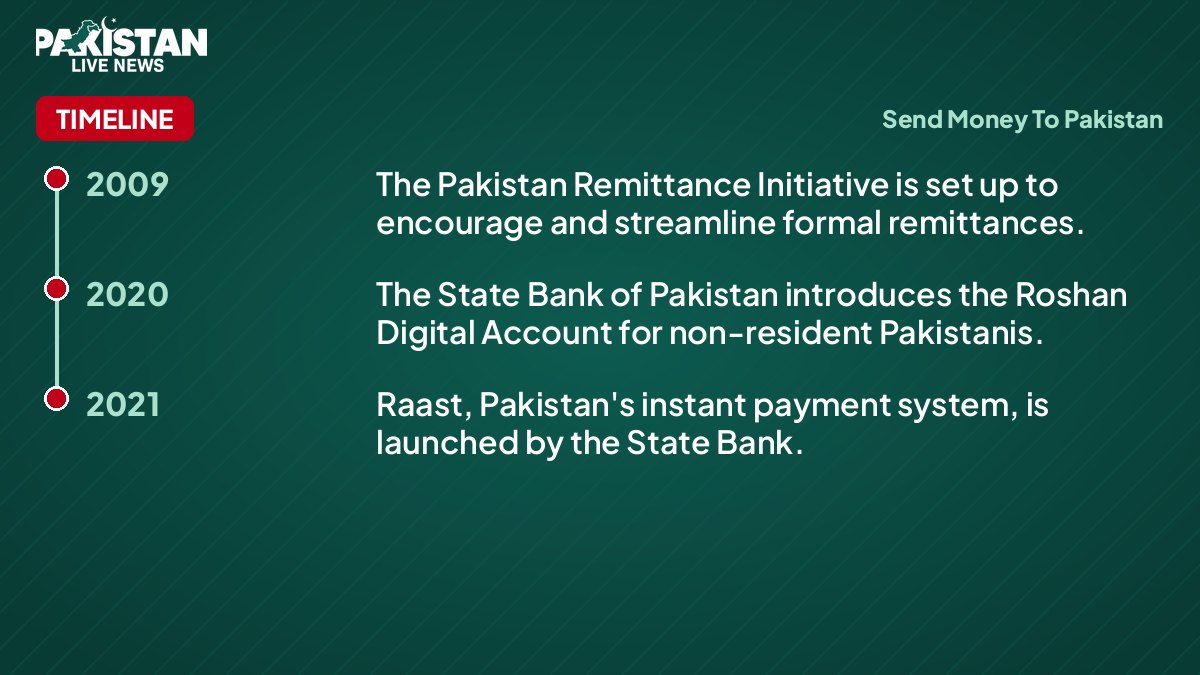
- 2009The Pakistan Remittance Initiative is set up to encourage and streamline formal remittances.
- 2020The State Bank of Pakistan introduces the Roshan Digital Account for non-resident Pakistanis.
- 2021Raast, Pakistan's instant payment system, is launched by the State Bank.
How the money reaches your family
There are usually three ways to receive a transfer: cash pickup at an agent or branch, a credit to a bank account, or a deposit into a mobile wallet. Your choice affects both speed and convenience.
For cash pickup, your relative will typically need their original CNIC and the transaction reference number. Make sure the name you enter matches the name on their identity document exactly. A small spelling difference is a common reason for delays.
For bank transfers, you will need the correct account number or IBAN, the bank name and the account holder's name. Always check these details twice, because a wrong digit can send money to the wrong place or cause it to bounce back.
Pakistan's instant payment system, Raast, launched by the State Bank in 2021, has made domestic transfers faster and easier. Many banks and wallets now connect to it, and this can help once your money has arrived in Pakistan.
Why formal channels beat hundi and hawala
Hundi and hawala are informal systems in which money is paid out locally by a broker while the sender settles with a partner elsewhere. They can seem quick and sometimes offer a tempting rate. But if you want to send money to Pakistan safely, they are best avoided.
These services operate outside the regulated system, and unlicensed money transfer is unlawful in Pakistan. If the broker disappears, delays payment or pays the wrong person, you may have little or no recourse. There is also often no clear paper trail.
That paper trail matters more than people realise. Bank and licensed-company receipts can help you show where your money came from and where it went. This can be useful when buying property, applying for a loan or visa, or answering tax questions. Formal channels can also support the country's official foreign exchange inflows, which feeds into the wider economy.
Programmes designed for overseas Pakistanis
The Pakistan Remittance Initiative (PRI) was set up in 2009 as a joint effort of the State Bank of Pakistan and government ministries. Its aim is to make formal remittances faster, cheaper and easier by working with banks and exchange companies.
In 2020 the State Bank introduced the Roshan Digital Account, which lets non-resident Pakistanis open accounts remotely. These accounts are meant for banking and, subject to the rules, certain investments. Eligibility, documents and permitted uses can change, so read the current official guidance or ask a participating bank.
Governments sometimes offer incentives or special schemes linked to remittances. Terms vary over time, so check whether anything currently applies before assuming it does.
A practical checklist before you send
Confirm the provider is licensed. Look for a regulator's registration in your country of residence and a recognised partner in Pakistan. If you are unsure, ask for the licence details or consult the regulator's public register.
Compare the total cost, not just the fee. A 'zero fee' offer can hide a weaker exchange rate. Compare how many rupees your family would actually receive for the same amount sent through two or three providers on the same day.
Check speed and limits. Some transfers may arrive within minutes, while others take days, and there are usually limits on single or monthly amounts. Plan ahead for urgent needs such as hospital bills.
Protect yourself from scams. Be wary of unexpected messages asking you to send money urgently, of people you have never met asking you to transfer to a personal account, and of rates that seem too good to be true. Use only official apps and websites, and never share one-time passwords.
Keep your records. Save the receipt, reference number and the recipient's details. If something goes wrong, contact the provider first, and escalate to the relevant regulator if the problem is not resolved.
Finally, remember that rules about reporting or sending large sums can differ between countries. Check the requirements where you live so your regular transfers stay smooth and compliant.
Questions and answers
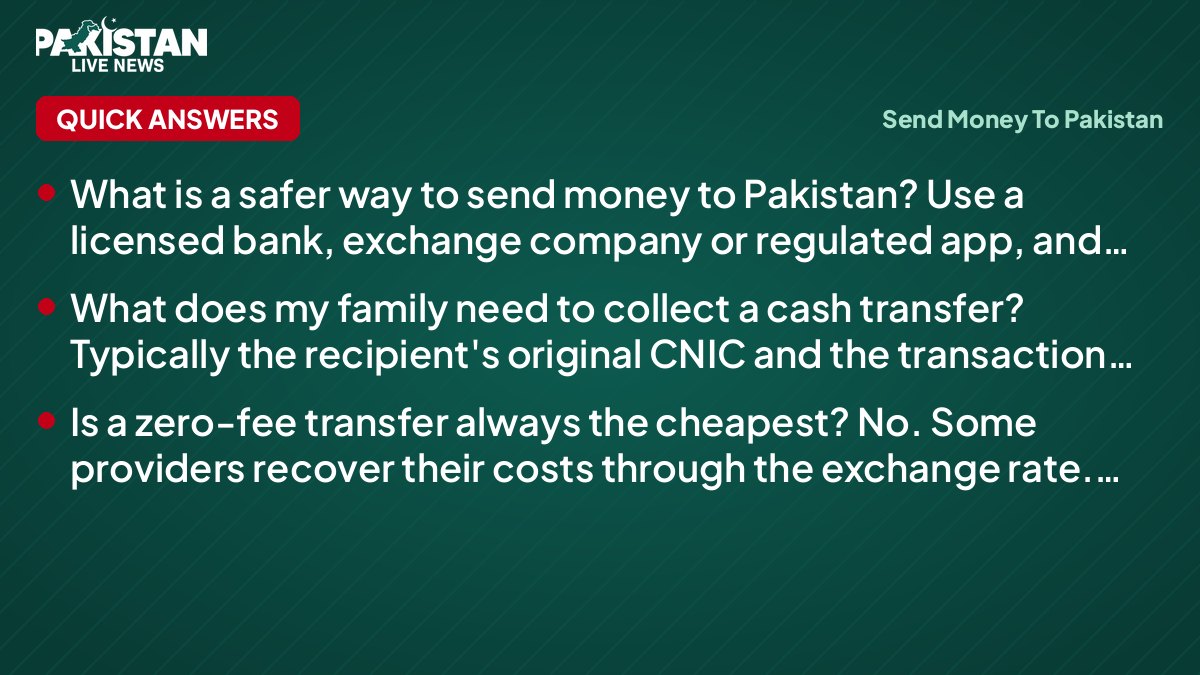
What is a safer way to send money to Pakistan?
Use a licensed bank, exchange company or regulated app, and keep your receipt and reference number. Informal hundi or hawala arrangements sit outside the regulated system and may offer little or no protection.
What does my family need to collect a cash transfer?
Typically the recipient's original CNIC and the transaction reference number. The name on the transfer must match the name on their identity document, so check the spelling before you send.
Is a zero-fee transfer always the cheapest?
No. Some providers recover their costs through the exchange rate. Compare how many rupees your family would actually receive across two or three providers for the same amount on the same day.
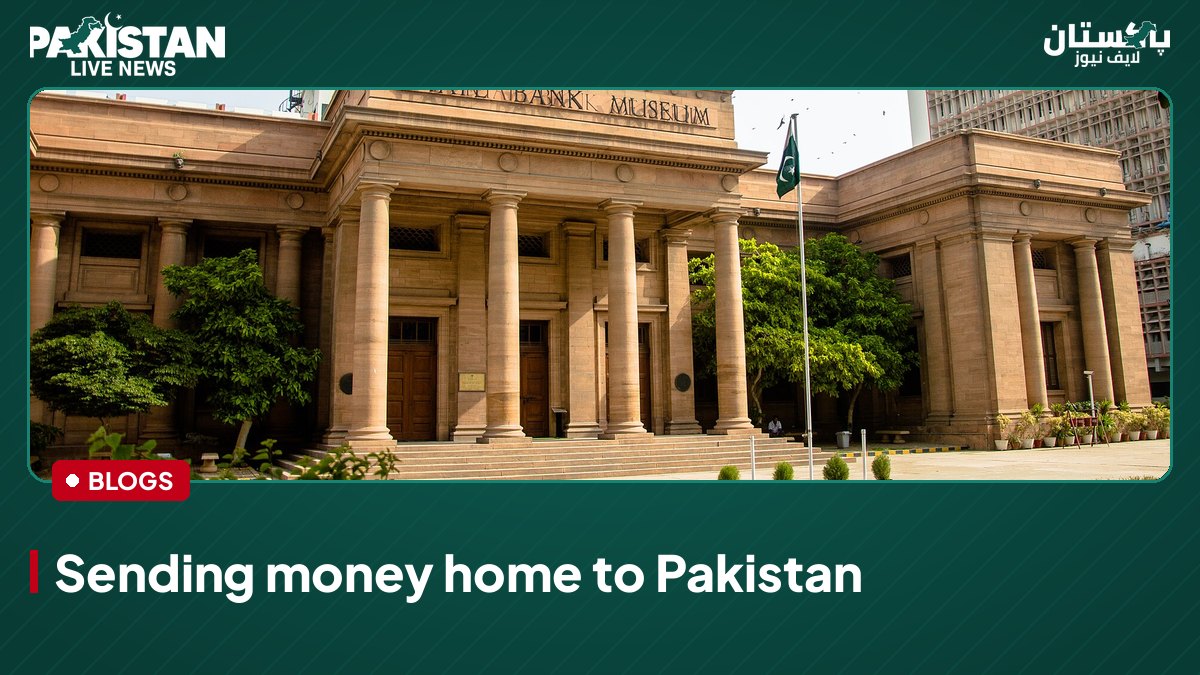
Image: Asim Iftikhar Nagi / Wikimedia Commons, CC BY-SA 4.0