


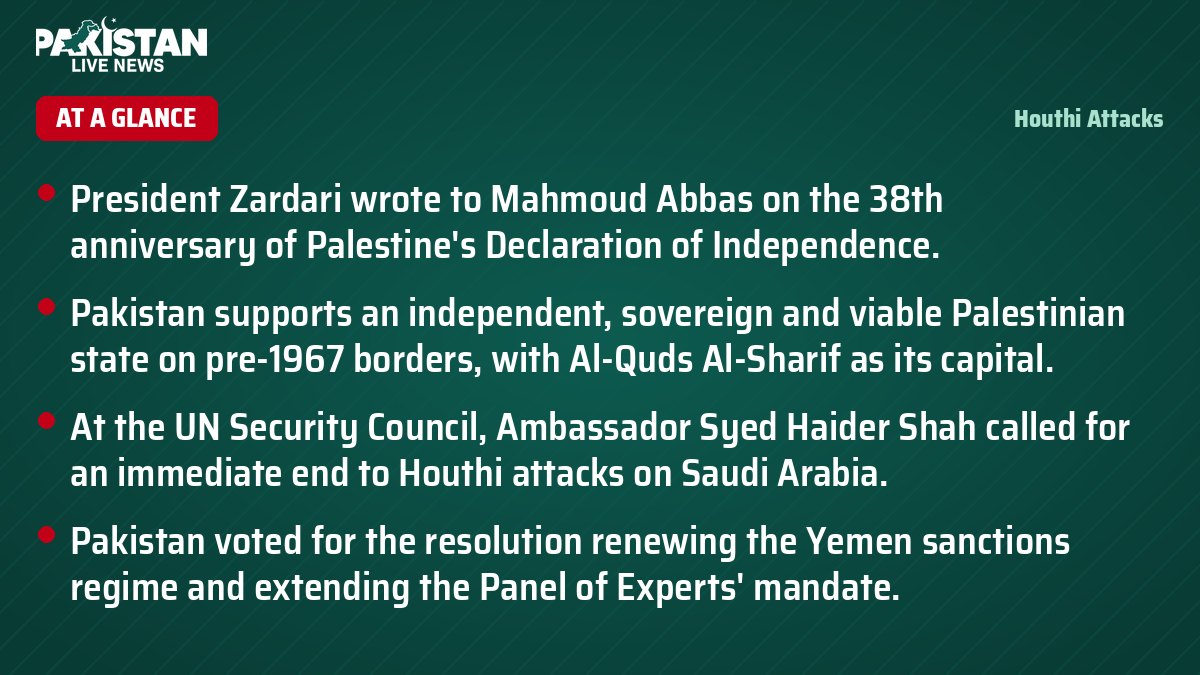
- President Zardari wrote to Mahmoud Abbas on the 38th anniversary of Palestine's Declaration of Independence.
- Pakistan supports an independent, sovereign and viable Palestinian state on pre-1967 borders, with Al-Quds Al-Sharif as its capital.
- At the UN Security Council, Ambassador Syed Haider Shah called for an immediate end to Houthi attacks on Saudi Arabia.
- Pakistan voted for the resolution renewing the Yemen sanctions regime and extending the Panel of Experts' mandate.
- Pakistan expressed full solidarity with Saudi Arabia over the Houthi attacks and backed its right to defend its territory.
Pakistan has restated its diplomatic positions on Palestinian statehood and on Houthi attacks against Saudi Arabia. President Asif Ali Zardari has reaffirmed support for the Palestinian people, while Pakistan's envoy at the United Nations has condemned the Houthi attacks.
In this article
Zardari's message to Palestine
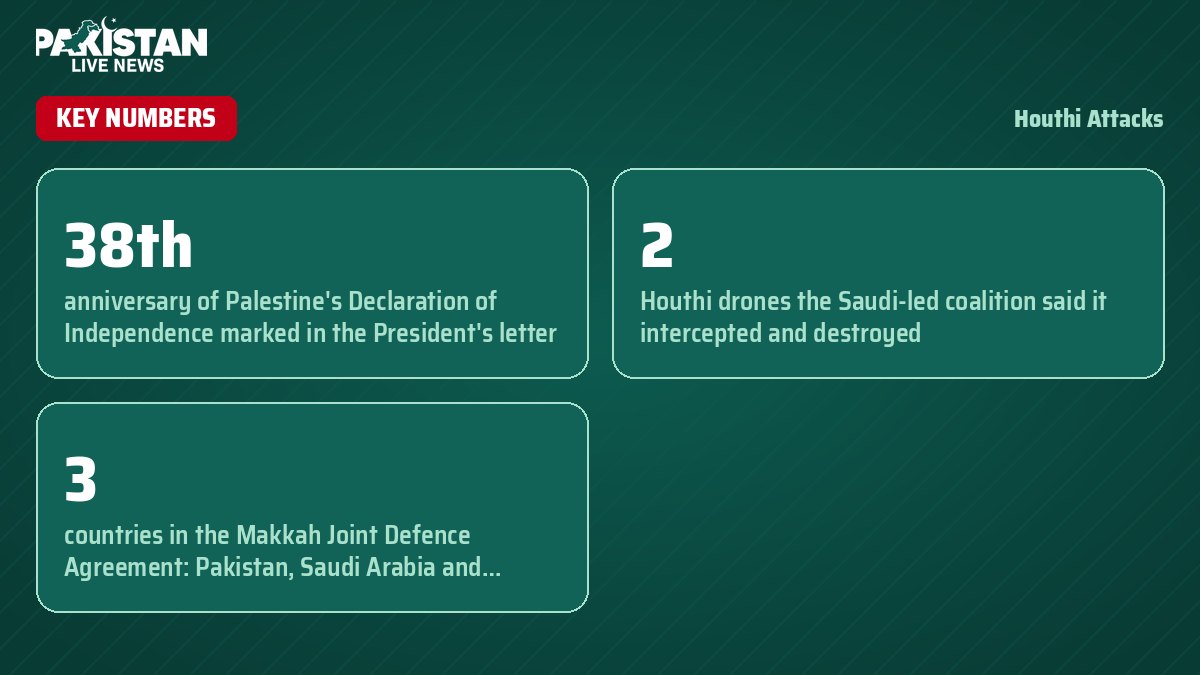
In a letter to Palestinian President Mahmoud Abbas, President Zardari extended his congratulations to Mr Abbas and the people of Palestine on the 38th anniversary of the Declaration of Independence of the State of Palestine. He reaffirmed Pakistan's unwavering support for the legitimate rights of the Palestinian people, particularly their right to self-determination.
He said the two countries enjoy close fraternal relations rooted in shared history, mutual trust, solidarity and common aspirations. According to the President, the people of Pakistan hold the Palestinians in the highest esteem and remain committed to strengthening the bonds of friendship and brotherhood.
Mr Zardari repeated Pakistan's support for an independent, sovereign, viable and contiguous State of Palestine. He said it should be based on the pre-1967 borders, with Al-Quds Al-Sharif as its capital, in line with relevant UN resolutions. He also expressed solidarity with Palestinians facing continued suffering and backed their aspirations for lasting peace, freedom and dignity.
Together with the UN statement on the Houthi attacks, the President's letter sets out Islamabad's current position on key Middle East issues.
Timeline
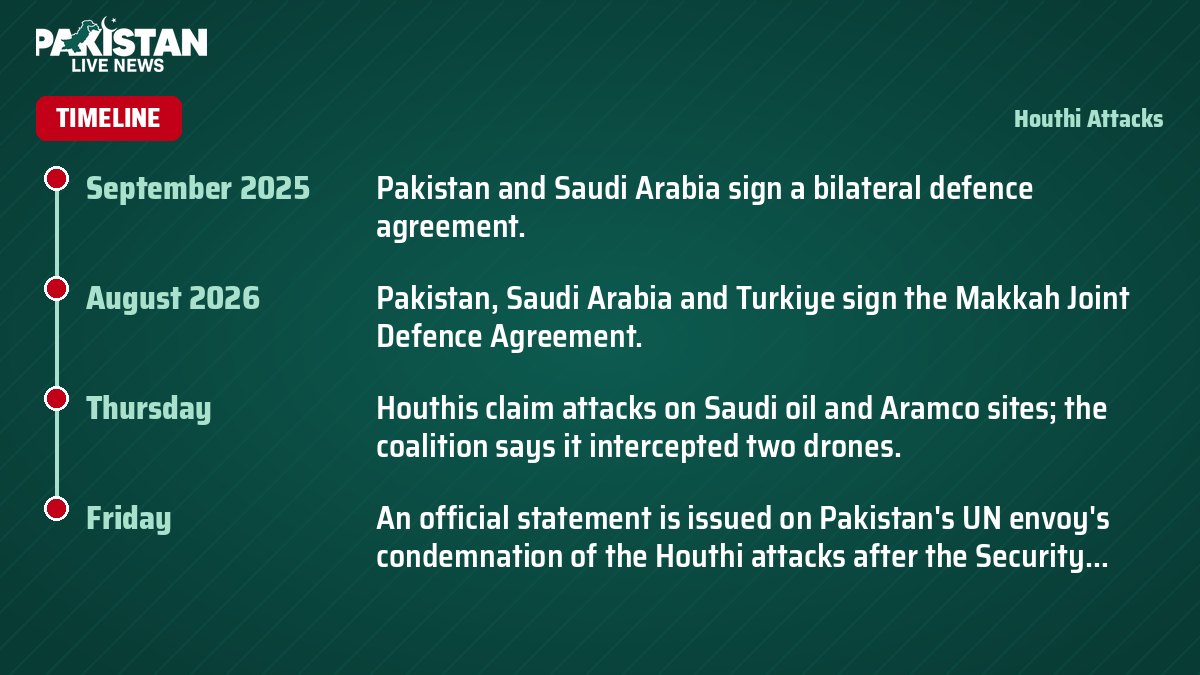
- September 2025Pakistan and Saudi Arabia sign a bilateral defence agreement.
- August 2026Pakistan, Saudi Arabia and Turkiye sign the Makkah Joint Defence Agreement.
- ThursdayHouthis claim attacks on Saudi oil and Aramco sites; the coalition says it intercepted two drones.
- FridayAn official statement is issued on Pakistan's UN envoy's condemnation of the Houthi attacks after the Security Council renews the Yemen sanctions measures.
Pakistan's stand on Houthi attacks at the Security Council
Speaking at the UN Security Council, Pakistan's Permanent Representative, Ambassador Syed Haider Shah, called for an immediate and unconditional end to Houthi attacks against Saudi Arabia. An official statement issued on Friday said he spoke after the Council adopted a resolution renewing the sanctions measures established under resolution 2140 (2014). The resolution also extended the mandate of the Panel of Experts supporting the 2140 Committee.
The ambassador said Pakistan voted in favour to underline the importance it attaches to the committee's work. He argued that holding accountable those who threaten Yemen's peace, security and stability is essential to creating conditions for durable peace. He also thanked the United Kingdom, as penholder, for its constructive efforts during the negotiations.
On implementation, he stressed the need to uphold the institutional framework set by the Security Council. He said the Panel of Experts must work strictly within its mandate, with professionalism, impartiality and consistency, to strengthen the credibility and effectiveness of its work.
Solidarity with Saudi Arabia after Houthi attacks
Ambassador Shah condemned the continued Houthi attacks in the strongest terms. He expressed full solidarity with the leadership, government and people of Saudi Arabia, and backed the kingdom's sovereignty, territorial integrity, security and stability. He also stressed its legitimate right to defend its territory and protect its citizens and residents under the UN Charter and international law.
The remarks followed Houthi claims on Thursday that they had attacked a pumping station on the Saudi East-West oil pipeline, an oil facility in Yanbu and an Aramco building in Riyadh. The Saudi-led coalition said later that day it had intercepted and destroyed two drones launched by the group, one in the Riyadh region and one in the Eastern Province. Pakistan's condemnation of the Houthi attacks therefore followed the claims and the coalition's response.
Background: the Houthi attacks and Pakistan's defence ties
Pakistan's position on the Houthi attacks was framed around sovereignty, territorial integrity, security and stability. The ambassador placed Saudi Arabia's right to defend itself within the UN Charter and international law.
Pakistan and Saudi Arabia have strengthened defence cooperation in recent years, signing a bilateral defence agreement in September 2025. In August 2026, Pakistan, Saudi Arabia and Turkiye signed the Makkah Joint Defence Agreement. Under it, an attack on any one of the three is to be treated as an attack on all three. These agreements form the background to Pakistan's expression of solidarity over the Houthi attacks.
The resolution adopted by the Council renewed the sanctions measures established under resolution 2140 (2014) and extended the mandate of the Panel of Experts supporting the 2140 Committee. Pakistan voted in favour, and its envoy said accountability for those who threaten Yemen's peace, security and stability is essential to durable peace.
Support for a Yemeni-led peace process
The envoy reaffirmed Pakistan's backing for Yemen's sovereignty, independence, unity and territorial integrity. He underscored the importance of UN-led efforts to advance an inclusive political process that is Yemeni-owned and Yemeni-led. Pakistan's condemnation of the Houthi attacks was delivered alongside this call for an inclusive political process.
Pakistan, he said, is ready to support all efforts to restore peace, stability and security in Yemen and to ease the immense humanitarian suffering of its people.
Questions and answers on the Houthi attacks and Palestine
What did President Zardari say about Palestine?
In a letter to President Mahmoud Abbas, he reaffirmed Pakistan's support for Palestinian self-determination and for an independent, sovereign, viable and contiguous Palestinian state based on pre-1967 borders, with Al-Quds Al-Sharif as its capital.
What did Pakistan say at the UN Security Council?
Ambassador Syed Haider Shah condemned Houthi attacks on Saudi Arabia and called for them to end immediately and unconditionally. He also reaffirmed Pakistan's support for Yemen's sovereignty, independence, unity and territorial integrity.
Did Pakistan vote for the Yemen sanctions resolution?
Yes. Pakistan voted in favour of the resolution renewing the sanctions measures under resolution 2140 (2014) and extending the mandate of the Panel of Experts.
What are the Houthi attacks Pakistan has condemned?
The Houthis claimed on Thursday that they had attacked a pumping station on the Saudi East-West oil pipeline, an oil facility in Yanbu and an Aramco building in Riyadh. The Saudi-led coalition said it intercepted and destroyed two drones.
What is the Makkah Joint Defence Agreement?
It is an agreement signed in August 2026 by Pakistan, Saudi Arabia and Turkiye. Under it, an attack on any one of the three is to be treated as an attack on all three.
Does Pakistan back Saudi Arabia's right to defend itself?
Yes. While condemning the Houthi attacks, Ambassador Shah expressed full solidarity with Saudi Arabia and stressed its legitimate right to defend its territory and protect its citizens and residents under the UN Charter and international law.
What did Pakistan say about peace in Yemen?
The envoy backed UN-led efforts for an inclusive, Yemeni-owned and Yemeni-led political process. He said Pakistan is ready to support all efforts to restore peace, stability and security in Yemen and to ease the humanitarian suffering of its people.
What is Pakistan's position on Al-Quds Al-Sharif?
President Zardari said Pakistan supports a Palestinian state based on the pre-1967 borders with Al-Quds Al-Sharif as its capital, in line with relevant UN resolutions.
Image: Jdforrester / Wikimedia Commons, CC BY 4.0


