

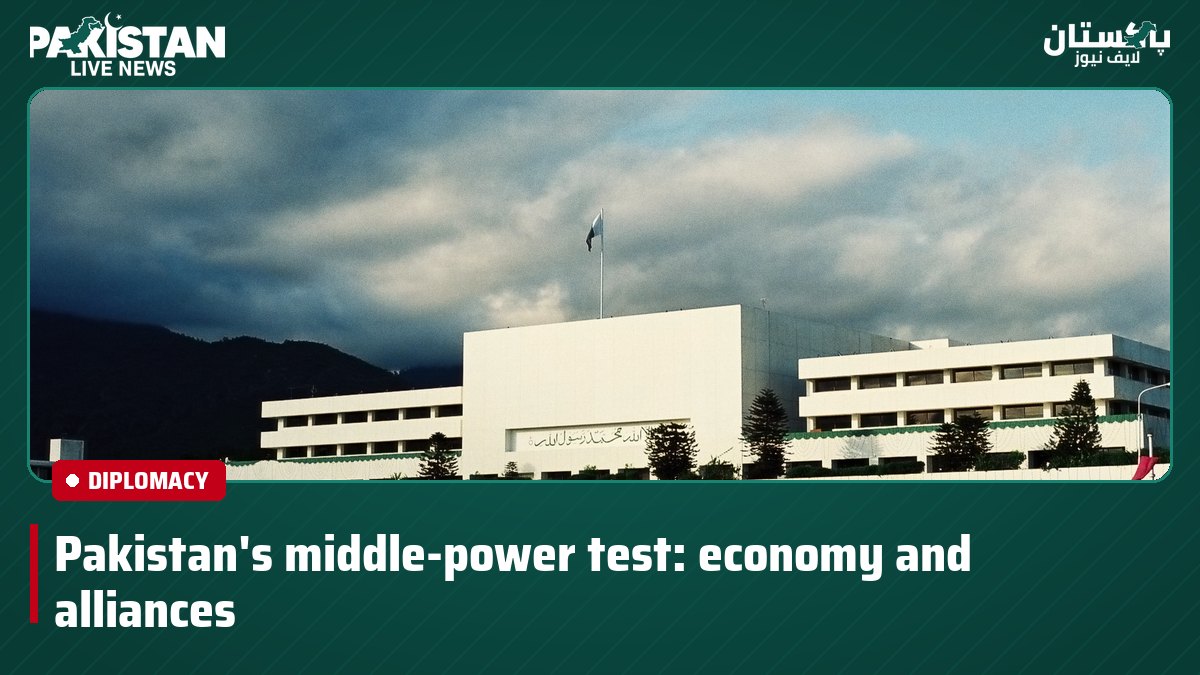
- An analyst says Pakistan is strong on military capability and diplomacy but weak on economic strength, the third pillar of middle power status.
- Investment stands near 15pc of GDP, against the 20-plus per cent needed to sustain 6pc growth.
- Prof Carlos Masala told a Karachi seminar that Pakistan should build partnerships with like-minded middle powers.
- He argues the world is heading towards bipolarity, with most states hedging between the US and China.
Pakistan’s claim to be a middle power rests on a strategic relevance it has rebuilt over the past two years, but its economy has not kept pace. That is the core argument of an analysis by a strategic analyst of international security, and it echoes a message delivered at a Karachi seminar this month.
In this article
The two accounts differ on the shape of the world order. The analyst describes a fragmented multipolar order in which middle powers have gained strategic weight, while Masala argues the system is bipolar. Both stress that Pakistan's standing as a middle power depends on more than military strength.
Three pillars of middle power status
According to the analysis, scholars generally judge middle power status on three pillars: military capability, diplomatic outreach and overall national strength. National strength rests largely on economic vitality and the ability to adopt new technology.
States earn the middle power label in different ways. South Korea and Australia do so through high-tech economies and trade integration, while Norway and Qatar rely on niche diplomacy and mediation. Türkiye and Pakistan depend mainly on military capability and regional security reach.
Pakistan needs to form alliances with like-minded countries to be able to withstand pressure from great powers.
Carlos Masala, professor of security and defence policy, University of the Federal Armed Forces, Munich

Strength in defence and diplomacy
The analyst describes the four-day conflict with India in May 2025 as South Asia's first multi-domain confrontation, involving aerial clashes, drone swarms and precision missile exchanges. A ceasefire facilitated by the White House took effect on May 10. In the analyst's view, Pakistan's response reinforced its deterrence.
Pakistan then built a network of security pacts. These include the Strategic Mutual Defence Agreement with Saudi Arabia in September 2025 and the Makkah Joint Defence Agreement with Saudi Arabia and Türkiye in August 2026. The analysis also cites the Badr agreement with Türkiye, Qatar and Indonesia.
On the diplomatic front, the analyst says the US accepted Pakistan as a primary conduit to Tehran in March 2026 after US-Israeli hostilities against Iran began. That led to the Islamabad peace talks in April and a June MoU that temporarily reopened the Strait of Hormuz. Pakistan also joined the Gaza peace plan as a founding member.
Together, these military and diplomatic steps form the basis of the middle power case, according to the analyst.
The economic gap in Pakistan’s middle power bid
The analyst says the third pillar is where Pakistan’s middle power case is weakest. GDP growth edged up to 3.7pc in FY2025-26 and inflation stayed between 7pc and 9pc, but investment hovers near 15pc of GDP. That is well below the 20-plus per cent needed to sustain 6pc growth and absorb a growing youth population.
The analysis lists further obstacles: deindustrialisation, high energy costs, slow privatisation, a low tax-to-GDP ratio and heavy debt servicing. It also cites investor concern over security in Balochistan and Khyber Pakhtunkhwa, and unrest in AJK. State solvency, it says, still leans on remittances, multilateral support and bilateral rollovers, such as a $3 billion Saudi cash deposit in April 2026.
Leverage built on crises and external support is "inherently transactional", the analyst argues. He calls for a broader tax base, an overhaul of education, an export-led industrial base and an end to elite economic capture. In short, he treats the economy as the missing pillar of middle power status.
| Main source of influence | Examples |
|---|---|
| High-tech economy and trade integration | South Korea, Australia |
| Niche diplomacy and mediation | Norway, Qatar |
| Military capability and regional security projection | Türkiye, Pakistan |

A warning from Karachi
Speaking at a seminar on the evolution of the international order at the Institute of Business Administration, Karachi, Prof Carlos Masala said pressure on Pakistan to pick a side between the US and China would be "extremely high". He argued that great powers hold "tools of coercion" to draw countries into their orbit.
Masala, who teaches security and defence policy at the University of the Federal Armed Forces in Munich, described himself as a "structural realist". He said the world is moving towards bipolarity or a weakened unipolarity rather than genuine multipolarity, which he called an "illusion". Unlike the Cold War, he said, the rivalry would turn on geoeconomic competition and technology rather than nuclear stockpiles.
He added that most countries are hedging their bets and chasing the best offer from Beijing or Washington. His advice was for middle powers like Pakistan to "gang up", echoing remarks Canadian Prime Minister Mark Carney made at Davos in January 2026. He also said Pakistan, with about 260 million people, is "unfortunately" only a middle power because of its geography between India and China.
Background: what a middle power means here
In the analysis, a middle power is judged on three pillars: military capability, diplomatic outreach and overall national strength. The analyst says Pakistan scores well on the first two, but weak investment and a narrow economic base hold back the third.
The seminar message points the same way. Masala argues that Pakistan should pair its position with partnerships among like-minded states, so that it is not squeezed between Washington and Beijing, and the analyst argues that economic reform must accompany its security and diplomatic gains.
Timeline
- May 2025Four-day conflict with India ends in a ceasefire on May 10
- September 2025Pakistan and Saudi Arabia sign the Strategic Mutual Defence Agreement
- March 2026The US accepts Pakistan as a primary conduit to Tehran
- April 2026Islamabad peace talks held; $3bn Saudi cash deposit made
- June 2026MoU temporarily reopens the Strait of Hormuz
- August 2026Pakistan, Saudi Arabia and Türkiye sign the Makkah Joint Defence Agreement
Prof Masala pointed to the Asia-Pacific Economic Cooperation Summit in Shenzhen on November 18-19, where he said the US, China and Russia share an interest in establishing spheres of influence. The analysis argues that Pakistan's standing will depend on whether it pairs its security and diplomatic gains with a domestic economic pivot.

Questions and answers
What are the three pillars of middle-power status?
According to the analysis, scholars generally assess military capability, diplomatic outreach and comprehensive national strength. National strength is defined largely by economic vitality and technological adaptation.
Why does the analyst call Pakistan's position fragile?
He says Pakistan is strong in military and diplomatic terms but weak economically. Investment is near 15pc of GDP, and state finances rely on remittances, multilateral support and bilateral rollovers.
What does Prof Carlos Masala recommend for Pakistan?
He says Pakistan should form alliances and partnerships with like-minded middle powers that do not want to side permanently with either China or the US. He argues this would help it withstand great-power pressure.
Why does Prof Masala call Pakistan only a middle power?
He says Pakistan, with about 260 million people, is "unfortunately" only a middle power because of its geography between India and China.
How much investment does Pakistan need?
The analysis says investment hovers near 15pc of GDP, well below the 20-plus per cent needed to sustain 6pc growth and absorb a growing youth population.
Image: Usman.pg / Wikimedia Commons, CC BY-SA 3.0


