

- The CDWP has deferred the Rs278 billion ML-3 railway project for the third time in five months.
- A $390 million bridge loan from Reko Diq Mining Company is under review.
- Gwadar is being weighed as an alternative export point to Karachi.
- Only Rs250 million has been allocated to the ML-3 railway scheme in the current fiscal year.
The ML-3 railway project, a $1 billion rehabilitation of the Main Line-3 track, has been put off by Pakistan for the third time in five months, as authorities struggle with financing and a possible change in the route for Reko Diq minerals.
In this article
The Central Development Working Party (CDWP) deferred the Rs278 billion ML-3 railway scheme this month. The project would upgrade the ML-3 track between Nokhandi and Rohri to support large-scale mineral transportation.
Why the ML-3 railway line needs rehabilitation
The ML-3 railway project covers around 996 kilometres of railway infrastructure. The existing track has outlived its operational life, and trains currently average only about 30 kilometres per hour.
Authorities consider full rehabilitation essential before the line can safely carry heavy cargo from the Reko Diq copper and gold project. That is why the ML-3 railway scheme is so closely tied to the plans for moving minerals out of the country.

Explained: what the scheme includes
The Rs278.62 billion scheme includes track renewal, rehabilitation of bridges and embankments, replacement of turnouts and 11 new railway stations between Spezand and Taftan. The upgrade of the track between Nokhandi and Rohri is meant to support large-scale mineral transportation.
In simple terms, the ML-3 railway project is a plan to renew an ageing line so that it can handle heavier traffic than it does today. Its estimated value is $1 billion, and the works would cover around 996 kilometres of railway infrastructure.
Three postponements in five months
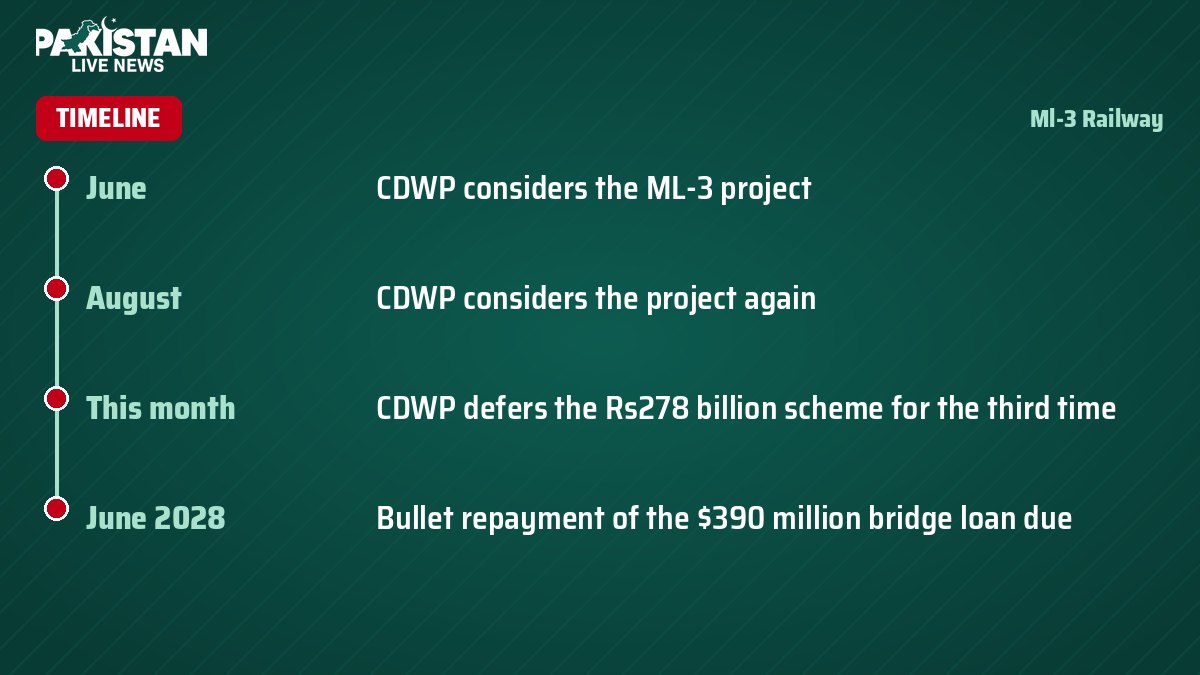
The CDWP first considered the ML-3 railway line in June and looked at it again in August. This month it deferred the Rs278 billion scheme for the third time, so the project still has no approval.
Timeline
- JuneCDWP considers the ML-3 project
- AugustCDWP considers the project again
- This monthCDWP defers the Rs278 billion scheme for the third time
- June 2028Bullet repayment of the $390 million bridge loan due
Bridge loan and the Gwadar question for the ML-3 railway project
The government has already approved a $390 million bridge loan from Reko Diq Mining Company, which is linked to the ML-3 railway project. It carries an estimated annual interest rate of around 6%, with a single bullet repayment due by June 2028. Officials estimate the total repayment could reach nearly $450 million.
Questions have arisen over whether the arrangement would hold if minerals are shipped through Gwadar Port instead of Karachi Port. Officials said a change of route could require a fresh commitment from the company on continuing the loan.
Under the original plan, minerals would travel along the Nokhandi-Quetta-Rohri corridor to Karachi. Using Gwadar would require the Nokhandi-Panjgur-Gwadar road connection to become fully operational.
Planning Minister Ahsan Iqbal said the delay in the ML-3 railway project was due to the need for further details on the bridge-financing arrangement. He also called for faster work on the Nokundi-Gwadar road corridor and proposed a joint working group of the Planning Ministry, National Highway Authority, Balochistan government and mining companies.
Funding concerns and earlier delays
The CDWP had previously considered the project in June and August. During an earlier review, officials asked the Ministry of Railways for a full picture of its funding needs over the next five years, including its own resources, PSDP funds and arrangements outside the PSDP.
The Planning Commission noted that project documents did not clearly explain the consultation held with Reko Diq Mining Company. It also warned that inadequate financing could cause further delays and sharply raise costs, based on past experience with railway schemes.
Only Rs250 million has been allocated to the ML-3 railway project this fiscal year. Ahsan Iqbal questioned how Pakistan Railways would fund the scheme, since the PSDP cannot cover the entire cost. He directed the ministry to prepare a consolidated five-year plan covering ML-3, ML-2 and ML-1, and advised it to pursue schemes within available resources. Its development portfolio stands at around Rs40 billion.

Corridor to Iran and Turkiye
The Quetta-Taftan section is part of Pakistan's transport corridor with Iran and Turkiye. Poor track conditions have sharply curtailed operations, and only one or two freight trains a month currently run between Quetta and Taftan.
The government expects rehabilitation of the ML-3 railway line to lift freight traffic significantly. Authorities hope the corridor could eventually handle up to eight sets of freight trains, besides other cargo services, boosting railway revenue.
The ML-3 railway financing problem comes as the government also looks for funds for the larger ML-1 Karachi-Peshawar project. Options under consideration include a possible Asian Development Bank loan, a lease model led by the Frontier Works Organisation, and using Pakistan Railways land as collateral for loans from domestic commercial banks.
The Railways Ministry has been directed to prepare a consolidated five-year funding plan for ML-3, ML-2 and ML-1. A joint working group has also been proposed to address technical, financing and feasibility issues on the Gwadar road corridor.
Questions and answers
Why was the ML-3 railway project delayed?
Officials need more details on the bridge-financing arrangement with Reko Diq Mining Company, and the possible shift of the export route to Gwadar has added uncertainty.
How much would the bridge loan cost Pakistan?
The $390 million loan carries an estimated interest rate of about 6%, with a single repayment by June 2028. Officials estimate the total could reach nearly $450 million.
What will ML-3 rehabilitation achieve?
It is meant to prepare the track for heavy mineral cargo and raise freight traffic toward Iran and Turkiye, potentially increasing railway revenue.
Could minerals travel through Gwadar instead of Karachi?
It is being considered. Under the original plan, minerals would go along the Nokhandi-Quetta-Rohri corridor to Karachi, while using Gwadar would need the Nokhandi-Panjgur-Gwadar road connection to be fully operational.
How much money has been set aside this year?
Only Rs250 million has been allocated to the scheme in the current fiscal year, and the PSDP cannot cover the entire cost.
What has the Planning Minister asked for?
Ahsan Iqbal asked for further details on the bridge financing, faster work on the Nokundi-Gwadar road corridor and a joint working group. He also directed the Railways Ministry to prepare a consolidated five-year plan for ML-3, ML-2 and ML-1.
Image: Sana Shams / Wikimedia Commons, CC BY-SA 3.0