


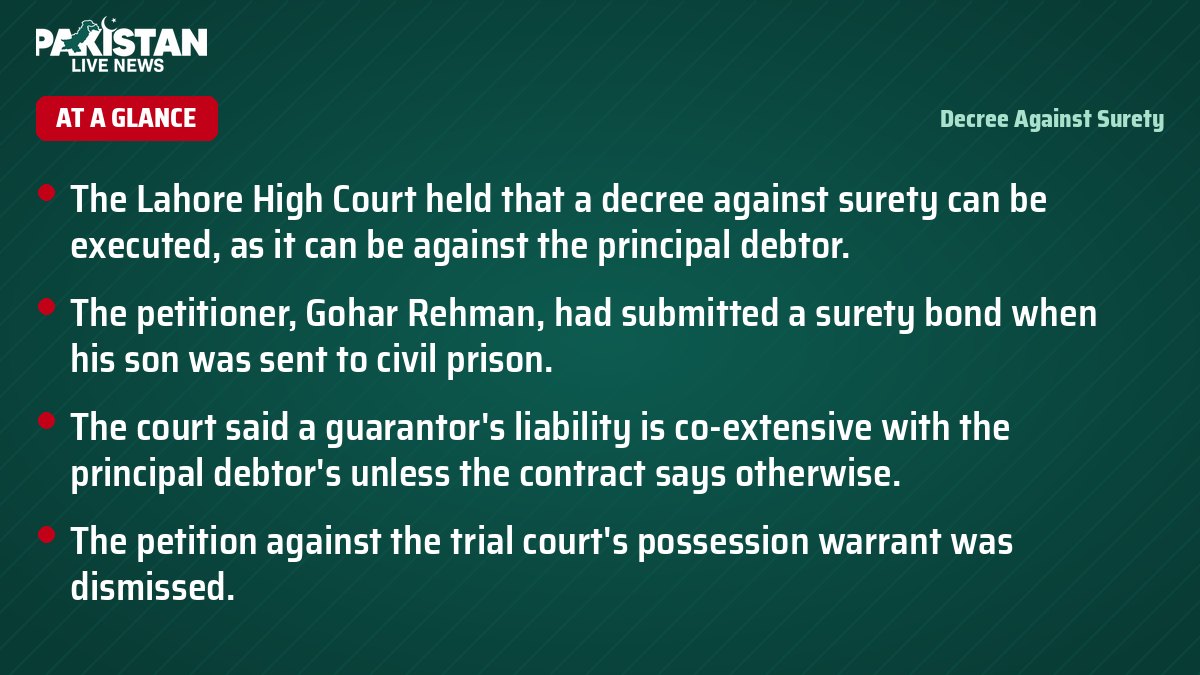
- The Lahore High Court held that a decree against surety can be executed, as it can be against the principal debtor.
- The petitioner, Gohar Rehman, had submitted a surety bond when his son was sent to civil prison.
- The court said a guarantor's liability is co-extensive with the principal debtor's unless the contract says otherwise.
- The petition against the trial court's possession warrant was dismissed.
The Lahore High Court has ruled that a decree against surety can be enforced, and not only against the principal debtor. It dismissed a petition from a man who tried to avoid losing his house after standing guarantee for his son.
In this article
The court stated that a guarantor cannot back away from, or refuse, the liabilities he took on by executing the relevant document. In other words, a guarantor who puts an undertaking in writing remains bound by it.
The ruling turns on a simple point: a decree against surety can stand where the surety has himself promised in writing to satisfy it. The petitioner, Gohar Rehman, found that his challenge to a possession warrant could not succeed on that footing.
Decree against surety: how the dispute began
According to the details of the case, Sadia Bibi was given a house by her husband, Raja Rizwan, at the time of their marriage. An entry to that effect was also recorded in the Nikahnama.
A trial court later issued a warrant of possession for the house of the petitioner, Gohar Rehman, in his capacity as guarantor. He challenged that order before the High Court, which then had to decide whether a decree against surety could be carried out in this way.
His argument was that he was neither a witness to nor a signatory of the Nikahnama, so his property could not be attached.
Why the decree against surety argument failed
The court accepted the general principle that a person who is neither a signatory nor a party to a suit, but whose property is made answerable for a decree, cannot ordinarily be burdened with its consequences. It added, however, that the position in this case was somewhat different.
The petitioner is the father of Raja Rizwan and had also appeared as a defence witness during the trial. When the executing court sent his son to civil prison for failing to comply with the terms of the decree, he came forward to help him and submitted a surety bond.
In that bond, the court noted, he undertook to satisfy the decree if his son failed to do so. The court said he was aware of all the proceedings and had stood closely alongside his son, so he could not now escape his liability.
The surety bond therefore proved decisive. Because the petitioner had undertaken in writing to satisfy the decree, the court held that a decree against surety could be executed against him.
The legal provisions cited
The court referred to section 128 of the Contract Act, 1872, under which a guarantor's liability is co-extensive with that of the principal debtor, unless the contract provides otherwise.
It also relied on section 145 of the Code of Civil Procedure, which makes a surety liable to perform what he has undertaken, in the manner set out in that provision.
Read together, these two provisions support the court's conclusion that a decree against surety may be enforced where the surety has given an undertaking in writing.

Limits of constitutional jurisdiction
The petition was filed under Article 199 of the Constitution. The court observed that this jurisdiction depends on the circumstances: either the judgment under challenge results from a gross misreading or non-reading of evidence, or there is a patent illegality on the face of the record.
It found no ground to take exception to the conclusions of the courts below. The petitioner, it said, had failed to point to any perversity or material irregularity that would justify using its constitutional jurisdiction, and the petition was dismissed.
The challenge to the decree against surety therefore failed at the constitutional stage as well.
Decree against surety explained
Put simply, the High Court's reasoning has three parts. First, a person who is neither a signatory nor a party to a suit cannot ordinarily be burdened with a decree. Second, the petitioner's position was different, because he is the father of the principal debtor, appeared as a defence witness and submitted a surety bond. Third, a guarantor's liability is co-extensive with that of the principal debtor unless the contract says otherwise.
That is why a decree against surety was held to be enforceable here. The petitioner had undertaken in the bond to satisfy the decree if his son failed to do so, and the court said he was aware of all the proceedings.
The court also said he had stood closely alongside his son. For that reason, it held, he could not now escape the liability he had accepted by executing the document.
Background: the house, the Nikahnama and the decree
The case concerns a house given to Sadia Bibi by her husband, Raja Rizwan, at the time of their marriage, with an entry recorded in the Nikahnama. The executing court later sent Raja Rizwan to civil prison for failing to comply with the terms of the decree.
His father, Gohar Rehman, then came forward and submitted a surety bond. The warrant of possession issued by the trial court against his house, in his capacity as guarantor, is the order he challenged before the High Court.
What the decree against surety ruling shows
On the facts reported, the ruling shows that signing a surety bond carries real consequences. The court held that a guarantor cannot refuse liabilities he incurred by executing the document, and that a decree against surety can be executed.
At the same time, the court did not reject the general principle that the property of a non-party cannot ordinarily be burdened. It said only that the position in this case was somewhat different.
Decree against surety: questions and answers
Can a decree be executed against a surety in Pakistan?
Yes. The Lahore High Court held that a decree against surety can be executed, and that a guarantor cannot refuse the liabilities he incurred by executing the document.
How does the law treat a guarantor's liability?
Under section 128 of the Contract Act, 1872, the guarantor's liability is co-extensive with that of the principal debtor, unless the contract provides otherwise.
Why was Gohar Rehman's petition dismissed?
The court noted that he is the father of Raja Rizwan, appeared as a defence witness and submitted a surety bond when his son was sent to civil prison. It found no perversity or material irregularity in the lower courts' decisions.
What was the petitioner's argument?
Gohar Rehman argued that he was neither a witness to nor a signatory of the Nikahnama, so his property could not be attached.
What does section 145 of the Code of Civil Procedure say about a surety?
The court said section 145 makes a surety liable to perform what he has undertaken, in the manner set out in that provision.
What did the court say about its jurisdiction under Article 199?
The court observed that this jurisdiction depends on the circumstances: either the judgment results from a gross misreading or non-reading of evidence, or there is a patent illegality on the face of the record. It found neither here.
Who is Sadia Bibi in this case?
According to the details of the case, Sadia Bibi was given a house by her husband, Raja Rizwan, at the time of their marriage. An entry to that effect was recorded in the Nikahnama.
Image: MariyamAftab / Wikimedia Commons, CC BY-SA 4.0