
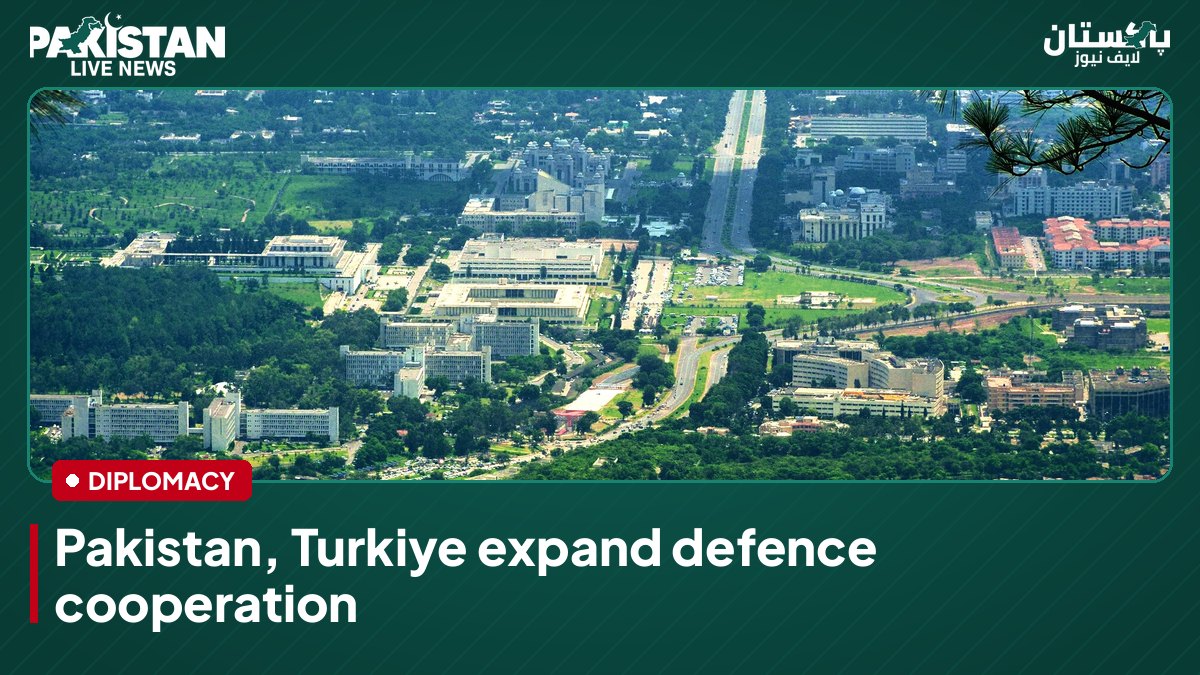
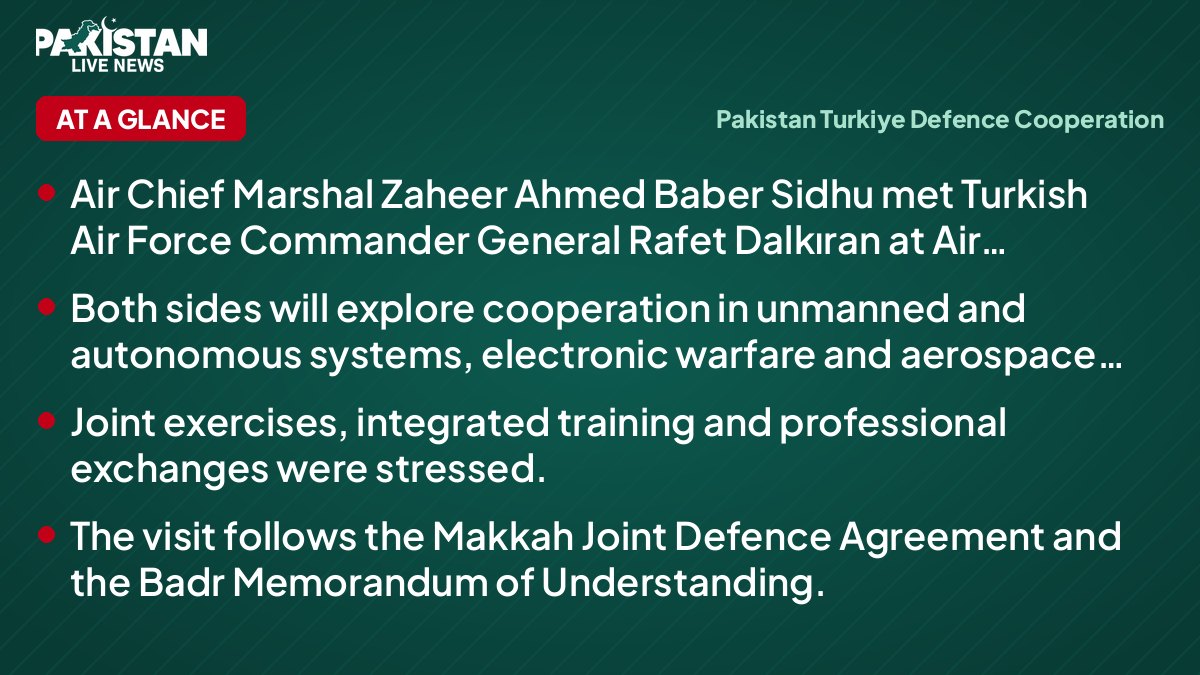
- Air Chief Marshal Zaheer Ahmed Baber Sidhu met Turkish Air Force Commander General Rafet Dalkıran at Air Headquarters, Islamabad.
- Both sides will explore cooperation in unmanned and autonomous systems, electronic warfare and aerospace technologies.
- Joint exercises, integrated training and professional exchanges were stressed.
- The visit follows the Makkah Joint Defence Agreement and the Badr Memorandum of Understanding.
Pakistan and Turkiye have agreed to explore a broader defence partnership covering drones, electronic warfare and advanced aerospace technology. The understanding was reached on Wednesday when the two countries' air force chiefs met in Islamabad.
In this article
The talks add fresh momentum to Pakistan Turkiye defence cooperation, which has been steadily widening through bilateral visits and multilateral agreements this year.
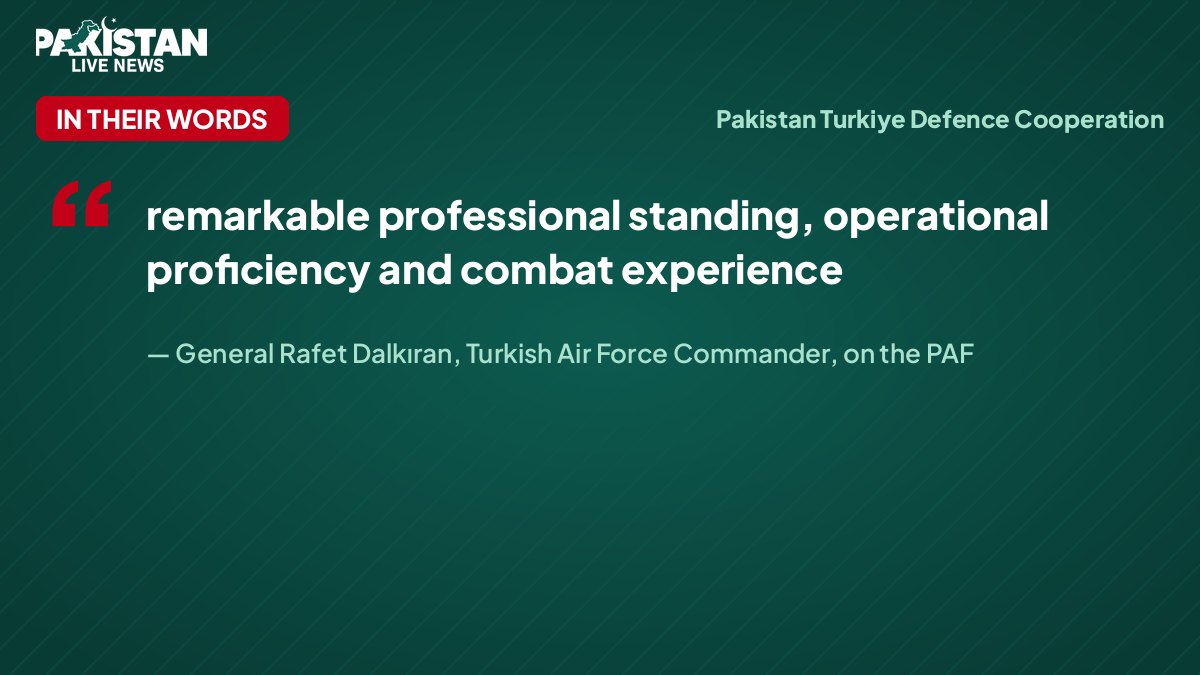
remarkable professional standing, operational proficiency and combat experience
General Rafet Dalkıran, Turkish Air Force Commander, on the PAF
What the air chiefs discussed
Air Chief Marshal Zaheer Ahmed Baber Sidhu received Turkish Air Force Commander General Rafet Dalkıran at Air Headquarters. According to a statement from the Pakistan Air Force's Directorate General of Public Relations, the visiting general was given a guard of honour on arrival.
The two commanders identified "substantial opportunities" in unmanned and autonomous systems, electronic warfare, advanced aerospace technologies, and indigenous research, development and production. The meeting also looked at turning the long-standing strategic relationship into practical operational and technological collaboration.
Both chiefs also underlined the need for institutionalised professional exchanges, integrated training programmes and joint exercises. These, they said, would improve interoperability and operational coordination between the two air forces.
| Framework | Signed | Participants | Focus areas |
|---|---|---|---|
| Makkah Joint Defence Agreement | August | Pakistan, Turkiye, Saudi Arabia | Defence industries, joint exercises, air defence, unmanned systems |
| Badr Memorandum of Understanding | October (Doha) | Pakistan, Turkiye, Qatar, Indonesia | Defence manufacturing, joint research, technical training, industrial capacity |
Training support and modernisation
Air Chief Marshal Sidhu said the relationship, built on shared history, common values and mutual trust, had grown into a robust strategic partnership. He added that it still had considerable room to expand in defence and aerospace.
He briefed his guest on the PAF's transformation into a "technologically advanced, multi-domain air force", driven by capability-centred modernisation, indigenous innovation and investment in next-generation operational concepts. He also assured the visitor of full PAF support for pilot training, professional development and capacity-building for the Turkish Air Force.
General Dalkıran, in turn, praised the PAF's modernisation drive, its growing home-grown aerospace capabilities and its pursuit of technological self-reliance. He also said he wished to draw on the PAF's combat legacy and operational expertise to advance bilateral cooperation.
Timeline
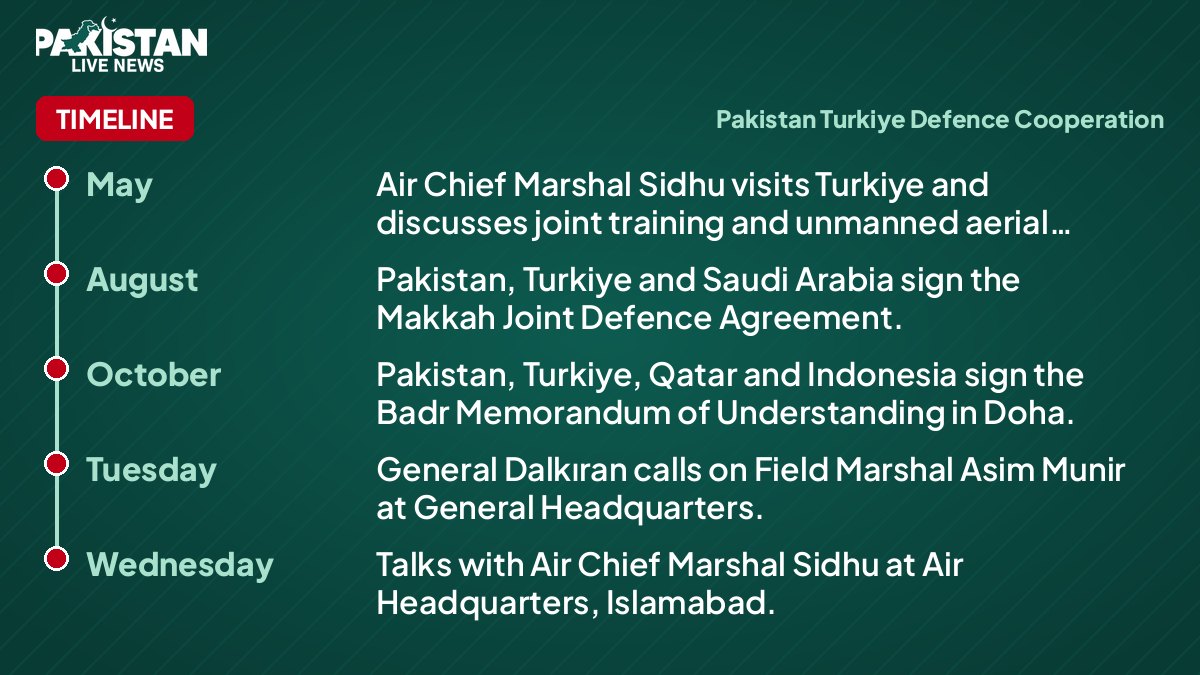
- MayAir Chief Marshal Sidhu visits Turkiye and discusses joint training and unmanned aerial systems.
- AugustPakistan, Turkiye and Saudi Arabia sign the Makkah Joint Defence Agreement.
- OctoberPakistan, Turkiye, Qatar and Indonesia sign the Badr Memorandum of Understanding in Doha.
- TuesdayGeneral Dalkıran calls on Field Marshal Asim Munir at General Headquarters.
- WednesdayTalks with Air Chief Marshal Sidhu at Air Headquarters, Islamabad.
Building on earlier agreements
The visit follows several recent engagements. During an official trip to Turkiye in May, Air Chief Marshal Sidhu met Turkish Air Force Commander General Ziya Cemal Kadioglu, Defence Minister Yasar Guler and Baykar Technologies Chief Technology Officer Selcuk Bayraktar. Those discussions covered joint exercises, training, professional exchanges and cooperation in unmanned aerial systems.
In August, Pakistan, Turkiye and Saudi Arabia signed the Makkah Joint Defence Agreement. It envisages deeper defence-industry collaboration, joint exercises and cooperation in air defence and unmanned systems.
In October, Pakistan, Turkiye, Qatar and Indonesia signed the Badr Memorandum of Understanding in Doha. The framework aims to expand defence manufacturing, joint research and development, technical training and industrial capacity-building, with an emphasis on joint production and technology transfer.
Wider military and regional contacts
General Dalkıran also called on Chief of Defence Forces and Chief of the Army Staff Field Marshal Asim Munir at General Headquarters a day earlier. They discussed matters of mutual interest, regional security dynamics and ways to strengthen defence cooperation. Field Marshal Munir pointed to the "deep-rooted historical, cultural and strategic ties between the two countries".
Pakistan and Turkiye are also members of the Regional Four (R4) Group with Saudi Arabia and Egypt. The group emerged in March and has met several times since.
The PAF said expanding engagement between the two air forces is expected to speed up defence innovation, strengthen indigenous capabilities and support regional security and stability. Both sides say they want a more integrated, technology-driven and forward-looking partnership.
No dates for follow-up steps were announced. Both sides stressed institutionalised exchanges, integrated training and joint exercises as the route to practical cooperation.
Questions and answers
Who met in Islamabad on Wednesday?
Pakistan Air Chief Marshal Zaheer Ahmed Baber Sidhu met Turkish Air Force Commander General Rafet Dalkıran at Air Headquarters.
Which areas of cooperation were discussed?
They discussed unmanned and autonomous systems, electronic warfare, advanced aerospace technologies, and indigenous research, development and production, along with joint exercises and training.
What earlier agreements support this partnership?
The Makkah Joint Defence Agreement, signed in August with Saudi Arabia, and the Badr Memorandum of Understanding, signed in Doha in October with Qatar and Indonesia.
Image: Zacharie Grossen / Wikimedia Commons, CC BY-SA 4.0