

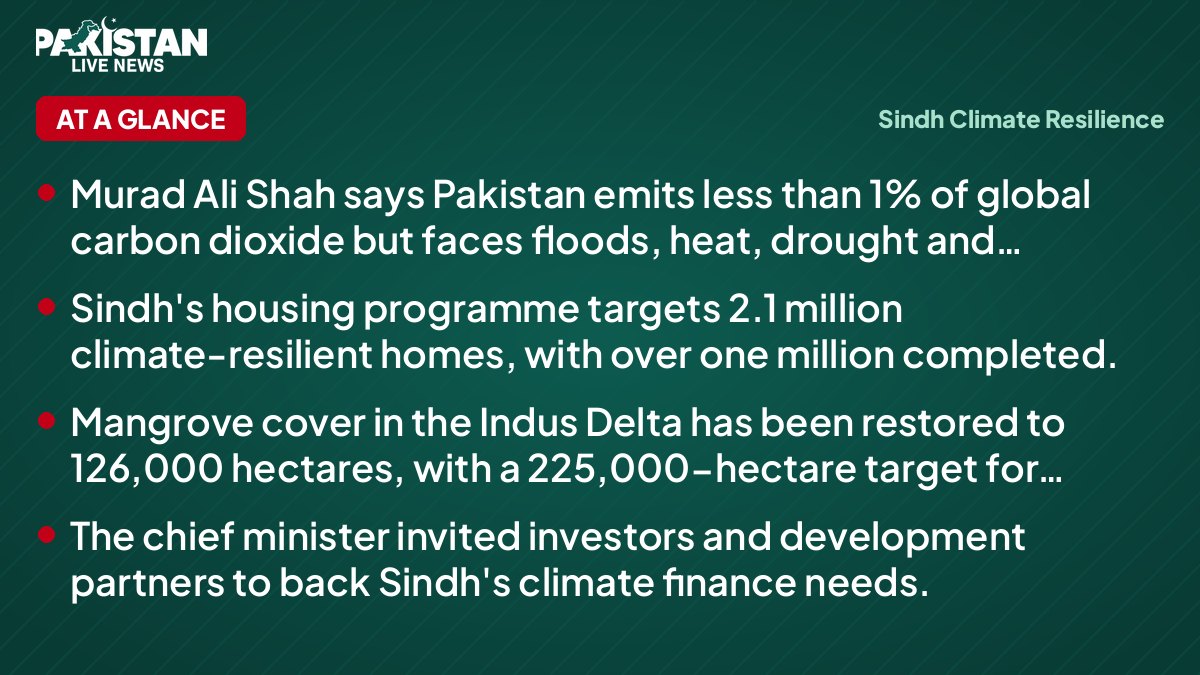
- Murad Ali Shah says Pakistan emits less than 1% of global carbon dioxide but faces floods, heat, drought and coastal threats.
- Sindh's housing programme targets 2.1 million climate-resilient homes, with over one million completed.
- Mangrove cover in the Indus Delta has been restored to 126,000 hectares, with a 225,000-hectare target for 2030.
- The chief minister invited investors and development partners to back Sindh's climate finance needs.
Sindh Chief Minister Murad Ali Shah has used the 31st United Nations Climate Change Conference (COP31) in Antalya, Turkiye, to demand climate justice for developing countries. He presented a broad Sindh climate resilience strategy covering disaster recovery, housing, water, energy and environmental protection.
In this article
He told delegates that Pakistan contributes less than 1% of global carbon dioxide emissions, yet continues to pay a heavy price for global warming.
A call for fair climate finance
Mr Shah urged the international community to strengthen cooperation, distribute climate finance fairly and make technology transfer easier for vulnerable countries. He said developing nations, despite contributing least to global emissions, carry the heaviest burden of climate change.
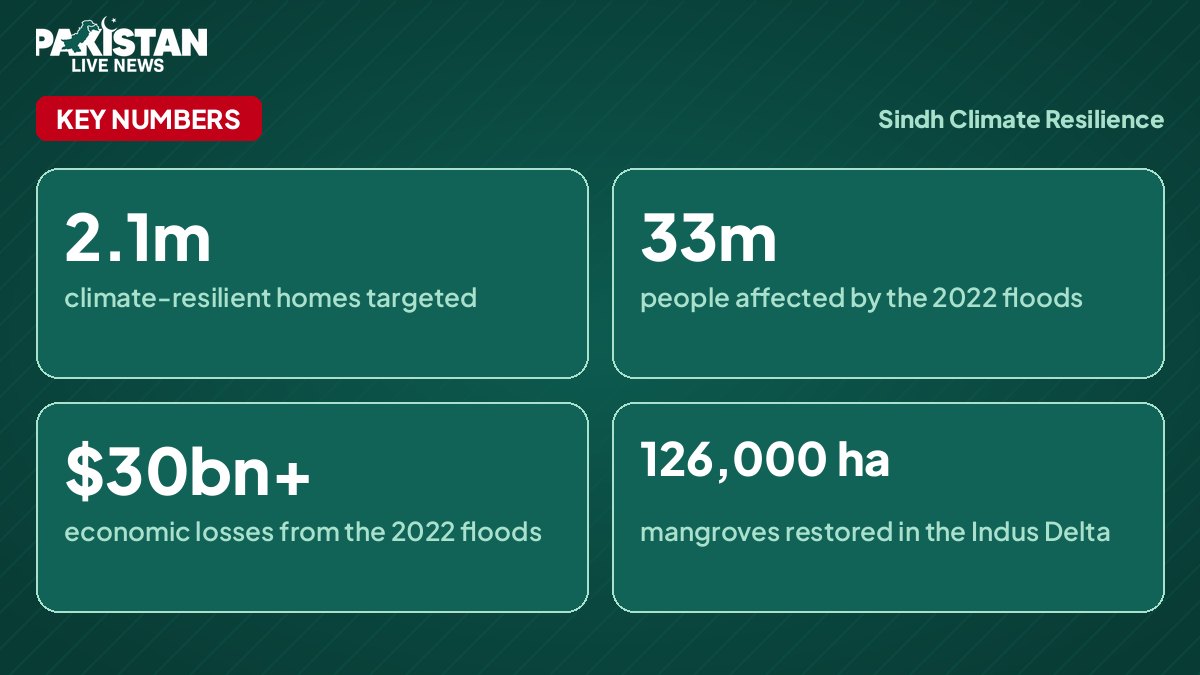
Citing Pakistan's own experience, he listed catastrophic floods, extreme heat, droughts and coastal threats. The 2022 floods affected 33 million people, claimed more than 1,700 lives and caused economic losses above $30 billion, he said. Sindh alone suffered nearly 70% of the total damage.
He added that his government had chosen to rebuild safer, more resilient communities rather than simply repair damaged infrastructure.
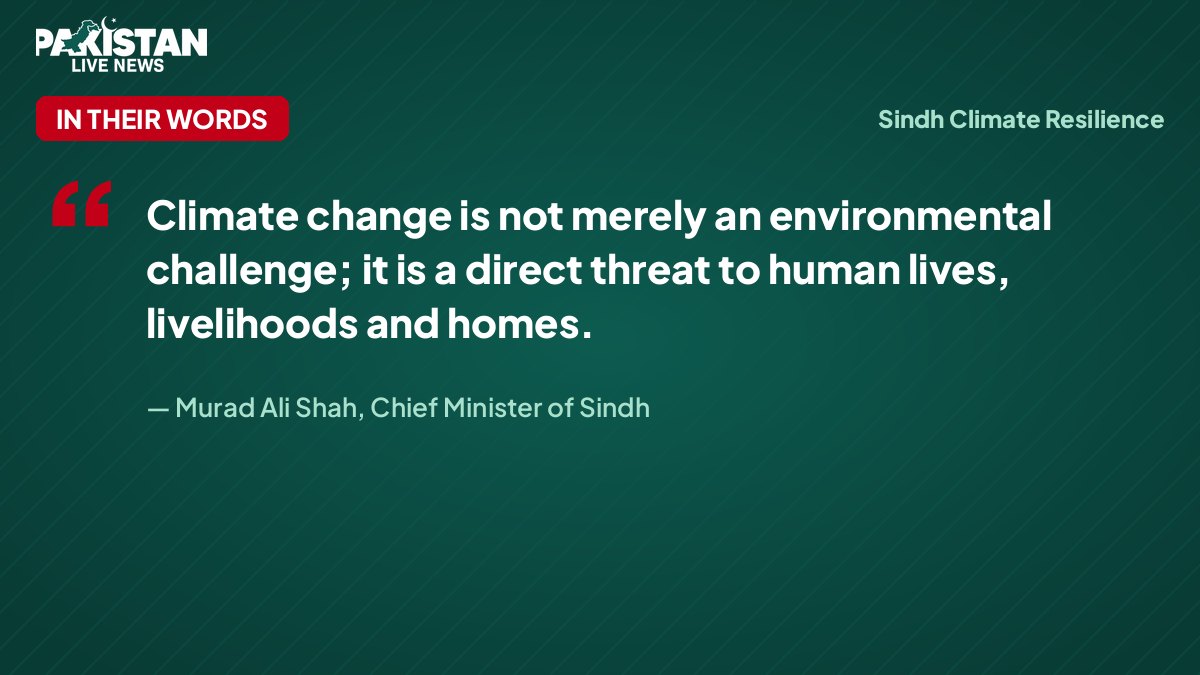
Climate change is not merely an environmental challenge; it is a direct threat to human lives, livelihoods and homes.
Murad Ali Shah, Chief Minister of Sindh
Sindh climate resilience: homes and flood defences
The centrepiece is the Sindh People's Housing Programme, which the chief minister described as the world's largest post-disaster housing reconstruction initiative. It targets 2.1 million climate-resilient homes for flood-affected families. More than one million have been completed in three and a half years, while another 700,000 are under construction.
More than 42,000 community committees have been set up and over 1.7 million bank accounts opened so that assistance reaches families directly. Women have been given a central role through property ownership and financial empowerment. Mr Shah recalled that World Bank President Ajay Banga had appreciated the programme's scale, direct banking mechanism and community participation during a visit to Larkana.
On flood protection, Sindh has rebuilt 205 kilometres of protective embankments and restored 157,000 hectares of farmland. The Manchar Lake protection system has been strengthened, raising its discharge capacity to 83,500 cusecs. He said drainage systems and natural waterways are also being restored so floodwater can drain in time.
All 44 gates of Sukkur Barrage have been replaced, and 54 of the 65 gates at Guddu Barrage have been rebuilt. The government aims to finish barrage rehabilitation and modernisation by 2027.
Alongside this, the province is rebuilding 5,811 flood-damaged schools, rehabilitating 141 roads spanning 825 kilometres across 19 districts, and restoring more than 1,000 damaged health facilities. Maternal and child healthcare is receiving particular attention.
| Barrage | Gates rebuilt | Total gates |
|---|---|---|
| Sukkur Barrage | 44 | 44 |
| Guddu Barrage | 54 | 65 |
Mangroves and the Indus Delta
Mr Shah said Sindh has restored mangrove forests over 126,000 hectares of the Indus Delta and aims to reach 225,000 hectares by 2030. The Delta Blue Carbon initiative is expected to absorb or reduce 142 million tonnes of carbon dioxide, and 5.6 million tonnes of carbon credits have been verified.
He stressed that mangroves protect coastal communities from erosion and cyclones, preserve marine biodiversity and support livelihoods. Continuous freshwater flows from the Indus, he said, are equally vital to the delta's ecological balance.
He also pointed to a proposed $20 million carbon agreement based on recovering methane from Karachi's Jam Chakro landfill site. Carbon credits would be transferred under Article 6.2 of the Paris Agreement.
Water, energy and farming projects
On water, the chief minister cited canal lining projects, including the Kalri Baghar Feeder, to cut losses and improve supplies to Karachi. Small dams and extra storage are being planned for drought-prone areas, particularly Thar.
He said Sindh generates all of the country's wind power and around 32% of its total electricity. Wind and solar projects in the province cut carbon dioxide emissions by roughly 2.67 million tonnes a year. Thirty-six institutions produce wind power along the coastal belt, with another 34 projects under development. The government also plans solar power for 275,000 low-income households.
The first phase of Karachi's Haroonabad Wastewater Treatment Plant is complete, with a capacity of 35 million gallons daily. It is planned to grow to 100 million gallons by early 2027, with treated water reused for industry. Mr Shah also highlighted electric public transport and plans to promote electric taxis.
The $540 million STARS-WASH programme is being implemented across all 22 flood-affected districts. Its first phase is meant to benefit 1.2 to 1.5 million people, especially in areas hit by child malnutrition and stunting. He further presented seven investment-ready agricultural projects worth $154.85 million, covering climate-smart farming, digital advisory services, solar-powered irrigation and groundwater recharge.
Appeal to partners and investors
Closing his address, Mr Shah invited development partners and investors to support Sindh's climate resilience work through finance, modern technology and investment in clean energy, water conservation and resilient infrastructure.
He recalled Sindh's five-thousand-year-old civilisation along the Indus and said the province is committed to protecting the environment and sharing its lessons with the world. He asked global leaders to turn shared experience into coordinated action.
The government aims to complete barrage rehabilitation and modernisation by 2027. The Haroonabad treatment plant is planned to reach 100 million gallons daily by early 2027, and mangrove cover is targeted to reach 225,000 hectares by 2030.
Questions and answers
What did the Sindh chief minister say at COP31?
Murad Ali Shah called for climate justice and fair climate finance. He said Pakistan emits under 1% of global carbon dioxide but suffers floods, extreme heat, droughts and coastal threats.
How many homes is Sindh building for flood victims?
The Sindh People's Housing Programme targets 2.1 million climate-resilient homes. Over one million are complete and another 700,000 are under construction, according to the chief minister.
What is the Delta Blue Carbon initiative?
It is Sindh's mangrove-based project in the Indus Delta. It is expected to absorb or reduce 142 million tonnes of carbon dioxide, and 5.6 million tonnes of carbon credits have been verified.
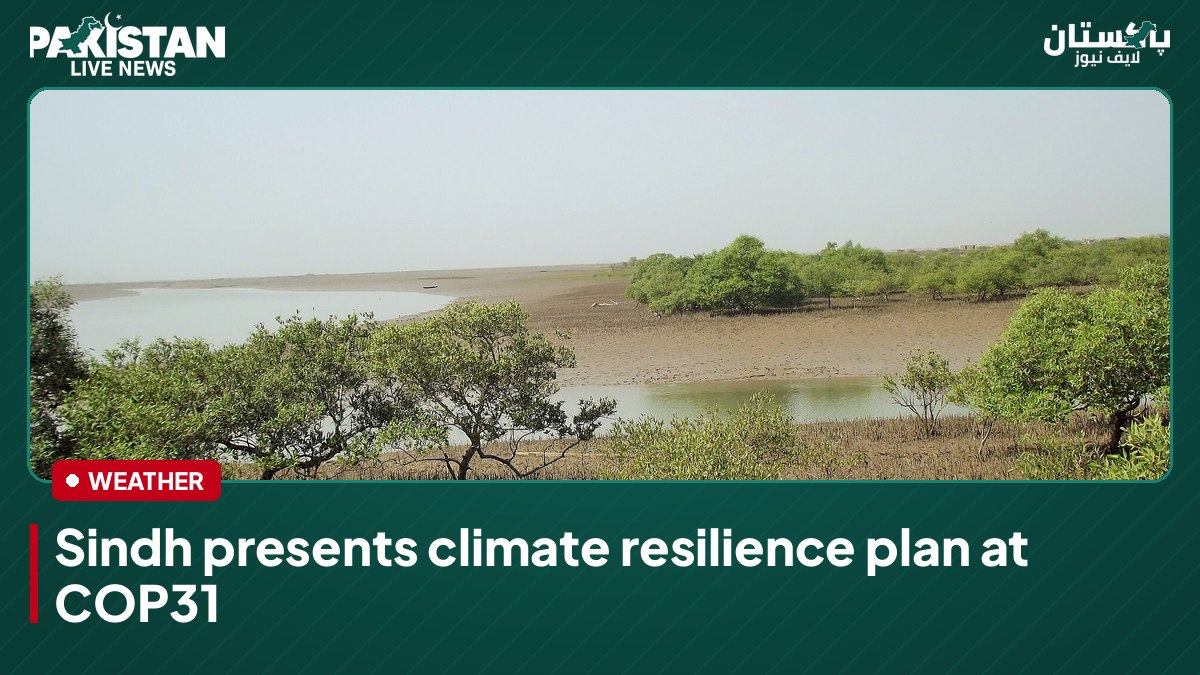
Image: Ayazan57 / Wikimedia Commons, CC BY-SA 4.0