
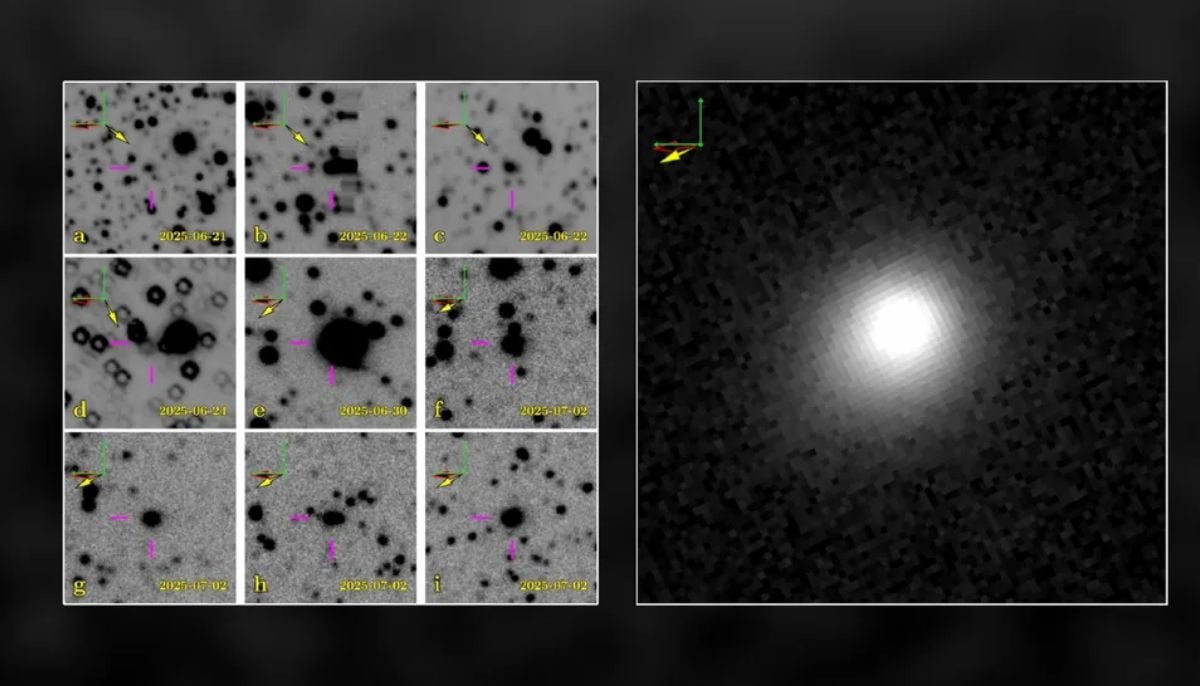
An interstellar comet that has captivated astronomers this year narrowly missed becoming the first object named after the Vera C. Rubin Observatory.
The event happened on June 20, 2025, when Rubin was practising its imaging system for the first time at night and detected 3I/ATLAS, which occurred ten days before ATLAS discovered it on July 1.
If the Chilean telescope’s data processing pipelines were in place, it would have been able to claim the discovery.
Scientists at the University of Washington, under the leadership of Colin Orion Chandler, made this close call while reviewing the commissioning data.
The 27.6-foot telescope, which is still undergoing science validation, did not have any automated data pipelines used in making regular observations.
To even view the images that had been stored away, Chandler’s team were required to write their own software to access the data. The team observed the comet at least thirteen times in twelve nights and managed to see the dusty coma, the bright halo around a comet indicating activity.
Rubin is designed to discover around 10,000 new comets in its first ten-year survey cycle. Given its expected performance during the early survey phase, Rubin will detect one interstellar comet passing through our solar system per year.
Based on 3I/ATLAS’s observation, it may be safe to say that while the current object will not be called with Rubin’s name, many more of its future visitors probably will.
In October 2025, when 3I/ATLAS was closest to the Sun, two NASA and ESA probes en route to Jupiter, Europa Clipper and JUICE, captured an interesting event. Using their ultraviolet spectrograph instruments, they detected hydrogen, oxygen, and carbon atoms produced by the photodissociation process of molecular gas escaping the nucleus.