
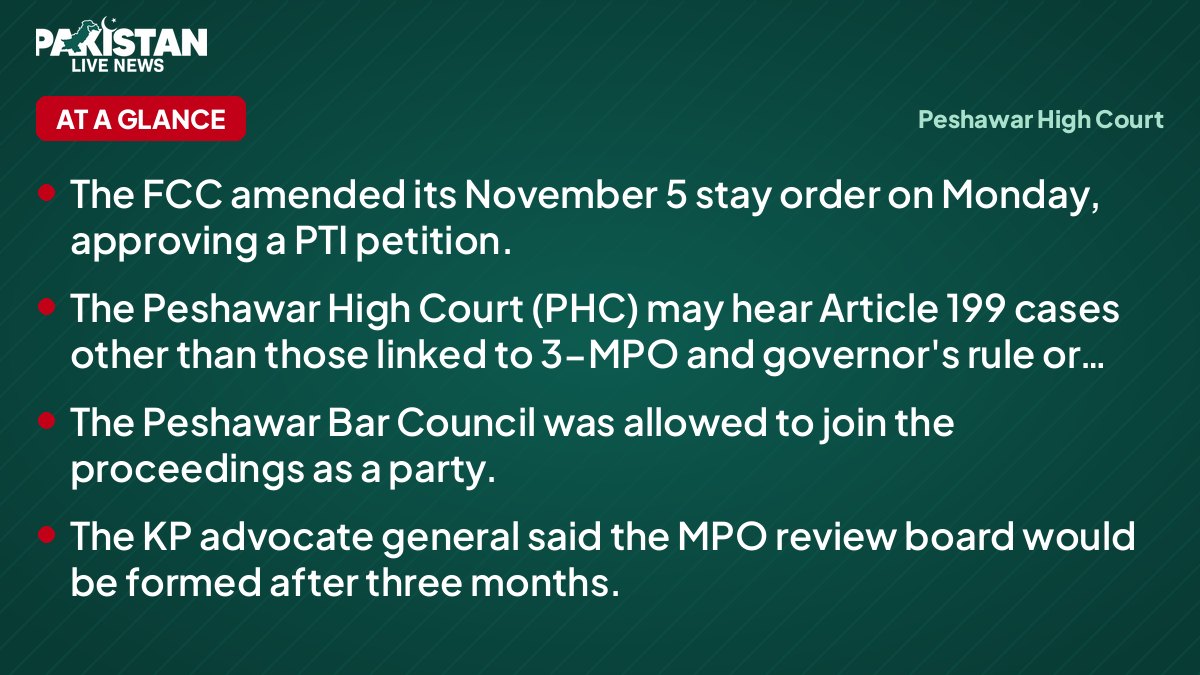
- The FCC amended its November 5 stay order on Monday, approving a PTI petition.
- The Peshawar High Court (PHC) may hear Article 199 cases other than those linked to 3-MPO and governor's rule or emergency in KP.
- The Peshawar Bar Council was allowed to join the proceedings as a party.
- The KP advocate general said the MPO review board would be formed after three months.
The Federal Constitutional Court (FCC) has loosened the restrictions it placed on the Peshawar High Court (PHC), allowing it to hear most petitions filed under Article 199 of the Constitution. The clarification came on Monday in a hearing on a petition filed by the PTI.
In this article
The bench, headed by Chief Justice Aminuddin Khan and including Justice Aamer Farooq, amended its stay order of November 5. That order had suspended proceedings before the Peshawar High Court under Article 199.
What the Peshawar High Court can hear now
The FCC said its November 5 order related to matters concerning Section 3 of the Maintenance of Public Order (MPO) law and governor's rule. The Peshawar High Court may continue hearing other cases under Article 199, so the restraint no longer covers every constitutional petition.
PTI chief Barrister Gohar told the media after the hearing that the Peshawar High Court would not hear cases relating to governor's rule or a state of emergency. He said proceedings in other Article 199 cases would continue.
The court also accepted an application from the Peshawar Bar Council to become a party to the case. The council was therefore allowed to join the proceedings.
Timeline
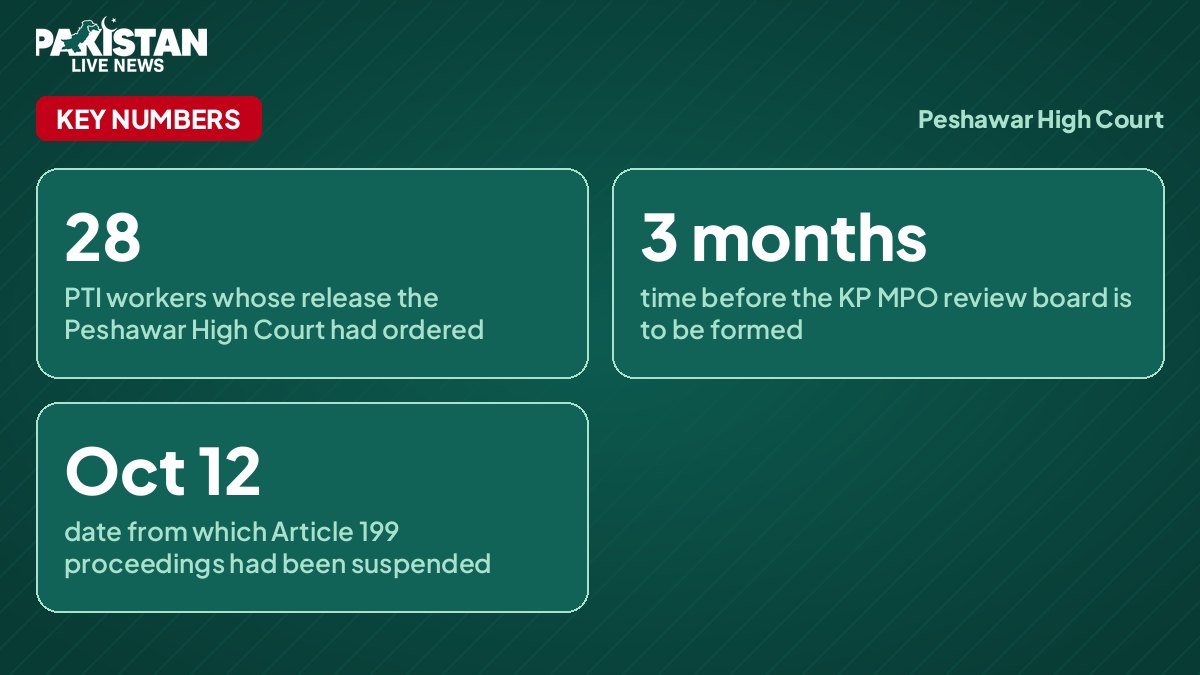
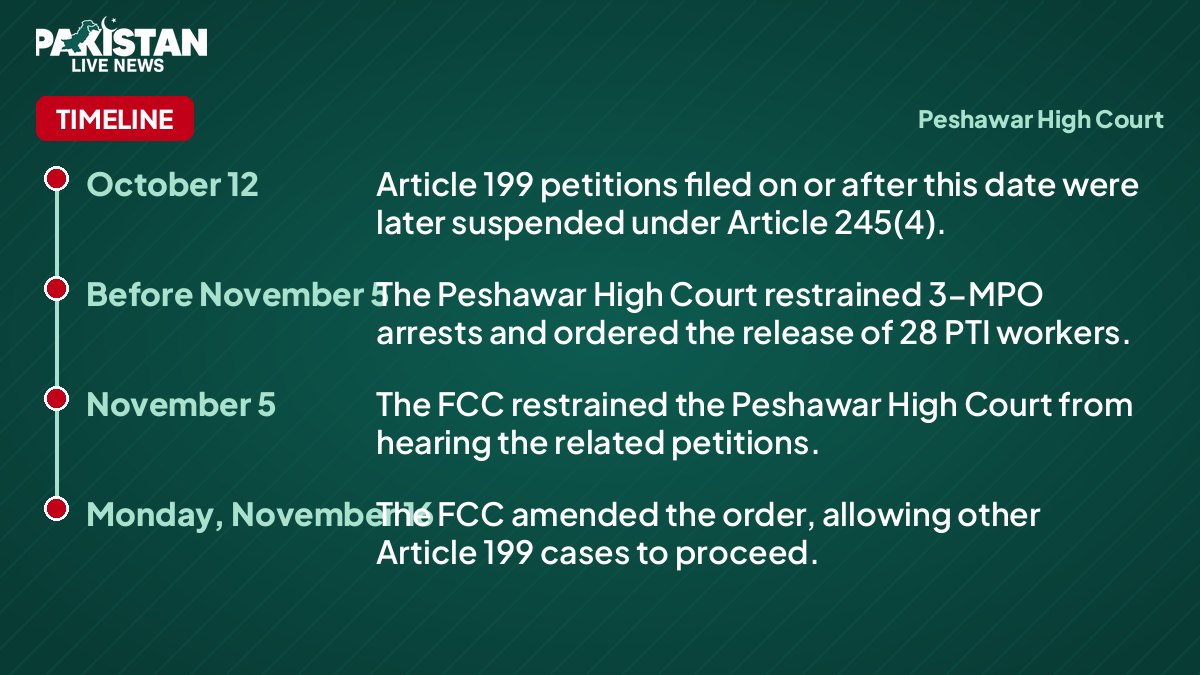
- October 12Article 199 petitions filed on or after this date were later suspended under Article 245(4).
- Before November 5The Peshawar High Court restrained 3-MPO arrests and ordered the release of 28 PTI workers.
- November 5The FCC restrained the Peshawar High Court from hearing the related petitions.
- Monday, November 16The FCC amended the order, allowing other Article 199 cases to proceed.
Arguments in court on Peshawar High Court hearings
Barrister Gohar told the bench that the November 5 order had disrupted the work of the Peshawar High Court and brought lawyers' professional activities to a halt.
Justice Aamer Farooq observed that a simple reading of Article 245 suggested Article 199 cases could not be heard in the circumstances. However, he said a literal interpretation would bring the entire judicial system to a standstill.
In other words, the bench weighed the wording of Article 245 against the effect a strict reading would have on the judicial system as a whole.
MPO detentions and the review board
Barrister Gohar also sought relief for people arrested under Section 3 of the MPO. He pointed out that a review board had not yet been constituted in Khyber Pakhtunkhwa.
The KP advocate general told the court the review board would be formed after three months.
Chief Justice Aminuddin Khan said miscellaneous petitions had been filed at the Peshawar High Court's Peshawar registry. He said they would be examined once they were brought before the bench.
How the dispute reached the Peshawar High Court
Before the FCC's November 5 order, the Peshawar High Court had restrained authorities from making arrests under 3-MPO. It had also ordered the release of 28 PTI workers detained in various districts of the province.
The FCC's November 5 ruling had restrained the Peshawar High Court from hearing constitutional petitions on the preventive detention of PTI workers and activists under the MPO Ordinance. It held that proceedings initiated under Article 199 on or after October 12 would remain suspended under Article 245(4). The suspension followed emergency measures and the deployment of armed forces in aid of civil power across the province.
After that directive, the PHC's administrative committee decided not to proceed with Article 199 petitions filed on or after October 12. The FCC adjourned further proceedings for an indefinite period.
Explained: what the amended stay order means
The petitions at the centre of this dispute were filed under Article 199 of the Constitution before the Peshawar High Court. The November 5 stay order was tied to Article 245(4), and under it Article 199 proceedings begun on or after October 12 were to remain suspended.
On Monday, the FCC amended that order. The court clarified that the November 5 order related to matters concerning Section 3 of the MPO law and governor's rule. Other Article 199 cases may therefore be heard by the Peshawar High Court.
Put simply, petitions on 3-MPO detentions and on governor's rule or a state of emergency in Khyber Pakhtunkhwa remain covered by the restraint. Other Article 199 cases may proceed.
Who is affected by the amended order
The ruling touches several groups named in the hearing. PTI workers and activists detained under the MPO Ordinance were the subject of the petitions the FCC restrained on November 5. Before that order, the Peshawar High Court had ordered the release of 28 PTI workers detained in various districts.
Lawyers were also affected, as Barrister Gohar told the bench that the November 5 order had brought their professional activities to a halt. The Peshawar Bar Council has now been allowed to join the case as a party.
The FCC adjourned further proceedings for an indefinite period. The miscellaneous petitions filed at the PHC's Peshawar registry will be examined once they come before the bench, and the KP advocate general said the MPO review board would be formed after three months.
Questions and answers
What did the FCC change on Monday?
It amended its November 5 stay order. The order was clarified as relating to 3-MPO and governor's rule matters, and the PHC may hear other cases under Article 199.
Which cases can the PHC still not hear?
Cases concerning 3-MPO and the imposition of governor's rule or a state of emergency in Khyber Pakhtunkhwa remain outside its remit, according to the court's clarification and Barrister Gohar's comments.
When will the MPO review board be formed?
The KP advocate general told the court it would be established after three months.
Why was the Peshawar High Court restrained in the first place?
The FCC's November 5 ruling restrained it from hearing constitutional petitions on the preventive detention of PTI workers and activists under the MPO Ordinance. Proceedings under Article 199 on or after October 12 were to remain suspended under Article 245(4), following emergency measures and the deployment of armed forces in aid of civil power.
Who was on the bench that amended the order?
The bench was headed by Chief Justice Aminuddin Khan and included Justice Aamer Farooq.
Was the Peshawar Bar Council allowed to join the case?
Yes. The court accepted the Peshawar Bar Council's application to become a party to the case.
What happens to the miscellaneous petitions at the Peshawar registry?
Chief Justice Aminuddin Khan said they would be examined once they were brought before the bench. The FCC adjourned further proceedings for an indefinite period.