
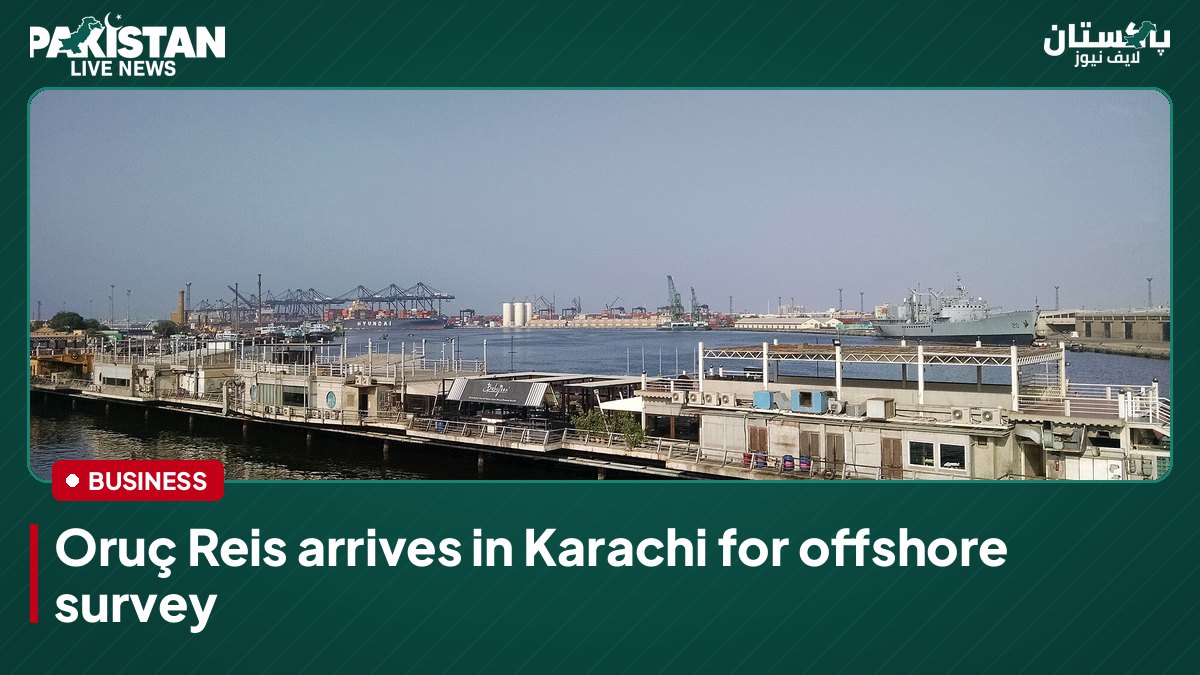
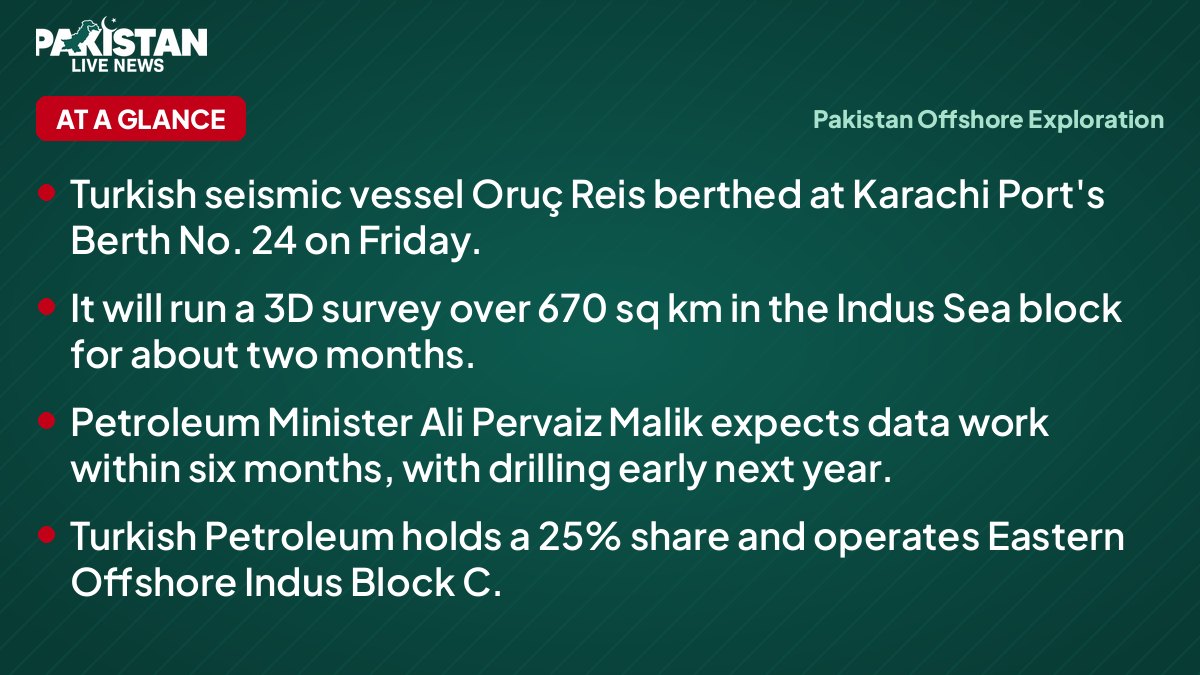
- Turkish seismic vessel Oruç Reis berthed at Karachi Port's Berth No. 24 on Friday.
- It will run a 3D survey over 670 sq km in the Indus Sea block for about two months.
- Petroleum Minister Ali Pervaiz Malik expects data work within six months, with drilling early next year.
- Turkish Petroleum holds a 25% share and operates Eastern Offshore Indus Block C.
Pakistan offshore exploration has entered a new phase after the Turkish seismic vessel Oruç Reis berthed at Karachi Port on Friday. The ship will map the seabed for oil and gas in the country's first major push of this kind in about two decades.
In this article
The vessel, operated by Turkish Petroleum (TPAO), is docked at Berth No. 24. A formal ceremony was held to mark its arrival and the start of the programme.
Ceremony in Karachi
Turkish Energy Minister Alparslan Bayraktar, who reached Karachi a day earlier, joined Deputy Prime Minister Ishaq Dar, Petroleum Minister Ali Pervaiz Malik and other officials to receive the ship. Dar described the arrival as the start of a new chapter in scientific exploration and strategic cooperation between the two countries.
Dar cautioned that a seismic survey cannot promise a commercial find. He argued, however, that no find is possible without such work. He also said Pakistan's coastline links it to vital international energy and trade routes, and that the maritime zone offers openings in energy, shipping and fisheries.
The deputy prime minister put the value of Pakistan's natural resources at "anything between $8-10 trillion".
But no discovery can be made without seismic and exploration
Ishaq Dar, Deputy Prime Minister
What the Pakistan offshore exploration survey covers
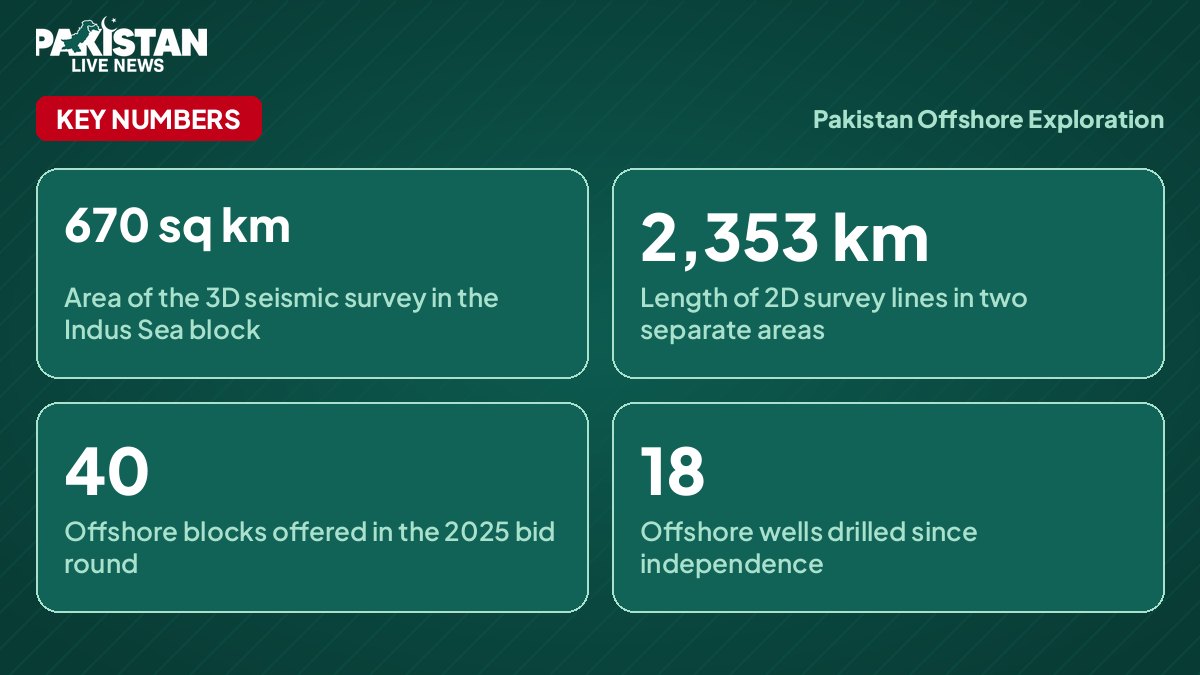
According to Bayraktar, Turkish Petroleum will carry out a 3D seismic data acquisition operation lasting roughly two months. It will cover 670 square kilometres in the Indus Sea block. It has also been reported that the vessel will gather 2D seismic data along 2,353 kilometres of survey lines in two separate areas, following its first intercontinental mission in Somalia.
Malik said the data collection and interpretation should be finished within six months, leading to drilling early next year. Bayraktar said the aim is to launch operations in the identified fields in 2027.
The Petroleum Minister said the data would give a clearer picture of the subsurface and reduce geological and drilling uncertainty. He added that it would form the basis of future exploration programmes.
Timeline
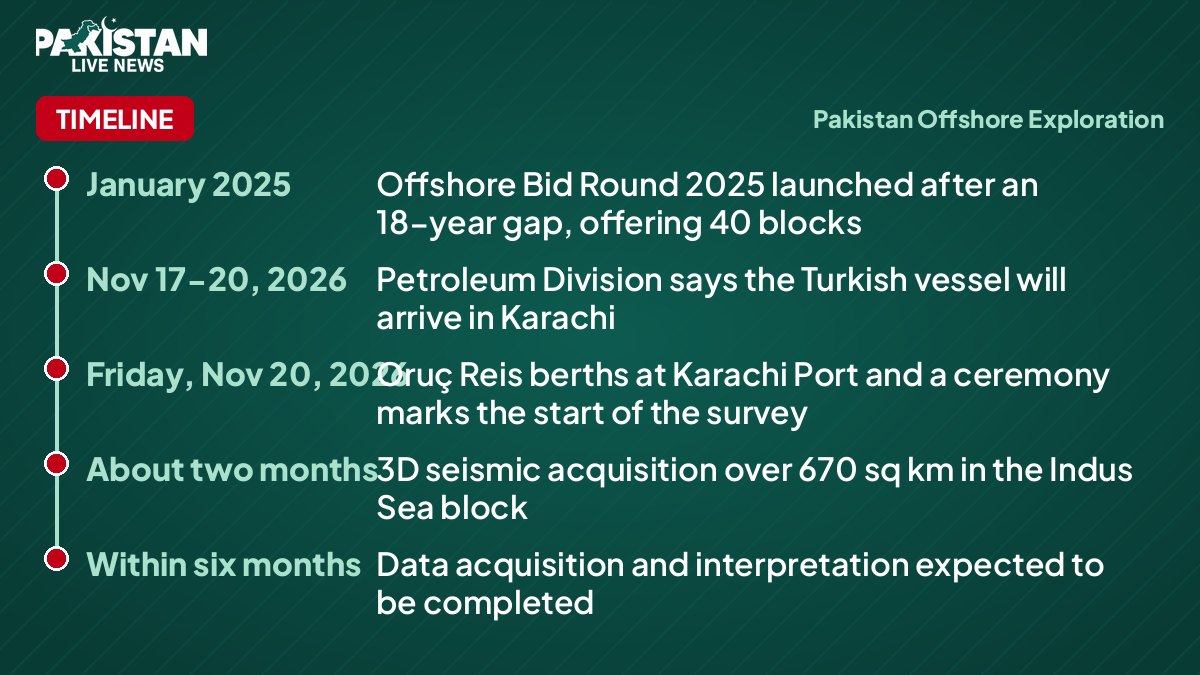
- January 2025Offshore Bid Round 2025 launched after an 18-year gap, offering 40 blocks
- Nov 17-20, 2026Petroleum Division says the Turkish vessel will arrive in Karachi
- Friday, Nov 20, 2026Oruç Reis berths at Karachi Port and a ceremony marks the start of the survey
- About two months3D seismic acquisition over 670 sq km in the Indus Sea block
- Within six monthsData acquisition and interpretation expected to be completed
- Early next year / 2027Drilling expected to start; operations in identified fields targeted for 2027
Turkish partnership and the bid round
Malik said petroleum cooperation between Pakistan and Turkiye has grown considerably. He pointed to Eastern Offshore Indus Block C, where Turkish Petroleum is the operator with a 25% share alongside PPL, OGDCL and Mari Energies.
The survey follows the Offshore Bid Round 2025, launched in January 2025 after an 18-year gap. It offered exploration licences for 40 offshore blocks in the Indus and Makran basins off Sindh and Balochistan. Pakistan Petroleum Limited has since signed production sharing agreements and exploration licences for eight offshore blocks.
An official statement said the blocks were auctioned for the first time in two decades as part of efforts to revive domestic exploration and cut reliance on imports.
Untapped potential and energy security
It has been reported that Pakistan has around 300,000 square kilometres of offshore territory with potential oil and gas reserves. Only 18 wells have been drilled offshore since independence. Exploration has stalled for years because of weak investment and limited technical capacity.
Malik linked the effort to the wider energy situation. He said Pakistan entered the current global crisis on 28 February with thin buffers and high exposure to the Strait of Hormuz. He added that there had been no fuel dry-out in the six months since war began in Iran.
The crisis, he said, has strengthened Pakistan's resolve to review its whole energy security architecture. In his view, developing indigenous resources reduces external vulnerability and strengthens the economy.
The Oruç Reis will spend about two months collecting seismic data in the Indus Sea block. Officials expect data acquisition and interpretation to be completed within six months, with drilling to follow early next year and operations in identified fields targeted for 2027.
Questions and answers
What is the Oruç Reis?
It is a Turkish seismic survey vessel operated by Turkish Petroleum (TPAO). It has arrived at Karachi Port to collect seismic data for offshore oil and gas exploration.
How long will the survey take?
The 3D seismic operation over 670 square kilometres is expected to last roughly two months. Petroleum Minister Ali Pervaiz Malik says data acquisition and interpretation should be completed within six months.
Does the survey guarantee an oil or gas discovery?
No. Ishaq Dar said a seismic survey cannot guarantee a commercial discovery, but that no discovery is possible without seismic work and exploration.
Image: Nawazahmed12 / Wikimedia Commons, CC BY-SA 4.0