


- The Peshawar High Court has upheld video conferencing for recording evidence in criminal trials.
- The court said technology must operate in harmony with the fair trial guarantee in Article 10-A of the Constitution.
- A Bannu trial court was directed to verify the witness's identity and examine the defence's claim of prompting.
- Physical appearance may be required if safeguards cannot be secured by video link.
The Peshawar High Court has upheld the use of modern technology, including video conferencing, for recording evidence in criminal trials. However, it has made clear that such arrangements must remain in harmony with the constitutional guarantee of a fair trial and due process.
In this article
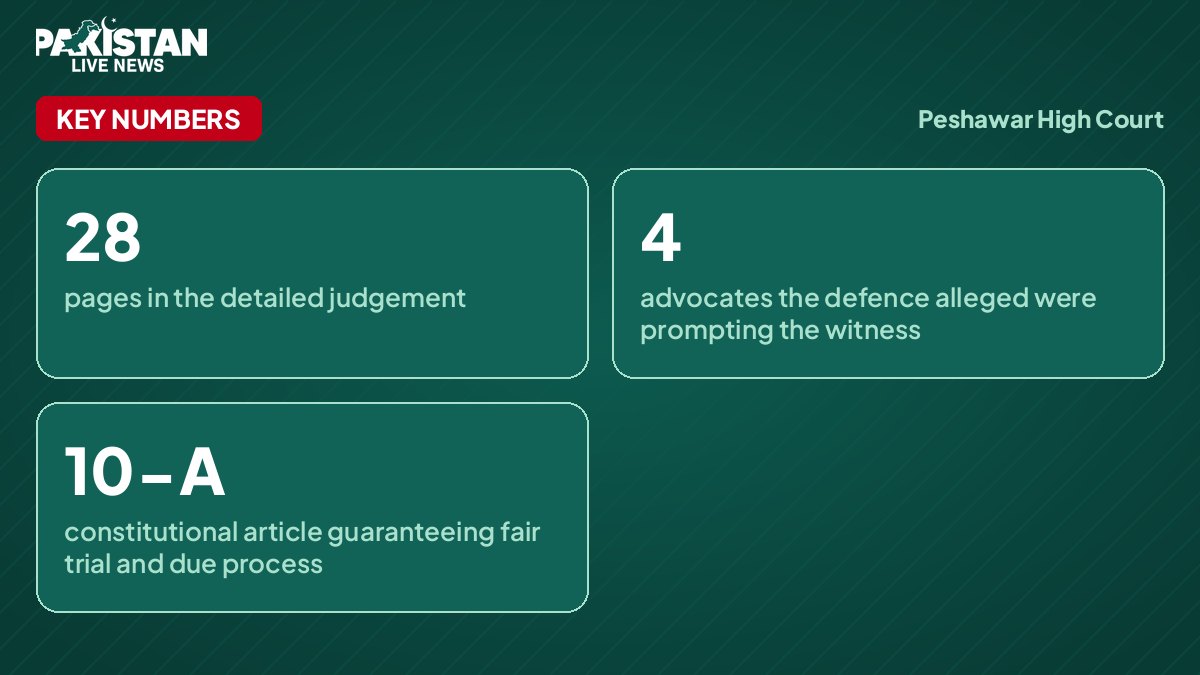
Justice Aurangzeb Khan, sitting as a single-member bench, issued a 28-page detailed judgement while disposing of a criminal revision petition arising from a murder trial in Bannu.
How the Bannu murder case reached the High Court
The petitioner, a suspect facing trial in a murder case, challenged a trial court order of February 25, 2026. That order had rejected his request that the complainant, who is also a prosecution witness, appear in person rather than through a video link.
Earlier, on January 10, 2026, the trial court had accepted the complainant's application to give her statement by video link. She had claimed a security threat in Bannu. The defence counsel raised no objection then, and the Peshawar district and sessions judge granted permission for the arrangement.
The use of technology is a means of facilitating the administration of justice and cannot be permitted to become a source of prejudice to either party.
Justice Aurangzeb Khan, Peshawar High Court
The disrupted hearing of January 15
On January 15, the complainant appeared by video from the Sessions Courts in Peshawar. The prosecutor, her counsel, the petitioner and his lawyer were present in the Bannu courtroom.
While her examination-in-chief was being recorded, the defence counsel objected that someone was instructing the witness. The defence counsel alleged that four advocates standing near the rostrum prompted her whenever she forgot something. The defence counsel and the petitioner then left the courtroom, and her statement could not be completed.
Timeline
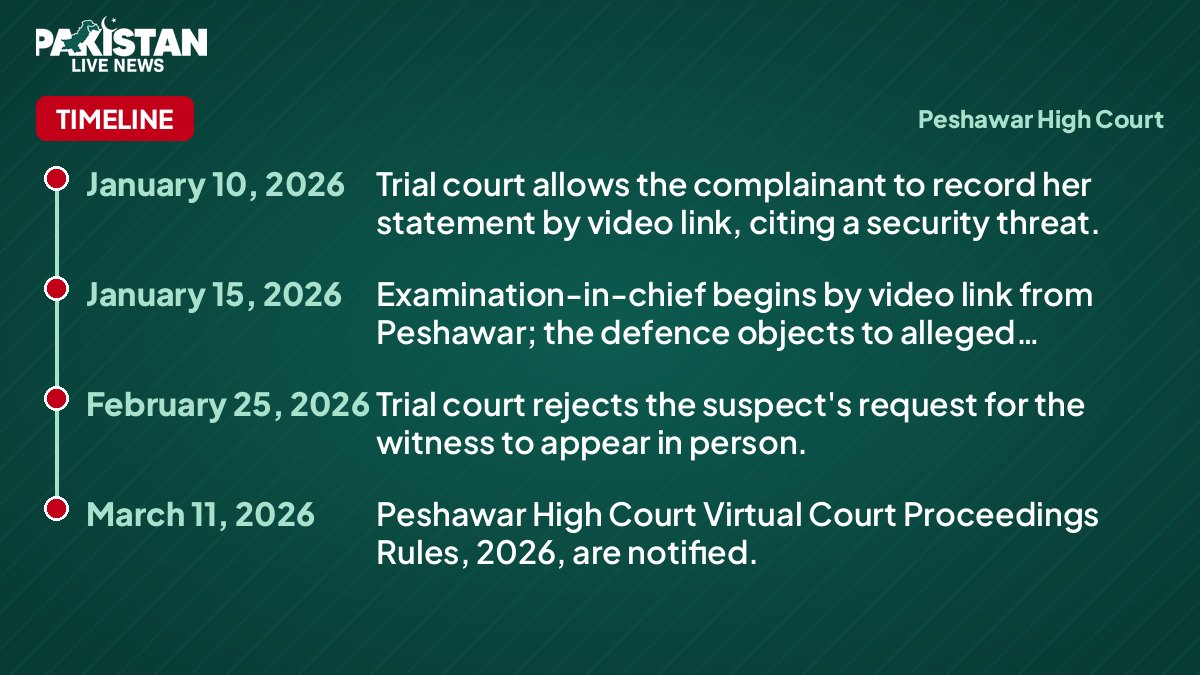
- January 10, 2026Trial court allows the complainant to record her statement by video link, citing a security threat.
- January 15, 2026Examination-in-chief begins by video link from Peshawar; the defence objects to alleged prompting and leaves the courtroom.
- February 25, 2026Trial court rejects the suspect's request for the witness to appear in person.
- March 11, 2026Peshawar High Court Virtual Court Proceedings Rules, 2026, are notified.
Technology as a tool, not a source of prejudice
The bench discussed the Constitution, the Qanun-i-Shahadat Order, 1984, and the Code of Criminal Procedure in detail. It noted that Article 164 of the Qanun-i-Shahadat Order, as substituted by Section 12 of the Criminal Laws (Amendment) Act, 2023, recognises modern devices and techniques for the purposes of evidence.
Even so, the court held that the new technology does not weaken the basic requirements for recording evidence. It said the identity, independence and credibility of a witness, and the accused's right to cross-examine effectively, stay intact whatever the mode of recording.
The bench also reviewed several judgements of superior courts. It concluded that physical presence is not an inflexible requirement in every case, provided the arrangement preserves the essential safeguards of a fair trial.
The court added that adopting video conferencing does not relieve a trial court of its duty to supervise the process. Evidence must still be recorded in a fair, transparent and reliable manner.
Virtual Court Proceedings Rules, 2026
The judgement also examined the Peshawar High Court Virtual Court Proceedings Rules, 2026, which were notified on March 11, 2026. The bench described Rule 4 as the principal provision enabling virtual conduct of judicial proceedings.
It noted that sub-rules 12 and 14 treat virtual proceedings as judicial proceedings. The formalities set out in the criminal procedure code, the Qanun-i-Shahadat Order and other applicable laws therefore apply to them just as they do to physical hearings.
The bench gave particular weight to Schedule-B of the rules. Where a person appears from a court in another district, the virtual assistant at the virtual court point must be an authorised official nominated by the relevant district and sessions judge. In this case, that means the Peshawar district and sessions judge must nominate the official who supervises the witness.
Directions issued to the trial court
While allowing the virtual appearance, the bench issued several directions to the trial court. It must ensure permission is granted in line with Rule 4 and that the criminal-proceedings requirements of Rule 4(7) are met.
The trial court must also confirm that an authorised virtual assistant, nominated by the Peshawar district and sessions judge, is present at the virtual court point. The witness's identity must be verified under Rule 8(5) to (7).
The trial judge was told to examine specifically the defence's objection about possible prompting or assistance to the witness. The bench further ordered compliance with rules 8(9) and (10), so that no unauthorised person is present or takes part without the court's permission.
If the necessary safeguards cannot be effectively secured through video conferencing, the trial court should consider requiring the witness to appear physically. It may instead adopt another mode permitted under the criminal procedure code and the Qanun-i-Shahadat Order.
The Bannu trial court must now follow the High Court's directions when the complainant's evidence is recorded by video link. This includes examining the defence's objection about prompting, and it may require her physical appearance if safeguards cannot be secured.
Questions and answers
Can evidence be recorded through video conferencing in Pakistan's criminal trials?
Yes. The Peshawar High Court upheld its use, noting that Article 164 of the Qanun-i-Shahadat Order recognises modern devices for evidence. It said safeguards of a fair trial must be preserved.
What must the trial court ensure during a virtual examination?
It must ensure compliance with Rule 4, verify the witness's identity, and have an authorised virtual assistant nominated by the relevant district and sessions judge present. It must also make sure no unauthorised person takes part.
When may a witness be required to appear physically?
If the necessary safeguards cannot be effectively secured through video conferencing, the trial court should consider requiring physical appearance or another mode permitted by law.