
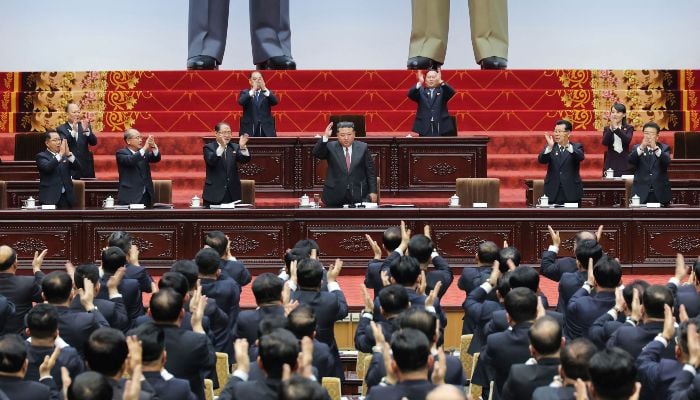
- SPA unanimously re-elects Kim.
- 687 deputies elected to new SPA term.
- 99.93% backing for deputies, 0.07% against.
SEOUL: North Korea’s legislature has re-elected Kim Jong Un as president of state affairs, state media reported on Monday.
Kim’s reappointment as head of the nation’s highest policymaking and governing body, the State Affairs Commission, was announced by the state news agency KCNA.
Critics argue that elections in North Korea are pre-determined and designed to give the country’s leadership a veneer of democratic legitimacy.
“The Supreme People’s Assembly of the DPRK reelected Comrade Kim Jong Un as President of the State Affairs of the Democratic People’s Republic of Korea at the First Session, the first state affairs activity of its 15th term, on March 22,” KCNA reported.
The report said the decision to re-elect Kim to the “top post” reflected “the unanimous will and desire of all the Korean people”.
Kim is the third-generation ruler of the nuclear-armed state founded by his grandfather Kim Il Sung in 1948. He has ruled the country since his father’s death in 2011.
The election is a “highly choreographed event with a pre-determined outcome”, said Lee Ho-ryung of the Korea Institute for Defence Analyses.
“Throughout the third-generation rule, the North has staged such events to showcase a procedure in an attempt to achieve political legitimacy,” she said.
“But no one thinks any different outcome would emerge from it.”
Photos released by KCNA show Kim dressed in a formal western suit and seated at the centre of a stage, flanked by top officials in front of two giant statues of his father Kim Jong Il and grandfather.
Barometer
Prior to the event, 687 deputies were elected to the SPA, with North Koreans over 17 given the choice of approving or rejecting the sole candidate put forward by the ruling party.
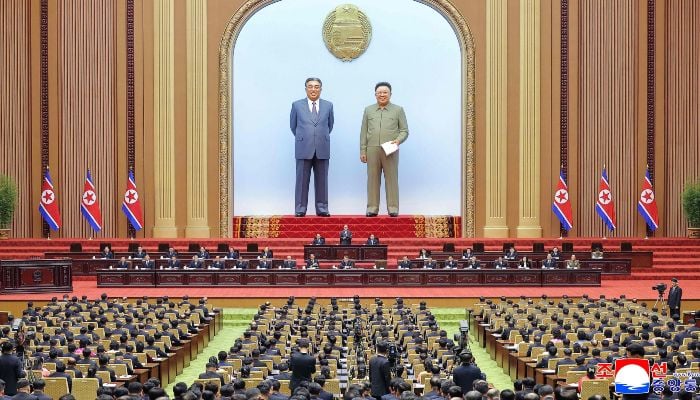
The new deputies were duly approved with 99.93% of votes in favour and 0.07% against, KCNA reported earlier, with turnout at 99.99%.
The Pyongyang assembly hall was “full of the extraordinary political awareness and revolutionary enthusiasm” by the newly elected members, it said.
Analysts say the current assembly session may also take up possible constitutional amendments that could include formally codifying inter-Korean relations as those between “two hostile states”.
The language Kim uses to describe his stance towards South Korea in his assembly speech will be a “barometer” of his inter-Korea plans, Hong Min, a senior analyst at the Korea Institute for National Unification, told AFP.
“The extent to which terms such as ‘national unification’ or ‘Korean unity’ are removed and replaced by aggressive expressions including ‘territorial control’ could serve as a barometer of his ideological framework,” he said.
The key point lies in how far he will “flesh out issues of territory, territorial waters and airspace” in dealing with Seoul, he added.
The gathering follows a five-yearly meeting of the ruling party last month.