
On November 14, 1979 — 10 days after Iranian students seized the US embassy in Tehran — then US president Jimmy Carter signed Executive Order 12170. With a single order, Washington froze roughly $8 billion in Iranian government assets held in the US.
The move was executed through the US Treasury’s Office of Foreign Assets Control — and it marked the beginning of America’s modern sanctions war against Iran.
Citibank, Chase Manhattan, Bank of America, HSBC, Standard Chartered, BNP Paribas, Deutsche Bank, Commerzbank, Credit Suisse and Barclays — along with Shell, Total, ENI, Siemens, General Electric and Boeing — all walked away from Iran as sanctions tightened. One by one, the world’s largest banks, energy companies and industrial giants walked away from Iran, leaving the country financially alone.
Iran needed to convert oil revenues into usable foreign currency. Iran needed to pay for weapons components and missile electronics sourced through global procurement networks. Iran needed to fund proxy operations from Hezbollah to the Houthis. Iran needed to maintain clandestine banking channels to move money across borders.
Iran needed front companies and shadow traders to sell oil despite sanctions. Iran needed drones and cash across Iraq, Syria and Lebanon. In short, Iran did not just need oil revenue, it needed a global sanctions-evasion architecture to turn oil into power.
Red alert: For 47 years, that architecture had an address: Dubai — a neutral trading hub where money was welcome even when its origins were complicated.
For 20 years, the US Treasury tried to close the Iran-Dubai connection and never fully succeeded — not for lack of effort, but because the UAE, for its own sovereign economic reasons, consistently declined to cooperate.
On February 28, 2026, Iran launched ballistic missiles, drone attacks and cruise missiles against the UAE.
Why did Iran attack its own financial pipeline? Perhaps regime survival simply overrode economic logic. Perhaps the relationship was already poisoned; the UAE had been quietly coordinating with Israel since the Abraham Accords of 2020.
Or perhaps the most unsettling explanation is institutional: that the IRGC — a parallel state within a state, with its own enemies list, and its own logic — had simply stopped making decisions in Iran’s national interest. The missile commands didn’t consult a cabinet — they consulted their own calculus.
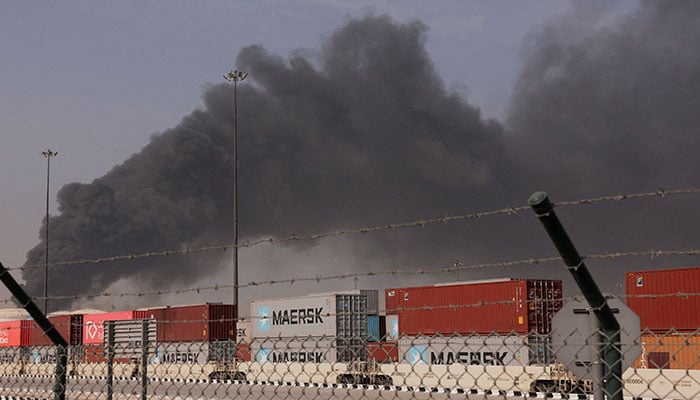
Between February 28 and March 4, Iran fired 189 ballistic missiles, 941 drones and three cruise missiles at the UAE — 1,133 projectiles in six days.
Red alert: According to The Wall Street Journal, the UAE is considering cutting off Iranian access to billions of dollars held in the Gulf state.
Imagine this: For 47 years, Iran built a financial architecture in Dubai that the US Treasury could never fully dismantle. Now, after more than a thousand missiles and drones, Dubai may do in a single decision what Washington spent two decades trying to achieve.
Iran did not just fire at a city. It may have fired at its own financial pipeline. And in doing so, it may have finally convinced its last banker to pull the plug.
The writer is an Islamabad-based columnist.
Disclaimer: The viewpoints expressed in this piece are the writer’s own and don’t necessarily reflect Geo.tv’s editorial policy.
Originally published in The News