

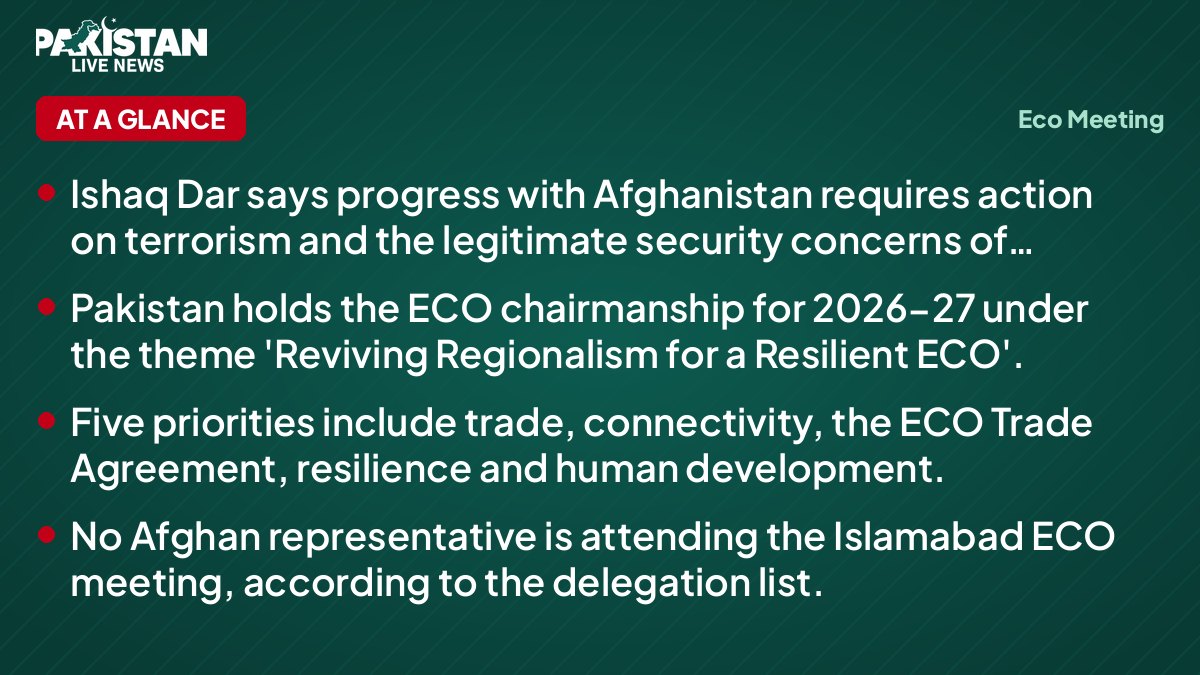
- Ishaq Dar says progress with Afghanistan requires action on terrorism and the legitimate security concerns of neighbours.
- Pakistan holds the ECO chairmanship for 2026-27 under the theme 'Reviving Regionalism for a Resilient ECO'.
- Five priorities include trade, connectivity, the ECO Trade Agreement, resilience and human development.
- No Afghan representative is attending the Islamabad ECO meeting, according to the delegation list.
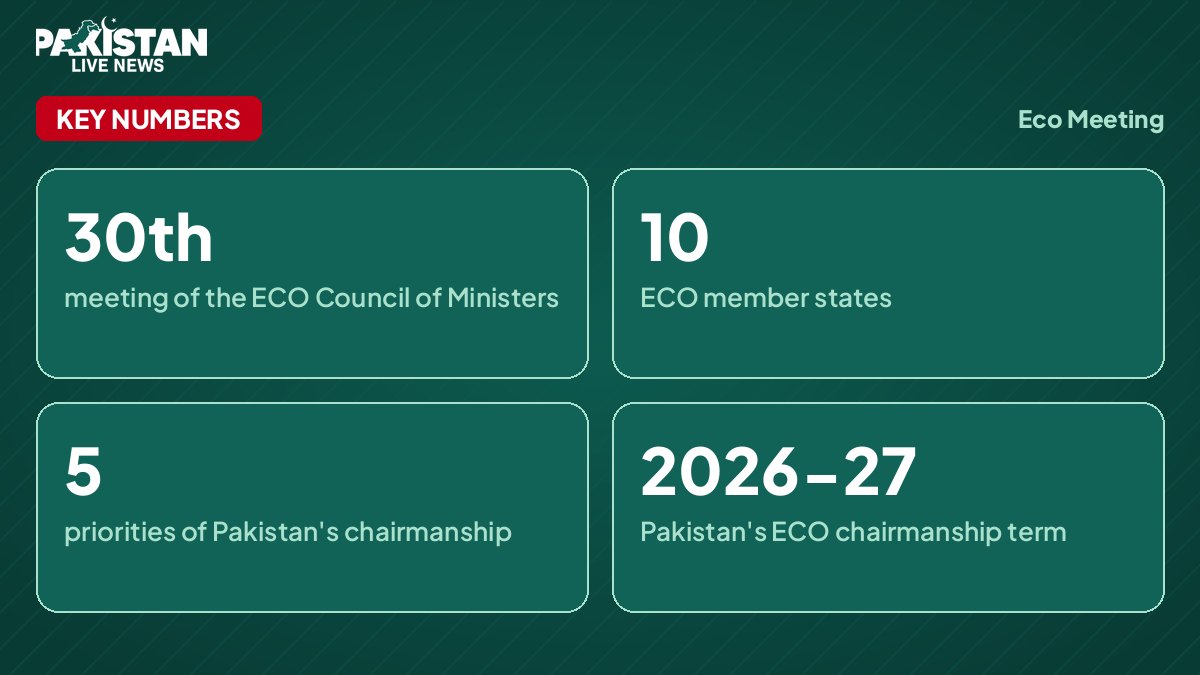
At the ECO meeting in Islamabad on Monday, Deputy Prime Minister and Foreign Minister Ishaq Dar said Pakistan wants a peaceful, prosperous and stable Afghanistan within the Economic Cooperation Organisation (ECO), but lasting progress depends on Kabul addressing the security worries of its neighbours. He was speaking at the 30th ECO Council of Ministers meeting.
In this article
Dar said a secure and stable environment was essential for sustained regional economic partnerships. He added that this consideration remained central to Pakistan's wider connectivity agenda. The ECO meeting is being hosted by Pakistan under its 2026-27 chairmanship.
Afghanistan and security at the ECO meeting
Dar said an Afghanistan at peace with itself and all its neighbours, and fully integrated into the ECO framework, would benefit both the Afghan people and the wider region. Such a country, he noted, would open up avenues for trade, transit and economic cooperation.
He linked that prospect directly to action against terrorism. He also spoke of trust between states and the honouring of international commitments. Unresolved disputes and unmet international obligations, he warned, can erode that trust and hold back economic progress. His remarks on Afghanistan at the ECO meeting therefore tied regional cooperation to action on terrorism.
The foreign minister stressed that respect for international law and treaties is essential to enduring economic partnerships. According to the delegation list shared by the Foreign Office, no one from Afghanistan, an ECO member, is attending the ECO meeting.
At the same time, meaningful progress requires the Afghan authorities to address the legitimate security concerns of the neighbouring countries, particularly the threat of terrorism.
Ishaq Dar, Deputy Prime Minister and Foreign Minister
Five priorities Pakistan set at the ECO meeting
Pakistan holds the ECO chairmanship for 2026-27 and is hosting the ECO meeting under the theme "Reviving Regionalism for a Resilient ECO". Dar named five areas of focus: expanding trade and investment, strengthening regional connectivity, advancing the ECO Trade Agreement, building regional resilience and promoting human development.
On trade, he said Pakistan would work for wider market access, stronger regional value chains and more private sector participation, particularly by small and medium-sized enterprises. On connectivity, Pakistan would seek better transport and transit links between Central Asia, South Asia and its Arabian Sea ports. He said harmonised customs procedures, efficient border management and predictable transit arrangements were essential for commercially viable trade routes.
Dar said the negotiating strategy and roadmap approved by ECO trade ministers in November 2025 gave a basis for modernising the ECO Trade Agreement. Pakistan would back a more effective, inclusive and digitally enabled regional trade framework, he added.
At the ECO meeting, he also called for closer cooperation on disaster preparedness, early warning systems, sustainable water management and climate-resilient infrastructure. On human development, he pointed to education, research, innovation and vocational training.
| Country | Representative |
|---|---|
| Iran | Foreign Minister Abbas Araghchi |
| Tajikistan | Foreign Minister Sirojiddin Muhriddin |
| Turkmenistan | Foreign Minister Rashid Meredov |
| Azerbaijan | Deputy Foreign Minister Elnur Mammadov |
| Turkiye | Deputy Minister of Foreign Affairs Musa Kulaklikaya |
| Kazakhstan | Deputy Foreign Minister Arman Issagaliyev |
| Kyrgyz Republic | Deputy Foreign Minister Kairat Tursunkulov |
| Uzbekistan | Deputy Foreign Minister Babor Usmanov Masudovich |
Peace and diplomacy at the ECO meeting
Dar said peace and development reinforce each other, and that Pakistan remained deeply concerned about conflict and instability in the region. He said Pakistan has consistently advocated resolving disputes peacefully through dialogue and diplomacy, in line with international law and the United Nations Charter.
Referring to Pakistan's diplomatic efforts in the war on Iran, he said Islamabad would continue them in support of dialogue, de-escalation and lasting regional stability. He added that Prime Minister Shehbaz Sharif and Field Marshal Asim Munir, the Chief of Defence Forces and Chief of the Army Staff, remained closely engaged with partner countries to facilitate peaceful outcomes.
Dar reaffirmed Pakistan's commitment to the ECO Charter and described Pakistan as a founding member of the organisation. He said regional cooperation should be guided by sovereign equality, mutual respect, non-interference and mutual benefit.
Timeline
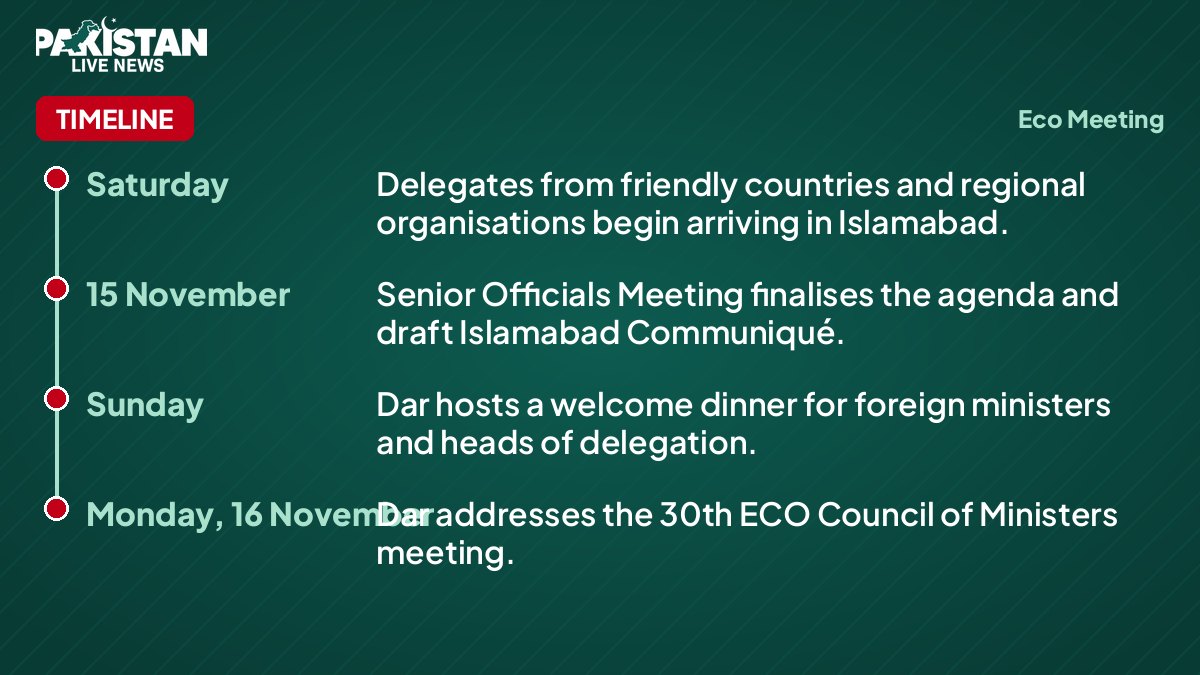
- SaturdayDelegates from friendly countries and regional organisations begin arriving in Islamabad.
- 15 NovemberSenior Officials Meeting finalises the agenda and draft Islamabad Communiqué.
- SundayDar hosts a welcome dinner for foreign ministers and heads of delegation.
- Monday, 16 NovemberDar addresses the 30th ECO Council of Ministers meeting.
Preparations before the ECO meeting
Senior officials met on 15 November under Foreign Secretary Ambassador Asim Iftikhar Ahmad and finalised the agenda and the draft Islamabad Communiqué for the ministers to consider. They also reviewed the ECO Secretariat's work during the year, including its programmes, the outcomes of sectoral ministerial meetings and the work of subsidiary bodies. Administrative and financial matters were discussed as well, with a view to improving the organisation's effectiveness.
On the sidelines of the ECO meeting, Dar met ECO Secretary General Dr Asad Majeed Khan and reaffirmed Pakistan's commitment to hosting the ECO Summit in 2027. He also met the Secretary General of the Organisation of Islamic Cooperation, Ismail Ould Cheikh Ahmed, on his first visit to Islamabad since taking office. Dar pledged Pakistan's continued support for the OIC as a unified and effective voice of the Muslim Ummah.
Background: what the ECO meeting involves
The 30th ECO Council of Ministers meeting is being held in Islamabad, with Pakistan in the chair for 2026-27. The organisation has 10 member states, and Dar described Pakistan as a founding member. Afghanistan is an ECO member, but the delegation list shows no Afghan representative at the ECO meeting.
Ministers at the ECO meeting are expected to consider the draft Islamabad Communiqué, which senior officials finalised on 15 November. Dar also said the negotiating strategy and roadmap approved by ECO trade ministers in November 2025 gave a basis for modernising the ECO Trade Agreement. Pakistan will host the ECO Summit in 2027.
The ministers are expected to consider the draft Islamabad Communiqué finalised by senior officials. Pakistan, as ECO chair, will host the ECO Summit in 2027.
Questions and answers on the ECO meeting
What did Ishaq Dar say about Afghanistan at the ECO meeting?
He said Pakistan wants a peaceful, prosperous and stable Afghanistan integrated into the ECO framework. He added that meaningful progress requires the Afghan authorities to address neighbours' legitimate security concerns, particularly terrorism.
What are Pakistan's priorities as ECO chair?
Pakistan has named five: expanding trade and investment, strengthening regional connectivity, advancing the ECO Trade Agreement, building regional resilience and promoting human development.
How long does Pakistan hold the ECO chairmanship?
Pakistan holds the chairmanship for 2026-27 and is hosting the 30th Council of Ministers meeting under the theme 'Reviving Regionalism for a Resilient ECO'.
Who is attending the ECO meeting in Islamabad?
Delegations include Iran's Foreign Minister Abbas Araghchi, Tajikistan's Foreign Minister Sirojiddin Muhriddin and Turkmenistan's Foreign Minister Rashid Meredov. Deputy foreign ministers are attending from Azerbaijan, Kazakhstan, the Kyrgyz Republic and Uzbekistan, and Turkiye is represented by Deputy Minister of Foreign Affairs Musa Kulaklikaya. According to the delegation list, no one from Afghanistan is attending.
What did senior officials finalise on 15 November?
Senior officials, under Foreign Secretary Ambassador Asim Iftikhar Ahmad, finalised the agenda and the draft Islamabad Communiqué. They also reviewed the ECO Secretariat's work during the year and discussed administrative and financial matters.
Whom did Dar meet on the sidelines?
Dar met ECO Secretary General Dr Asad Majeed Khan and reaffirmed Pakistan's commitment to hosting the ECO Summit in 2027. He also met Organisation of Islamic Cooperation Secretary General Ismail Ould Cheikh Ahmed, on his first visit to Islamabad since taking office.


