
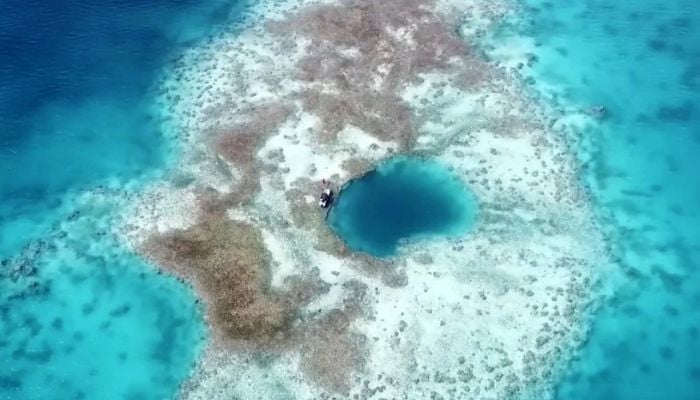
A rare coral reef blue hole discovered in South China Sea. The Ministry of Ecology and Environment of People’s Republic of China has released a survey report confirming this new discovery.
The newly discovered sea-blue hole seems like a large natural depression on the ocean floor, identified in the waters off Huangyan Island.
Located in the lagoon of Huangyan Island also known as Scarborough Shoal, this formation is the first of its kind identified in China.
According to a report released on Thursday, it has emerged as a biodiversity hot spot. Environmental DNA technology has helped scientists detect more than 2,700 marine species in and around the blue hole.
It was first spotted by a scientific observation team in August last year in the central area of a lagoon, said the 2025
Based on their genesis, these underwater sinkholes can be categorized into two types — one formed through limestone dissolution and the other formed by coral reefs, with the latter considered a rare phenomenon worldwide.
Preliminary geochronological studies suggest that the Huangyan blue hole formed at least 3,200 years ago and developed in a high-density patch reef area within the lagoon, the report said.
The sinkhole is shaped like a funnel, with a surface diameter of 56.3 meters and a depth of 16.6 meters. The surface area of the blue hole is 1,491.7 square meters.
Field surveys in the surrounding waters over the past two years have recorded 165 species of hard corals, belonging to 14 families and 44 genera, and 184 species of fish, belonging to 27 families and 85 genera.
Typical coral reef biological communities are thriving inside the blue hole including different species of sponges, fish, giant clams, and sea anemones.
The green sea turtle, which is a Class I protected wildlife species in China, has been observed inhabiting the blue hole and its surrounding waters.
The report said this coral reef blue hole serves as a vivid testament to the natural ecosystem diversity of Huangyan Island and a key geological archive for reconstructing paleo environmental changes in the South China Sea, including sea-level fluctuations and the impacts of global and regional climate change.
The blue hole can provide critical insights into the geological evolution of the Huangyan region, as well as biodiversity and environmental changes in the South China Sea since the Holocene epoch, it said.
Additionally, the sinkhole offers essential scientific support for understanding the formation, evolutionary mechanisms and ecological effects of this unique marine ecosystem, the report added.
Pei Xiaofei, a spokesman for the Ministry of Ecology and Environment, said the results of the survey highlight the progress China has made in its ecological protection efforts in the surrounding waters of the island, which is firmly underpinned by the establishment of the Huangyan Island national nature reserve in September 2025.
The ministry will conduct “more in-depth, systematic and comprehensive research” on the blue hole to provide scientific support for further enhancing ecosystem and biodiversity conservation in the South China Sea, Pei added.
Preliminary geochronological studies estimate it formed at least 3,200 years ago.
Unlike many blue holes that form through limestone dissolution, this one was created by the long-term growth of coral reefs.