
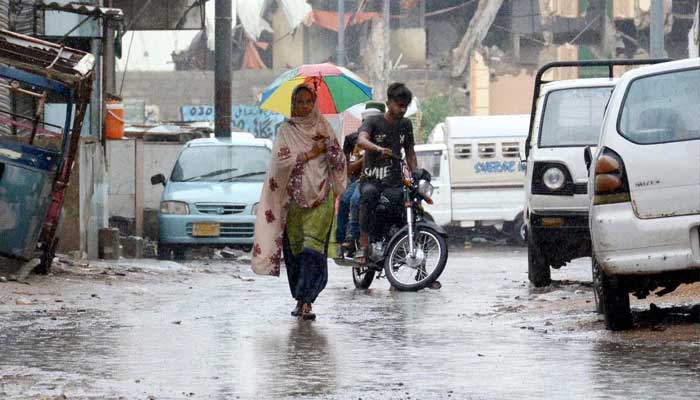
- PMD says Balochistan to hit with rain, isolated hail.
- KP hills to see snowfall; thunderstorms in multiple districts.
- Travellers advised to plan Eid journeys with weather in mind.
A westerly weather system is expected to trigger widespread rain across Pakistan from March 17 to 20, with Karachi and other parts of Sindh to receive downpours during the Eid ul Fitr holiday period, according to the Pakistan Meteorological Department (PMD).
The PMD has issued a detailed weather advisory indicating that widespread rain, breezy conditions, and occasional thundery spells are expected to move across much of the country from the evening of March 17.
While the weather will be notably active, authorities are keeping a close watch and have shared timely guidance to help everyone stay safe and prepared.
The weather change is being driven by a westerly wave, which is a naturally occurring seasonal weather system that is forecast to enter the western parts of the country on the evening or night of March 17.
It is expected to spread gradually across most of Pakistan by March 18 and ease off by March 20, bringing with it a refreshing but unsettled few days.
Balochistan will be among the first regions to experience the weather change, with rainy and breezy conditions accompanied by occasional thunderstorms and isolated hail expected in Quetta, Ziarat, Chaman, Pishin, Qilla Abdullah, Qilla Saifullah, Zhob, Kalat, Khuzdar, Kech, Gwadar, Panjgur and Awaran, as well as surrounding areas.
The spells are forecast from the evening of March 17 through the morning of March 20, with intermittent breaks.
Sindh will see its share of rainy and cloudy weather with occasional thunder on March 18 and 19, covering Karachi, Hyderabad, Larkana, Sukkur, Jacobabad, Mirpurkhas, Badin, Thatta, and several other districts.
Khyber Pakhtunkhwa will see rainy and breezy weather with thundery intervals and snowfall over the higher hills across a wide area including Chitral, Dir, Swat, Kalam, Peshawar, Abbottabad, Mansehra, Kohat, Bannu, Dera Ismail Khan, Waziristan, and many neighbouring districts. Isolated hail is possible at a few places during this time.
Across Punjab and Islamabad, the capital region, along with Rawalpindi, Lahore, Faisalabad, Gujranwala, Sialkot, Sargodha, Sahiwal, and a number of other cities and towns, can expect rainy, breezy spells with isolated hail from the night of March 17 through the morning of March 20.
Southern Punjab, including Multan, Bahawalpur, Dera Ghazi Khan, and Rahim Yar Khan, is expected to receive similar conditions on March 18th and 19.
Gilgit Baltistan and Azad Kashmir will also experience rainy and cloudy weather with thundery spells and snowfall over higher elevations.
The areas including Hunza, Gilgit, Skardu, Diamir, Muzaffarabad, Neelum Valley, Poonch, Mirpur, and Kotli are included in the forecast from the evening of March 17 onward, with a few heavier spells possible, particularly over Kashmir.
The Met Office has highlighted a few areas worth keeping in mind during this period. People in hilly areas of Khyber Pakhtunkhwa, Gilgit-Baltistan, and Kashmir should be mindful of the possibility of landslides on slopes and mountain roads.
Lightning can occur at isolated places during thundery spells, so staying indoors during heavy rain is a sensible precaution.
The farmers are encouraged to look after their crops in light of the breezy and rainy conditions, as hail at isolated spots could affect standing crops in some areas.
The daytime temperatures will feel cooler than usual across the country during this period.
Travellers and tourists are advised to plan their Eid journeys with the weather in mind, stay updated on road conditions, and avoid unnecessary travel during the heaviest spells.
All relevant government departments have been alerted and are taking the necessary steps to ensure public safety throughout the forecast window.