
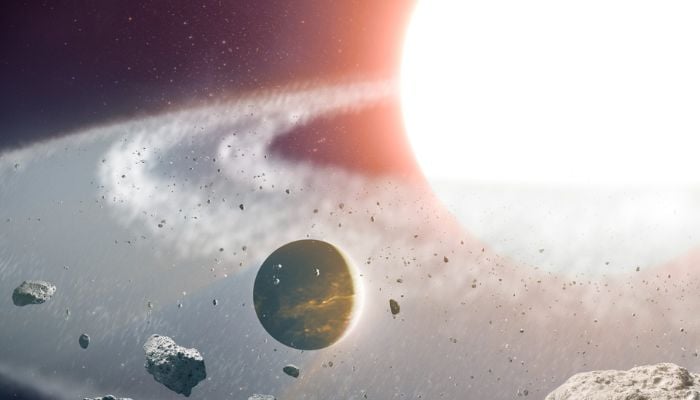
Chinese astronomers identified three Jupiter-like planets orbiting ageing red giant stars that survived after their host stars expanded and shrank back.
The discovery led by Qian Shengbang’s team from Yunnan University holds significance as previously planets who were in such close orbits were believed to be either swallowed or dragged in by gravity. And finding these surviving planets suggest this is not a fluke, highlighting a broader underlying physics.
Qian said that “once a star burns through the hydrogen in its core and expands, any nearby planet is in trouble. It’s either swallowed by the star’s bloated atmosphere, or slowly dragged in by its gravity until it crashes,”
“If we had found just one surviving planet, you could put it down to chance. But finding three of these ‘lucky ones’ at once tells us this is no fluke, and some common physics may be at work,” Qian added.
Here lies the connection with the survival of Earth after the Sun’s death. Conventional models predict Earth will be engulfed when the sun becomes a red giant in ~5 billion years.
“But our study suggests that the long-term fate of the solar system, including the Earth humans depend on, may be far more complicated than predicted.”
Scientists suspect these planets survived either because their host stars merged or interacted with partner stars aimed at preventing maximum expansion or because absorbed inner planets reshuffled the remaining planetary orbits. The team said both ideas had yet to be tested.