
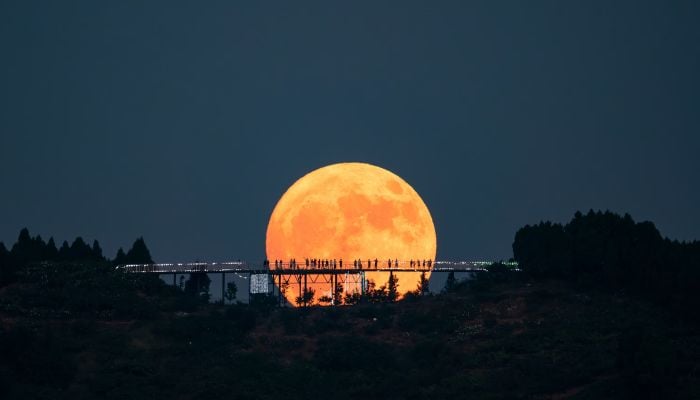
October’s Hunter’s Moon has graced skies around the world with its brightness this week. However, this is not the last full moon of 2026. In November, sky watchers can experience the moon’s maximum illumination.
November’s full moon is traditionally known as the Beaver Moon and originates from Native American and early Colonial traditions.
November was traditionally the time of year when beavers finished building their winter dams and retreated into their lodges ahead of the deep freeze. According to the Old Farmer’s Almanac, this moon also rose around the time when small mammals took shelter in their dens to survive the long winters.
Speaking about the peak time, the full moon will reach its maximum illumination at 9:53 a.m. EST on November 24. During this time the lunar disk sits opposite the sun in Earth’s sky, appearing fully brightened by its rays.
Because the exact moment happens during daylight in the US, viewers in America will get their best look at the near-full Beaver Moon heading toward the western horizon in the predawn hours of November 23, while appearing fully lit on both the evenings of November 23-24.
And the most interesting thing is that November’s Beaver Moon will be the first of three consecutive supermoons.
Supermoon phenomenon occur when the moon is within “90 percent of perigee when it is the closest to Earth in its elliptical orbit.” Owing to this proximity the moon will appear 14 percent larger and 30 percent brighter than the other full moons of 2026 like Hunter Moon.
To enjoy the better viewing, use a tripod and remote shutter time to avoid camera wobble. For landscape photography use a 12-50mm lens and if you want to take lunar surface shots use a 400mm lens. Utilize stargazing apps like Stellarium or SkySafari 7 Pro to track exact local moonrise and moonset times.