
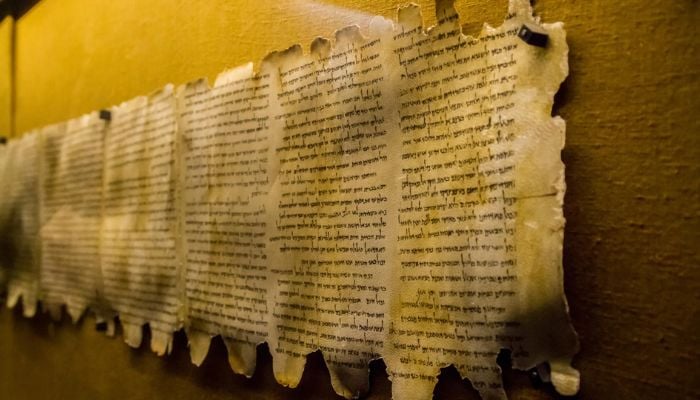
A calendar built on exactly 364 days sounds like a minor curiosity until you realise it may have helped drive one of the most significant religious splits in ancient Judea.
A new 2026 study from Tel Aviv University argues the Qumran sect, the community linked to the Dead Sea Scrolls, didn’t just theorise about its distinctive calendar. It actually used it for a while.
The scholarly opinions have always been divided on this issue, some stating that the sect occasionally included extra days/weeks to make sure that the 364-day calendar remained synchronised with the seasons.
Others have held that it was a symbolic calendar only, which did not ever rule real religion. Prof. Eshbal Ratzon from the Department of Jewish Philosophy at Tel Aviv University writes in the Tarbiz Quarterly for Jewish Studies that the Dead Sea Scrolls do not support any of the above views conclusively.
Why 364 days mattered so much?
The number wasn’t arbitrary. Divisible evenly by seven, it produced exactly 52 weeks a year, meaning every festival landed on the same weekday, always.
For the Qumran sect, that mathematical tidiness reflected what they saw as a divinely fixed order, set at Creation and not subject to human revision, a direct challenge to the Jerusalem establishment’s authority to set the religious calendar.
The elegance also had its own inherent flaw. A 364-day year is short by about a quarter-day from the true solar year, which builds up in much the same way as a clock that loses a minute every day.
Allowing this flaw to go unchecked for two decades would make the festivals of planting and harvest be off by almost a month at one point, eventually putting them into the wrong seasons altogether for a people concerned with agriculture.
According to Ratzon, however, the abandonment of the calendar had more to do with politics than astronomy.
Alexander Jannaeus was not only a ruler but also an ally of the Essenes because he became religiously aligned with their beliefs against the Pharisees.
Nearly 20 scrolls found at Qumran deal with calendrical and astronomical questions, and the Book of Jubilees, a central text in the community’s library, frames the 364-day system as the original calendar given to Moses at Sinai, evidence Ratzon reads as proof the system never fully left the sect’s religious imagination even after it stopped being used day to day.