
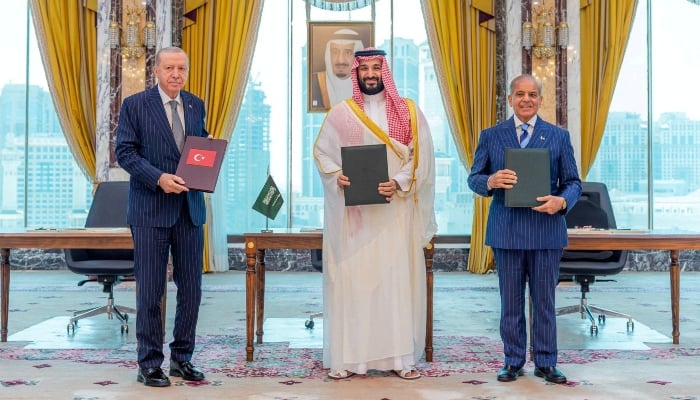
ISLAMABAD: The trilateral defence pact signed by Pakistan, Saudi Arabia and Turkiye in Makkah is being hailed as a landmark security arrangement, but its biggest dividend may ultimately be economic rather than military.
Coming at a time when Pakistan is striving to revive economic growth, attract foreign investment, expand exports and strengthen energy security, the agreement has raised expectations that closer strategic cooperation could unlock billions of dollars in investment, deepen trade and accelerate industrial collaboration among the three countries, according to The News on Saturday. The economic potential of the partnership is difficult to ignore. Together, Pakistan, Saudi Arabia and Turkiye represent an economic bloc worth more than $3 trillion.
Turkiye’s economy is valued at around $1.4 trillion, Saudi Arabia’s at nearly $1.28 trillion, while Pakistan’s economy stands at approximately $410-420 billion. Collectively, the three countries account for a market of nearly 380 million people, stretching from the Gulf to South Asia and connecting Europe, Central Asia and the Middle East. Economists say such economic weight provides a strong foundation for regional integration if security cooperation is followed by trade liberalisation, investment and industrial partnerships.
Despite decades of close diplomatic and defence relations, commercial engagement among the three countries remains well below its potential. Pakistan’s annual trade with Saudi Arabia is estimated at around $4-5 billion, while bilateral trade with Turkiye stands at only $1.3-1.5 billion. By comparison, trade between Saudi Arabia and Turkiye has already exceeded $8.5 billion, with both governments targeting $10 billion in the near term and $30 billion over the longer term. Analysts say these figures underline the enormous scope for Pakistan to expand its economic ties with both countries.
Signs that strategic cooperation is already spilling over into economic engagement are beginning to emerge. Pakistan is seeking a $6.7 billion concessional oil financing facility from Saudi Arabia for a period of 15 years, including a five-year grace period, at a proposed interest rate of 1%. Officials at the Ministry of Economic Affairs have confirmed that discussions are underway between Islamabad and Riyadh. If approved, the facility would significantly strengthen Pakistan’s energy security while easing pressure on the country’s foreign exchange reserves amid volatile global oil prices. It would replace the previous Saudi deferred oil payment arrangement under which Pakistan received $1.2 billion in financing at an interest rate of around 6%, an agreement that expired earlier this year. Economists view the negotiations as one of the earliest economic manifestations of the growing strategic trust between the two countries.
Saudi Arabia has already positioned itself as one of Pakistan’s most significant prospective investors. Through the Special Investment Facilitation Council (SIFC), Riyadh has announced plans to invest up to $10 billion in Pakistan across mining, oil refining, petrochemicals, renewable energy, agriculture, food security, logistics, tourism, ports, industrial zones, healthcare and digital infrastructure. Among the flagship projects under discussion are Saudi participation in the Reko Diq copper and gold project, development of an oil refinery and petrochemical complex, renewable energy ventures and large-scale logistics infrastructure. Analysts believe the Makkah pact could accelerate these projects by strengthening investor confidence and reducing strategic uncertainty.
Turkiye, meanwhile, is expected to complement Saudi Arabia’s financial strength with industrial expertise and advanced manufacturing capabilities. Turkish companies have already invested more than $2 billion in Pakistan and completed dozens of projects in construction, transport, municipal services and infrastructure over the past two decades. Pakistani businesses have also expanded into Turkiye in sectors including information technology, manufacturing, hospitality, trade and real estate. Industry experts believe the new strategic framework could encourage further Turkish investment in defence manufacturing, aerospace, engineering, renewable energy, industrial machinery, railways, urban transport, healthcare technologies, information technology, food processing and automotive engineering.
There are already indications that Turkish investment is gathering momentum. The Turkish Petroleum Overseas Company (TPOC) recently signed five Petroleum Concession Agreements (PCAs) — three offshore and two onshore blocks — marking its formal entry into Pakistan’s upstream oil and gas sector. The exploration programme, being undertaken in partnership with leading Pakistani exploration and production companies, is expected to generate around $300 million in investment.
As operator of the offshore Indus Block-C, TPOC is expected to deploy two seismic survey vessels later this year to begin exploration activities. At the same time, Turkish investors are increasingly looking beyond hydrocarbons. Several Turkish companies have expressed interest in Pakistan’s privatisation programme, including the proposed acquisition of the Faisalabad Electric Supply Company (FESCO), reflecting Ankara’s growing confidence in Pakistan’s energy and infrastructure sectors.
Among all sectors, defence manufacturing is expected to emerge as one of the biggest beneficiaries of the trilateral partnership. Pakistan and Turkiye already cooperate closely in naval shipbuilding, aerospace and military modernisation, while Saudi Arabia’s Vision 2030 seeks to localise 50% of the Kingdom’s defence procurement.
Defence analysts say the three countries now have an opportunity to combine Saudi investment, Turkish technology and Pakistani manufacturing capabilities to establish joint ventures producing drones, naval vessels, armoured vehicles, electronic warfare systems, ammunition and defence software for both domestic use and export markets. Such cooperation would not only strengthen defence capabilities but also generate skilled employment, attract investment and create new high-value export industries.
The economic opportunities extend well beyond defence. Pakistan could expand exports of textiles and apparel, rice, surgical instruments, sports goods, leather products, pharmaceuticals, engineering goods, halal food products and information technology services to both Saudi Arabia and Turkiye. At the same time, greater access to Turkish machinery and industrial technology, coupled with Saudi investment in mining, energy and infrastructure, could help modernise Pakistan’s manufacturing base and improve the competitiveness of its exports.
Business-to-business (B2B) cooperation has also gathered momentum through investment forums, meetings between chambers of commerce and official business delegations. Pakistani, Saudi and Turkish companies have increasingly explored joint ventures in construction, logistics, renewable energy, mining, agriculture, healthcare, manufacturing, tourism, food processing and digital technologies. Business leaders argue that stronger private-sector partnerships will determine whether the trilateral relationship evolves into a genuine economic alliance or remains largely confined to government-to-government cooperation.
Pakistan’s strategic location provides another compelling economic argument for closer integration. Situated at the crossroads of South Asia, Central Asia, China and the Middle East, the country offers Saudi and Turkish investors access to regional markets through its ports, transport corridors and growing industrial base. Analysts describe the partnership as highly complementary: Saudi Arabia brings sovereign wealth and investment capital, Turkiye contributes advanced manufacturing and engineering expertise, while Pakistan offers strategic geography, a large and youthful workforce and an expanding domestic market.
Even so, economists caution against expecting an immediate investment boom simply because of the defence pact. Foreign investors will continue to assess Pakistan’s macroeconomic stability, regulatory framework, taxation policies, legal protections, energy availability and ease of doing business before making significant commitments. Pakistan also continues to face structural challenges, including policy inconsistency, infrastructure bottlenecks, energy shortages and delays in implementing large investment projects. Unless these issues are addressed, many announced investments could take longer than anticipated to materialise.
Even with those challenges, analysts believe the Makkah pact presents Pakistan with one of its most significant economic opportunities in recent years. If the three countries complement their security cooperation with trade facilitation, investment protection agreements, industrial partnerships, technology transfer and stronger business-to-business collaboration, Pakistan could attract billions of dollars in new foreign investment, diversify its exports and integrate more deeply into regional supply chains.
Ultimately, the success of the Makkah pact will not be measured solely by military cooperation but by whether it succeeds in transforming strategic trust into factories, infrastructure, technology, jobs and sustainable economic growth. If Saudi capital, Turkish technology and Pakistan’s strategic location can effectively align, the trilateral partnership could become one of Pakistan’s most consequential economic relationships in decades.
Originally published in The News