
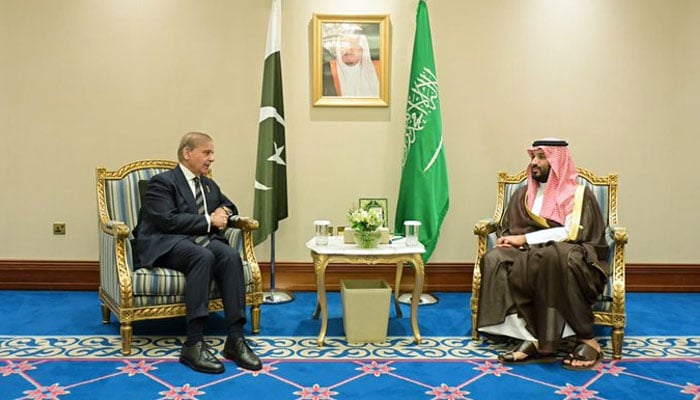
Prime Minister Shehbaz Sharif has reaffirmed Pakistan’s unwavering support for Saudi Arabia, as he told Crown Prince Mohammed bin Salman that Islamabad would stand firmly with the Saudi Kingdom during challenging times and continue working with it for peace in the region.
Pakistan has intensified diplomacy following the Iran war — which was caused by US and Israeli attacks on Iran, killing its supreme leader and plunging the Middle East into conflict — with the PM Shehbaz and DPM/FM Dar speaking to their counterparts in the region as well as in the Gulf nations to play their role in easing the regional tensions.
PM Shehbaz’s remarks came during a restricted meeting between the two leaders in Jeddah, where they discussed recent regional developments and the need for close cooperation to promote stability across the Middle East.
At the start of the meeting, the minister conveyed his respectful regards to the Custodian of the Two Holy Mosques, King Salman bin Abdulaziz Al Saud, and expressed appreciation for Saudi Arabia’s longstanding support for Pakistan.
Senior Pakistani officials, including Deputy Prime Minister and Foreign Minister Mohammad Ishaq Dar and Chief of Army Staff and Chief of Defence Forces Field Marshal Syed Asim Munir, were also present during the meeting.
According to the official handout, the two sides held detailed discussions on the evolving regional situation and agreed to maintain close coordination in efforts aimed at ensuring peace and stability.
“The Prime Minister expressed Pakistan’s full solidarity and support for the Kingdom of Saudi Arabia in these challenging times,” states the PM’s media wing.
Prime Minister Shehbaz Sharif said Pakistan values its longstanding relationship with Saudi Arabia and will continue striving for the shared goal of regional harmony.
“The Prime Minister assured His Royal Highness that Pakistan would always stand firmly with the Kingdom of Saudi Arabia and strive for their mutual desire for peace in the region,” it added.
Middle East tensions
Pakistan has intensified diplomacy following the Iran war — which was caused by US and Israeli attacks on Iran, killing its supreme leader and plunging the Middle East into conflict — with the PM Shehbaz and DPM/FM Dar speaking to their counterparts in the region as well as in the Gulf nations to play their role in easing the regional tensions.
Iran has targeted US bases as well as targets in Gulf nations, including in the United Arab Emirates (UAE) and Saudi Arabia, and has also closed the Strait of Hormuz, which has skyrocketed the price of oil — and warned that the world should be ready for $200 a barrel.
Meanwhile, Chief of Defence Forces Field Marshal Syed Asim Munir and Saudi Defence Minister Prince Khalid bin Salman held a meeting last week in which both sides discussed Iranian attacks on the kingdom within the framework of the joint strategic defence agreement between the two nations.
Pakistan and Saudi Arabia signed the landmark Strategic Mutual Defence Agreement (SMDA) in September last year, which treats an attack on either nation as an act of aggression against both.
In a statement posted on X early Saturday, Khalid bin Salman said the meeting focused on ways to stop the attacks, which he said do not serve the security and stability of the region.
He added that there is hope that the Iranian side will prioritise wisdom and reason and refrain from “wrong calculations”.
Saudi Arabia intercepted two drones headed towards the Shaybah oil field on Thursday, as Iran targets the facility again in its campaign to disrupt global energy markets.
“Two drones heading towards the Shaybah oil field were intercepted and destroyed,” a spokesperson for the country’s defence ministry posted on X.
It came after Saudi Arabia confirmed on Wednesday that it had prevented several drone attacks against the facility, which is crucial to the country’s oil production.
Speaking to Bloomberg TV, Prime Minister’s spokesperson for Foreign Media Mohsarraf Zaidi recently said it is unquestionable that Islamabad will come to Riyadh’s aid “no matter what and no matter when”.
Although Iranian President Masoud Pezeshkian has expressed regret over strikes in regional countries, Tehran has maintained that it will target those sites which are used to launch attacks on its soil.
The PM’s spokesperson Zaidi highlighted that Islamabad and Riyadh have always “operated on the principle of being there for the other”.