
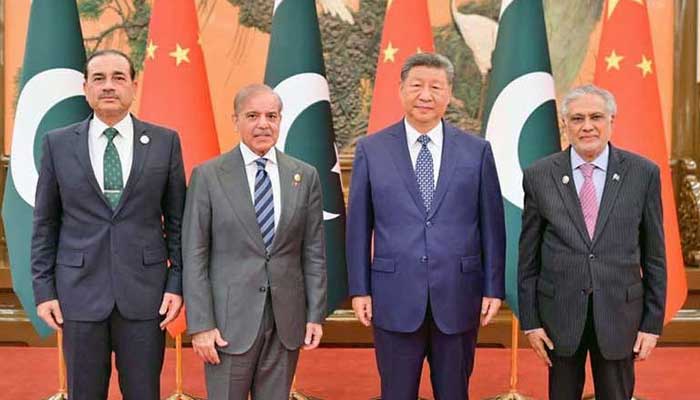
KARACHI: Pakistan and China are marking 75 years of their bilateral relationship. In recent times, we have witnessed some very dramatic events that have the potential to define this relationship in the years to come.
In order to take a peek into the past and the future, I posed some significant questions to the Chinese Consul General in Karachi, Yang Yundong.
In order to preserve the true essence of the conversation, I am writing this interview in question-and-answer format.
Q: How important is this day for both Pakistan and China as they mark the 75th year of their bilateral relationship?
Yang Yundong: May 21, 2026, marks another milestone in the history of China-Pakistan relations. It serves as both an important juncture to review the past and a brand-new starting point to look into the future, carrying extraordinary historical and practical significance.
Over the past 75 years, no matter how the international landscape changed, the China-Pakistan relationship has always remained as rock-solid as ever. This high level of strategic mutual trust, built on the solid foundation of mutual support on each other’s core interests, has become a global paradigm of sincere cooperation between countries with different political systems. Time has proven that the “ironclad” friendship between China and Pakistan is the most valuable historical asset for both countries.
Standing at this new starting point, the two countries have consistently maintained close exchanges and policy coordination. The construction of the China-Pakistan Economic Corridor (CPEC) is accelerating its pace toward high-quality development. Meanwhile, the deepening pragmatic cooperation in fields such as agriculture, science and technology, and people’s livelihood is directly contributing to mutual benefit, win-win outcomes, and Pakistan’s economic revitalisation.
In the face of the current turbulence and transformation in the world, China and Pakistan are committed to strengthening strategic coordination, serving as an anchor of peace, stability, and prosperity in the region.
In conclusion, this milestone moment of the 75th anniversary of diplomatic ties profoundly demonstrates that China-Pakistan friendship not only enjoys a deep historical accumulation but also radiates with vigorous vitality. We will take this as an opportunity to further implement the important common understandings reached by the leaders of the two countries, accelerate the building of an even closer China-Pakistan community with a shared future in the new era, and look forward to seeing our “ironclad” friendship shine even more brilliantly in the new historical period.
Q: Pakistan is highly appreciated by the United States of America and at the same time enjoys a great relationship with China. What is the level of trust between the two countries, and how can it be improved further?
Yang Yundong: The China-Pakistan relationship maintains its independence and autonomy; it does not target any third party, nor is it subject to any third-party interference. We always welcome and are glad to see Pakistan develop normal relations of cooperation with other countries on the basis of mutual respect, equality, and mutual benefit.
Our strategic mutual trust can be described as “rock-solid and resilient against any storms.” Deeply rooted in the close exchanges between the leaders of both sides and the profound friendship between the two peoples, and grounded in the firm mutual support for each other’s core interests and major concerns, this mutual trust is a strategic asset that has stood the test of 75 years of a changing international landscape, possessing unique and irreplaceable qualities.
Standing at the new starting point of the 75th anniversary of diplomatic ties, to further deepen and elevate this high-level mutual trust, we should sustain our efforts in the following three areas:
First, deepening strategic guidance through high-level exchanges. We should continue to maintain high-level interactions between the two countries, deepen strategic communication and coordination on major international and regional issues, and always serve as each other’s most trustworthy reliance in the face of winds and waves.
Second, consolidating the bond of mutual trust through pragmatic cooperation. We should thoroughly implement the important common understandings reached by the leaders of the two countries, build the upgraded version 2.0 of the China-Pakistan Economic Corridor (CPEC) with high quality, and translate our political mutual trust into more tangible outcomes that benefit the people of both nations.
Third, fortifying the safety barrier of cooperation by deepening security collaboration. Security is the prerequisite for development. The two sides need to further deepen counter-terrorism and security cooperation, join hands to address security challenges, and earnestly guarantee the safety of Chinese personnel, projects, and institutions in Pakistan, thereby creating a safe and stable developmental environment for win-win cooperation between our two countries.
Q: Prime Minister Shehbaz Sharif is visiting China to mark this moment. We also see a very close coordination between Deputy PM Ishaq Dar and Chinese Foreign Minister Wang Yi. What steps are expected to be taken during PM’s visit to further strengthen all-weather strategic partnership between the two countries?
Yang Yundong: China and Pakistan are all-weather strategic cooperative partners and “ironclad” brothers. At this important historical moment marking the 75th anniversary of the establishment of diplomatic ties between our two countries, China warmly welcomes Prime Minister Shehbaz’s official visit to China. This visit carries significant milestones for China-Pakistan relations, serving as a crucial link between past achievements and future progress.
China stands ready to work with Pakistan to take this visit as an opportunity to further implement the important common understandings reached by the leaders of the two countries, close high-level exchanges, deepen strategic communication, and firmly support each other on issues concerning our respective core interests and major concerns.
We will always view and advance China-Pakistan relations from a strategic height and long-term perspective. We will thoroughly implement the action plan between China and Pakistan on building an even closer China-Pakistan community with a shared future in the new era (2025-2029), and comprehensively deepen pragmatic cooperation and security collaboration across all fields. By doing so, we will push the building of an even closer China-Pakistan community with a shared future in the new era to break waves and sail steady and far, creating greater well-being for the two peoples and injecting more stability into regional peace and prosperity.
Q: This anniversary also comes at a time when Pakistan is celebrating a victory in Marka-e-Haq against India. No doubt, it was thanks to the military cooperation with China. How can Beijing further help Islamabad in modern battlefield technologies like aerospace and others?
Yang Yundong: China has always respected and firmly supported Pakistan’s efforts to safeguard its national sovereignty, independence, and territorial integrity, and appreciates the cornerstone role played by the Pakistani military in maintaining national security and stability.
Regarding China-Pakistan defence collaboration and future cutting-edge technological cooperation, I would like to emphasise the following three points:
First, China-Pakistan defence cooperation is always defensive in nature. As all-weather strategic cooperative partners, defence cooperation between China and Pakistan is an important manifestation of the high-level of strategic mutual trust between the two countries. This cooperation has always been built on the basis of mutual respect, equality, and mutual benefit; it does not target any third party, and its fundamental purpose is to safeguard the national security of both countries as well as regional peace and stability.
Second, the two sides are steadily advancing exchanges and cooperation in the fields of science, technology, and space. China and Pakistan have maintained normal exchanges in scientific and technological innovation as well as the space sector. In the future, we will continue to deepen normal cooperation based on the actual development needs of both sides, focusing on areas such as the peaceful use of outer space and technical capacity building. This will align with the trends of modernisation and steadily enhance the scientific and technological components of our traditional cooperation.
Third, joining hands to build stronger regional security safeguards. In the face of an increasingly complex international and regional security landscape, China stands ready to work with Pakistan to continue deepening law enforcement and security cooperation, constantly improve the capability to jointly respond to diversified security challenges, and provide a solid guarantee for the modernisation drive of both countries as well as the long-term peace and stability of the region.
Q: What is the current status of CPEC 2.0? It is expected to focus on high-quality industrialisation, agricultural modernisation, technological innovation, green development and improved livelihood of people of Pakistan. What are the roadblocks, and when will a common citizen start reaping benefits?
Yang Yundong: The China-Pakistan Economic Corridor (CPEC) is not only a flagship project of the Belt and Road Initiative (BRI) but also an important carrier for building an even closer China-Pakistan community with a shared future in the new era. Since its implementation more than a decade ago, CPEC has brought approximately 25.9 billion US dollars in direct investment, 260,000 direct jobs, 510 kilometres of highways, over 8,000 megawatts of electricity, and 886 kilometres of core transmission grid to Pakistan, making outstanding contributions to Pakistan’s economic and social development as well as the well-being of its people.
At present, both China and Pakistan are working together with all-out efforts to deepen the alignment between CPEC’s “Five Corridors” (the Growth Corridor, the Livelihood Corridor, the Innovation Corridor, the Green Corridor, and the Open Corridor) and Pakistan’s “5Es” development framework. We are fully utilising the achievements of CPEC in energy, infrastructure construction, and other fields, while vigorously promoting cooperation in agriculture, industry, mining, and the facilitation of people-to-people exchanges, so that the corridor construction can bring greater benefits to the Pakistani people.
Admittedly, while achieving tremendous successes, CPEC does face certain challenges that require joint efforts from both sides to overcome, the most concerning of which is the challenge of the security situation. China and Pakistan should further strengthen bilateral and multilateral counter-terrorism cooperation, enhance cooperation on counter-terrorism capacity building, and implement targeted reinforcement of security measures and security cooperation, to ensure the safety of Chinese personnel, projects, and institutions in Pakistan.
China has the confidence and capability to work hand in hand with Pakistan to leap over current challenges, push the construction of CPEC toward even greater achievements, and ensure that the fruits of CPEC Phase 2.0 can better benefit the entire Pakistani nation.
Q: Over these years, we have also witnessed a rise in people-to-people contacts. How China can help ordinary Pakistanis who intend to learn AI. Are there any programmes being planned for schools, colleges or universities?
Yang Yundong: China-Pakistan educational cooperation enjoys deep historical roots and a solid practical foundation. China actively supports the development of Pakistan’s education sector. Through expanding scholarship programmes, encouraging joint school-running, strengthening vocational skills training, and promoting the “Luban Workshop,” China aims to cultivate more professionals for Pakistan who meet its developmental needs, effectively transforming its “population scale” into “human capital.”
The action plan between China and Pakistan on building an even closer China-Pakistan Community with a shared future in the new era specifically highlights the need to deepen exchanges and cooperation in the information technology industry through the construction of the innovation corridor, encourage enterprises of both countries to create high-quality projects in fields such as artificial intelligence, strengthen exchanges between educational and scientific research institutions, and carry out digital talent training.
The cooperation between China and Pakistan in the field of artificial intelligence enjoys bright prospects. We stand ready to work with the Pakistani side to well implement the common understandings reached by the leaders of the two countries, strengthen cooperation in the field of artificial intelligence, support Pakistan in developing artificial intelligence technologies and services in light of its national conditions, and promote the inclusive and beneficial development of artificial intelligence.
Q: Pakistan and China are marking this day at a time when another neighbour, Iran, is facing renewed threats by the United States of America. During his recent visit to Beijing, President Trump said that China has offered help in opening up the Strait of Hormuz. How does China see Islamabad’s role as a mediator and what Beijing can add to avert another devastating war in the region?
Yang Yundong: China’s position on the situation in Iran is crystal clear. This conflict has severely damaged the common interests of the international community, impacted the stable development of the world economy, and disrupted the global energy supply order. China has always maintained that peaceful dialogue is the only right path and that there is no way out through the use of force.
Since the outbreak of the conflict, President Xi Jinping has solemnly put forward a four-point proposal to maintain and promote peace and stability in the Middle East, and China and Pakistan have jointly proposed a five-initiative proposal on restoring peace and stability to the Gulf and the Middle East regions. Guided by the spirit of President Xi Jinping’s four-point proposal, China will continue to work together with the international community to provide greater impetus for peace talks and play a constructive role in ultimately achieving lasting peace in the Middle East.
China appreciates Pakistan’s efforts in facilitating the US-Iran negotiations and extending the temporary ceasefire, as well as its mediation efforts to properly resolve the issue of keeping the Strait of Hormuz open. China will continue to support Pakistan’s mediation and make its own efforts to this end.
Q: And finally, some world leaders say that if the US cannot win a war against Iran, it should think twice before opting for aggression against China. What message should be deduced from the US war imposed on Iran?
Yang Yundong: This conflict enlightens us that there are no winners in conflicts, and the use of force is not the way out. As China has always emphasised, dialogue and negotiation represent the only right path to resolving disputes. Now that the door to dialogue has been opened, it should not be shut again. The realisation of any lasting peace must return to the right track of respecting sovereignty, adhering to a political settlement, and accommodating the legitimate security concerns of all parties. China consistently maintains that one country’s security cannot be built on the insecurity of others. still less should any country wantonly undermine the international rule of law and multilateralism in pursuit of its own absolute security. China will continue its efforts to promote peace and talks, and will keep playing its role in pushing for an early cessation of hostilities and restoring peace to the Middle East.
The China-US relationship is the most important and complex bilateral relationship in the world. History and reality have fully proven that both countries benefit from cooperation and lose from confrontation; they should be partners rather than adversaries. For China and the United States to achieve peaceful coexistence and win-win cooperation on the basis of mutual respect, and to find a right way to get along, is the shared aspiration of the two peoples and the common expectation of people around the world. Recently, US President Trump paid a state visit to China. The leaders of the two countries agreed on a new vision of building “a constructive China-US relationship of strategic stability” as the new positioning of bilateral relations. Such a constructive relationship of strategic stability should be positive stability where cooperation is the mainstay, health stability where competition is kept within proper limits, constant stability where differences are manageable, and lasting stability where peace is expectable. Building a constructive China-US relationship of strategic stability is not a slogan, and it should be a goal both sides uphold and entail concerted actions. President Xi Jinping emphasised that China and the United States should join hands to span the “Thucydides trap,” pioneer a new paradigm for major-country relations, and jointly address global challenges. China’s development represents a growth in the forces for peace. China always stands on the side of peace, injecting much-needed certainty and stability into a turbulent world through its own development and responsibilities as a major country.