

- The 18th Amendment (April 2010) abolished the Concurrent Legislative List and gave provinces far more responsibility.
- The NFC award is the formula for sharing the divisible pool of federal taxes between the federation and the provinces.
- The 7th NFC award (2009) moved away from population as the only criterion for sharing money among provinces.
- The Constitution says the provinces' collective share in a new award cannot fall below what they received under the previous award.
If you have followed any debate on Pakistan's budget, education, health or disaster relief, you will have heard two phrases again and again: the 18th Amendment and the NFC award. They are often mentioned together, and just as often misunderstood.
In short, one is about who makes decisions and the other is about who gets the money. This explainer walks through both in plain language, so you can follow the next budget season with more confidence.
The starting point: a federation with a strong centre
Pakistan is a federation. The 1973 Constitution divides authority between the federal government and the provinces, and the provinces are represented on equal terms in the Senate, whatever their population.
In practice, for decades much power stayed with Islamabad. One reason was the Concurrent Legislative List, a set of subjects on which both the federal Parliament and provincial assemblies could make laws. Where the two clashed, federal law generally prevailed. This gave the centre a wide reach into areas that many people expected provinces to run.
Provincial governments also complained, over many years, that they had too little say over resources and too little money to match their responsibilities. These concerns are what the 18th Amendment and the 7th NFC award tried to address.
What the 18th Amendment changed
Passed by Parliament in April 2010, the 18th Amendment was a major constitutional change. It was drawn up through a cross-party parliamentary process rather than by a single party.
Its best-known change was abolishing the Concurrent Legislative List. Most of the subjects on it moved to the provinces, which meant that provincial governments took over responsibility for areas such as education and health policy, among others. A narrower Federal Legislative List remained, with Part II subjects overseen by the Council of Common Interests (CCI), a body in which the federal and provincial governments sit together.
The amendment did much more than redistribute subjects. It renamed the North-West Frontier Province as Khyber Pakhtunkhwa. It removed the President's power to dismiss the National Assembly under the old Article 58(2)(b). It changed how senior judges are appointed. It also added the right to education (Article 25A), the right to information (Article 19A), and a requirement for provinces to establish local government systems (Article 140A).
On natural resources, it recognised that oil and gas within a province are owned jointly by that province and the federation, and gave the province where a resource is produced a priority claim on it.
| Province | Share of provincial portion (%) |
|---|---|
| Punjab | 51.74 |
| Sindh | 24.55 |
| Khyber Pakhtunkhwa | 14.62 |
| Balochistan | 9.09 |
What the NFC award actually is
NFC stands for National Finance Commission. Under Article 160 of the Constitution, the President constitutes it periodically, and it recommends how certain federal tax revenues should be shared. The Constitution envisages a new award at intervals of no more than five years.
The money being shared is known as the divisible pool, which is made up of major federal taxes. The NFC award does two jobs. First, it decides what share goes to the federal government and what share goes to the provinces together. Second, it decides how the provincial portion is split among Punjab, Sindh, Khyber Pakhtunkhwa and Balochistan.
Provinces receive their share as a transfer from the federal government. They then add whatever they raise themselves, such as certain provincial taxes, and spend it through their own budgets.
Timeline
- 1973The Constitution establishes Pakistan's federal structure, including the Concurrent Legislative List and the NFC mechanism.
- Late 2009The 7th NFC award is agreed, using a multi-criteria formula.
- April 2010The 18th Amendment is passed, abolishing the Concurrent List and strengthening provincial autonomy.
- 2018The 25th Amendment merges the former FATA into Khyber Pakhtunkhwa.
The 7th NFC award of 2009
The 7th NFC award, agreed in late 2009, is the one most people refer to. Its biggest innovation was to stop using population as the only yardstick for dividing money among provinces. It used a multi-criteria formula that also took into account poverty and backwardness, revenue collection and inverse population density, although population still carried by far the greatest weight.
The award raised the provinces' collective share of the divisible pool to 57.5 per cent from 2011-12 onwards, with a slightly lower share in the first year. Within that provincial share, the split is shown below. Balochistan's share is higher than its population alone would suggest, reflecting the formula's recognition of factors such as its size, sparse population and development needs.
The 18th Amendment then added a safeguard to Article 160. The provinces' collective share in any future award cannot be less than what they received under the previous one. This makes it hard to reduce provincial transfers without provincial agreement.
Why the debate continues
Because the two reforms work together, the pressure points are easy to see. Provinces now carry more responsibility for services, and they receive a larger slice of federal taxes. But the federation still bears major commitments, including defence and debt servicing, and these are paid from a smaller portion of the pool.
Federal voices argue that this squeezes the centre. Provincial voices point out that devolved services still depend heavily on transfers, and that some provinces need stronger local capacity to deliver them. Many analysts also stress that provinces and local governments can do more to raise their own revenue and to empower elected local councils, as Article 140A intends.
A fresh NFC award is meant to be negotiated periodically, but the 7th award has remained the reference point far longer than the five-year interval envisaged. For the current position, check the latest official announcements from the Finance Division and the National Finance Commission.
One more point worth remembering: the formula covers the four provinces. Islamabad Capital Territory, Azad Jammu and Kashmir and Gilgit-Baltistan have different constitutional arrangements. Since the 25th Amendment of 2018, the former FATA districts have been part of Khyber Pakhtunkhwa.
The Constitution expects the National Finance Commission to be reconstituted periodically, so any new award would need agreement between the federal and provincial governments. Check the latest official announcements for the current position.
Questions and answers
What is the difference between the 18th Amendment and the NFC award?
The 18th Amendment is a constitutional change that moved legislative and administrative responsibilities to the provinces. The NFC award is a revenue-sharing agreement that decides how federal tax money is divided between the federation and the provinces, and among the provinces.
Can the federal government cut the provinces' share of the divisible pool?
Not easily. Article 160 says the provinces' collective share in a new award cannot be less than in the previous one, so any reduction would need broad political agreement.
Why is Balochistan's share larger than its population share?
The 7th award did not use population alone. It also weighed factors such as poverty and backwardness and inverse population density, and Balochistan received additional consideration given its size and development needs.
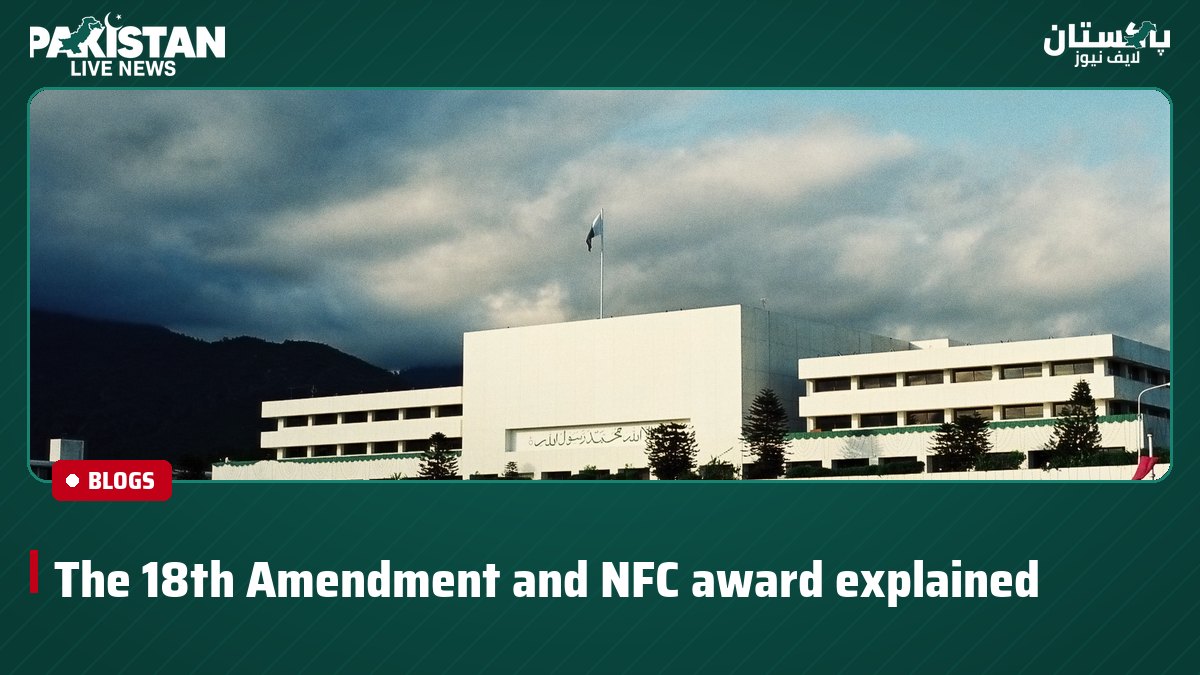
Image: Usman.pg / Wikimedia Commons, CC BY-SA 3.0


