
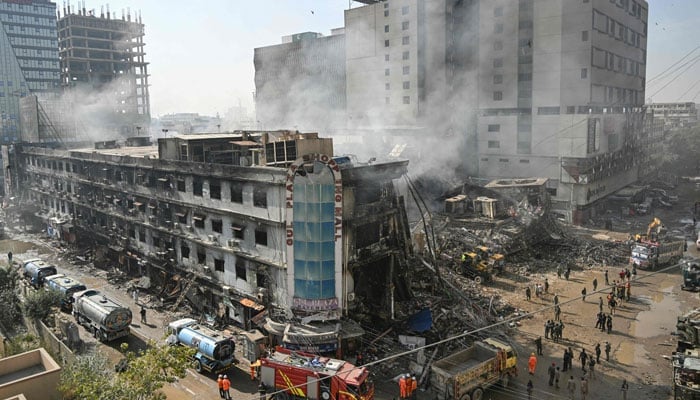
KARACHI: As questions continue to surround the Gul Plaza inferno, a critical one is now being voiced: did the victims die from burns or were most — possibly all — of them overcome by toxic smoke and fumes before the fire consumed their bodies?
Experts say there is a strong possibility that the majority of the victims lost consciousness due to smoke inhalation and suffocation before death, and that their bodies burned only after they had already died.
Experts say that in any fire incident, smoke proves to be the deadliest factor. During a fire, victims usually try to find safe areas to protect themselves from the flames, and in many cases, they succeed to some extent.
However, avoiding smoke is almost impossible. According to experts, smoke enters the body through breathing and reaches the lungs and bloodstream. Toxic gases in the smoke, particularly carbon monoxide, replace oxygen in the blood, which disrupts the supply of oxygen to the brain and heart.
Due to the lack of oxygen, the affected person first experiences dizziness, panic and difficulty in breathing, followed by loss of consciousness. Without immediate rescue and medical assistance, this condition ultimately leads to death.
Experts further explain that in most fire incidents, the primary cause of fatalities is not the flames but smoke inhalation, which can cause victims to lose consciousness within minutes and succumb before help can reach them.
According to doctors, survival in a fire largely depends on how close a person is to the flames, how long they are exposed, and whether they can protect their airways. If a victim fails to cover their nose and mouth with a wet cloth and is close to the fire, their chances of survival drop sharply. Fire rapidly consumes oxygen while producing carbon monoxide, which enters the body through inhalation.
In such conditions, a person can collapse within four to five minutes. If dense smoke and fumes persist, death from suffocation can occur within 10 to 12 minutes. This suggests that those who were trapped in the Gul Plaza inferno early on or had no opportunity to distance themselves from the fire likely died in the initial stages.
However, officials, eyewitnesses, and video footage recorded inside the Gul Plaza before the victims’ deaths that continued to circulate on mainstream and social media for several hours also indicate that several individuals managed to survive for a prolonged period.
In these videos, victims can be seen desperately attempting to rescue themselves and calling for help. Despite their efforts to shield themselves from flames and toxic smoke, the continuous spread of the fire throughout the building ultimately made escape and survival impossible.
The Gul Plaza contained a wide range of materials, which, when burnt, produced multiple highly toxic gases. It remains unclear which substances combined to generate what kinds of lethal fumes during the blaze.
All these factors strengthen the likelihood that victims first lost consciousness due to smoke and fumes, collapsed, suffocated, and only afterwards did their bodies burn. The severely cremated remains recovered from the site have raised further questions. Doctors explain that third-degree burning — which occurs at temperatures approaching 2,000 degrees Celsius — can result in such conditions when bodies are exposed to fire for prolonged periods.
In cases where bodies continue to burn for many hours, as reportedly occurred in the Gul Plaza incident, where some remains were exposed to fire for 35 hours or more, the resulting remains are often beyond recognition.
In such circumstances, DNA can be destroyed, and even bones may burn, fragment or turn to ash. This appears to be consistent with the Gul Plaza case, where a large number of skulls could not be recovered, indicating extreme and extended exposure to fire.
These findings lead to another pressing question: could many of these deaths have been prevented if rescue operations had been carried out effectively and in time? One doctor remarked that, grim as it sounds, it was perhaps fortunate that the victims died due to smoke inhalation, as being burned alive in such an intense fire would have involved far greater suffering.
The News also spoke to journalists who covered the tragedy on the ground. Rajab Ali, a senior journalist who has reported on hundreds of fire incidents and is currently associated with a private news channel, described the coverage as one of the most difficult of his career.
“Believe me, we were standing at a considerable distance from the fire, yet reporting was extremely difficult. I was wearing a mask and maintaining distance, but the smoke simply did not allow us to stay there for long.”
He said that even after returning home daily, he had to gargle with warm water and use a nebuliser, yet his voice did not return to normal even after the fire was extinguished and the smoke cleared.
Due to his deteriorating health, he was forced to take one to two days off work. If experienced journalists struggled to breathe from a distance, what chance did the trapped victims inside the Gul Plaza really have?
When comparing the fires that broke out at the Gul Plaza and the RJ Mall, one common factor in both incidents was suffocation. However, there was a key difference between the two tragedies.
In the RJ Mall fire, victims died due to suffocation, but their bodies were not severely burned or reduced to ashes. But in the Gul Plaza fire, the bodies were later completely burned and turned to ashes.
The RJ Mall building administration was handed over to the Nexus Building Management (NBM) in 2024 following the tragic fire incident that occurred in 2023. Explaining the situation, NBM Director Muhammad Adnan said: “When the fire broke out at the RJ Mall, there was no proper ventilation system in the building.”
As a result, he said, thick smoke spread throughout the mall, causing people to lose consciousness first, then suffocate to death. Eleven people lost their lives in the RJ Mall fire, and all of them died due to suffocation, he added.
A senior fire officer said that although fire itself is extremely dangerous, smoke is the most lethal element in such incidents, as it affects victims before the flames do. He explained that smoke enters the human body and can cause death even before a person comes into direct contact with fire.
“This is why building laws place great importance on proper ventilation in malls and other buildings. Unfortunately, in practice, many builders do not pay sufficient attention to this requirement.”
He said if buildings and malls are equipped with proper ventilation systems, the amount of smoke would be significantly reduced. “When smoke levels are lower, people face fewer difficulties in rescuing themselves, as most casualties occur due to smoke inhalation rather than burns.”
Among the few who survived the Gul Plaza fire was Azra Raees. “I was shopping with my husband when suddenly chaos erupted. People were screaming, the building was on fire, and the smoke engulfed us — I felt myself losing consciousness.”
She recounted that her husband somehow held her and guided her out. “I shudder to think what might have happened if he hadn’t been there — I could have been among the victims whose remains were later recovered.”
Originally published in The News