
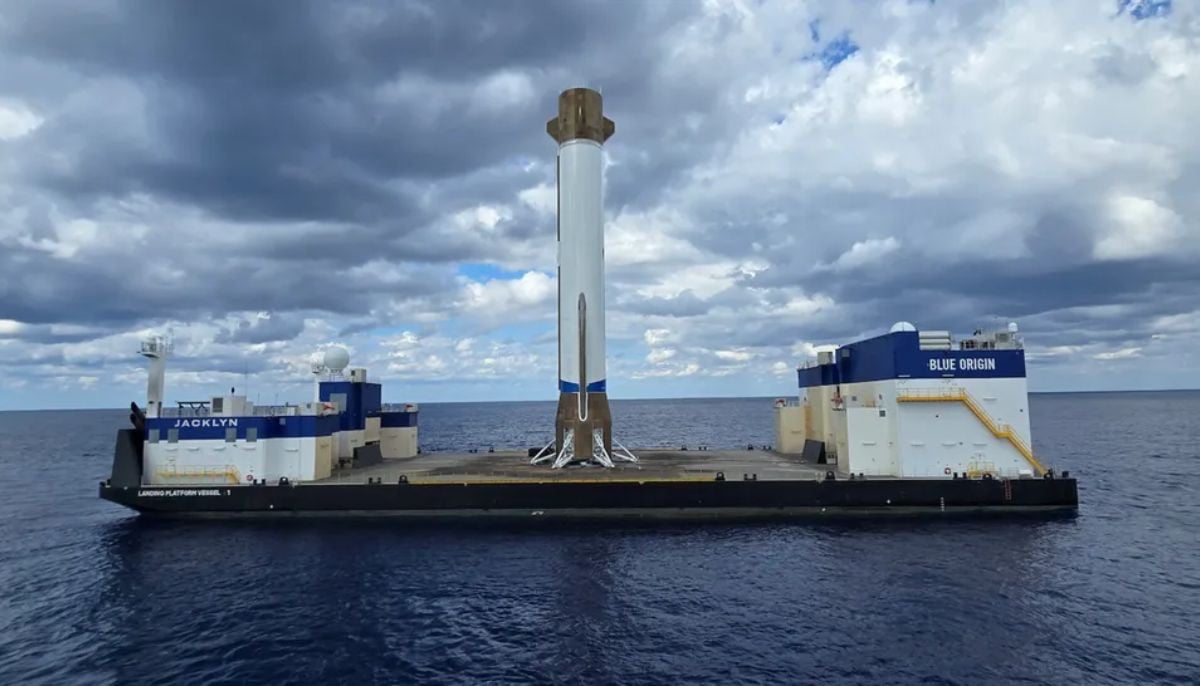
Blue Origin is entering its most important test yet against SpaceX, which will take place when its New Glenn rocket performs its first reused booster demonstration.
The NG-3 mission represents the third operational test of the New Glenn rocket, which stands 322 feet tall and was engineered for 25 reusable missions starting with its first stage. The outcome of this landing attempt will have significant implications that extend beyond this particular launch.
What’s flying, and why is BlueBird 7 unusually large?
The primary payload aboard NG-3 is BlueBird 7, a direct-to-cellphone internet satellite built by Texas-based AST SpaceMobile. It is the second “Block 2” satellite in the company’s growing constellation and one of the largest commercial satellites currently operating in low Earth orbit, with an antenna spanning 2,400 square feet, roughly the footprint of a modest family home.
Its predecessor, BlueBird 6, launched on an Indian LVM3 rocket last December and shares the same dimensions. The earlier Block 1 satellites in the same constellation carry antennas of just 693 square feet apiece, making the generational leap in scale immediately apparent.
The first stage flying on NG-3 is the same booster core that successfully landed on Blue Origin’s Atlantic droneship, Jacklyn, during the NG-2 mission in November 2025 – the flight that delivered NASA’s ESCAPADE Mars probes to orbit. For this launch, Blue Origin replaced all seven BE-4 methalox engines and introduced several upgrades, including a thermal protection system on one engine nozzle.
The CEO of the company confirmed the configuration on April 13 because he stated that future flights would use the original NG-2 engines.
The booster which got the nickname “Never Tell Me the Odds” performed a 19-second static fire test on April 16 before the vehicle moved to Launch Complex-36 at Cape Canaveral Space Force Station in Florida. The spacecraft will launch during a two-hour window which begins at 6:45 a.m. EDT on Sunday.
The commercial operations of Blue Origin need to establish their base upon the reusable engineering achievement which serves as their fundamental engineering accomplishment.
New Glenn is the launch vehicle earmarked to carry the company’s Blue Moon lander to the Moon as part of NASA’s Artemis programme. Blue Moon recently completed vacuum chamber testing at NASA’s Johnson Space Center in Houston and is being shipped to Kennedy Space Center for further qualification.
NASA has restructured its Artemis timeline, which now establishes mid-2027 as the target date for a crewed lunar landing attempt that will use whichever lander, Blue Moon or SpaceX’s Starship, has completed its development first.
NASA must finish demonstrations for both vehicles, which they need to pass before the agency will grant certification for crewed missions.