
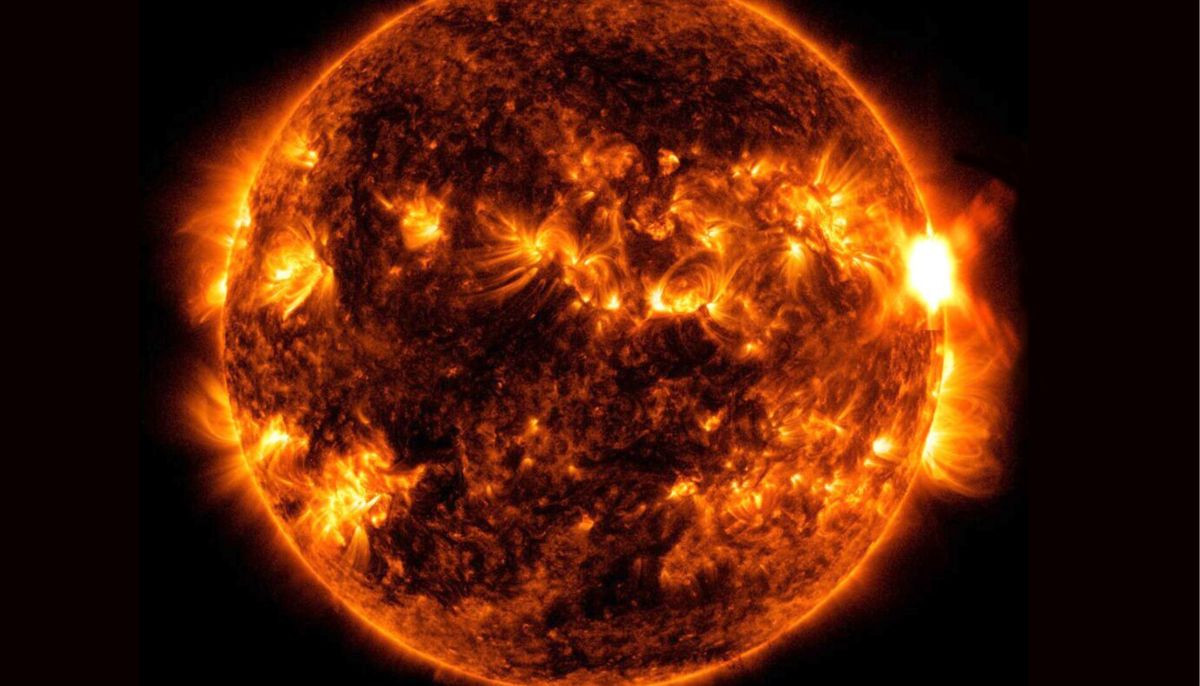
The sun released two powerful X2.5 solar flares within a seven-hour window, marking the strongest solar activity in 78 days. Both eruptions originated from AR4419, a volatile sunspot region currently located on the sun’s western edge. The first solar flare peaked at 9:07 p.m. EDT on April 23, followed by the second at 4:14 a.m. EDT on April 24.
According to solar physicist Ryan French, these are the strongest flares we’ve seen in 78 days. The bursts of radiation triggered strong radio blackouts on the sunlit side of Earth; the first affected parts of the Pacific Ocean and Australia, while the second had a significant impact on East Asia.
The X-flares were preceded by a flurry of M-class solar flares on April 23, along with a rare “sympathetic flare” where eruptions occurred in two separate sunspot regions on opposite sides of the sun.
According to forecasters, modeling of the paths is still underway, and a glancing blow remains possible. Such an event triggers geomagnetic storms and spark vivid aurora displays.
Solar flares: Everything you need to know
Solar flayers are powerful explosions from the sun that result in bright chromospheric eruptions, releasing intense bursts of electromagnetic radiation-including X-rays and ultraviolet light-at the speed of light. When radiation from a solar flare hits Earth, it ionizes the ionosphere.
Under normal circumstances, long-distance radio signals travel by bouncing off the upper layers of the ionosphere. This causes radio waves to lose energy through particle interactions, weakening signals and ultimately leading to shortwave radio blackouts.