
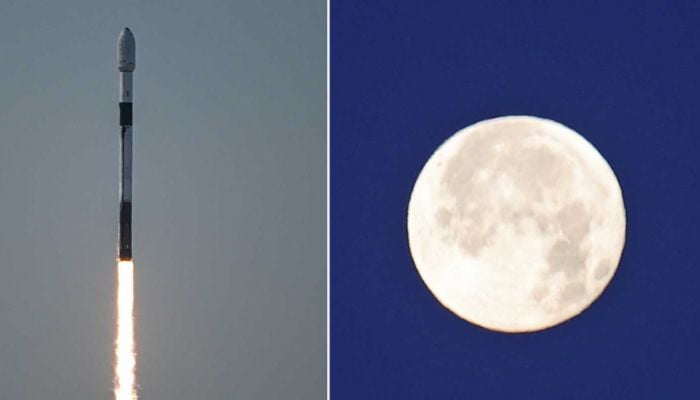
An abandoned SpaceX Falcon 9 rocket is on a high-speed collision course with the moon after launching a pair of landers more than a year ago. The rocket’s upper stage will crash blindly into the moon on Wednesday, August 5 carving out a crater and sending up a plume of dust and rubble that scientists are eager to observe.
According to Space tracking expert Bill Gray, an impact of 5,400 mph-seven times the speed of sound near Einstein Crater on the moon’s sunlit western limb will likely unfold in the eastern portions of the US and Canada and much of South America should have remarkable views.
At present scientists are not too apprehensive about this specific term, rather it underscores the growing threat as more and more items cram into orbit. In this connection, Gray said: “Things are getting crowded up there.”
This marks only the second and dead rocket known to have crashed into the moon accidentally after a Chinese rocket segment carved out a pair of craters on the lunar far side in 2022.
The upcoming impact will occur on the moon’s star which is fortunate for astronomers. The impact flash will probably be too dim to see but the stream of ejected matter could scratch for several miles into space and remain visible through a telescope for tens of minutes.
Los Alamos National Laboratory’s Benjamin Fernado said: “The gravity on the moon is low and there is no wind to blow the dust away.”
“Part of the reason for our interest in this event is to figure out how much of a hazard debris impacts pose to future astronauts.”
Scientists said its pivotal move is to improve debris monitoring and traffic control before packs of robots and astronauts reach a certain point.
Furthermore, retired astrophysicist Jonathon MCDowell said in an email, “But in a future where there are long-term bases on the moon, similar impacts would be an issue, and we need not to leave cricket stages in chaotic orbits of this kind.”