
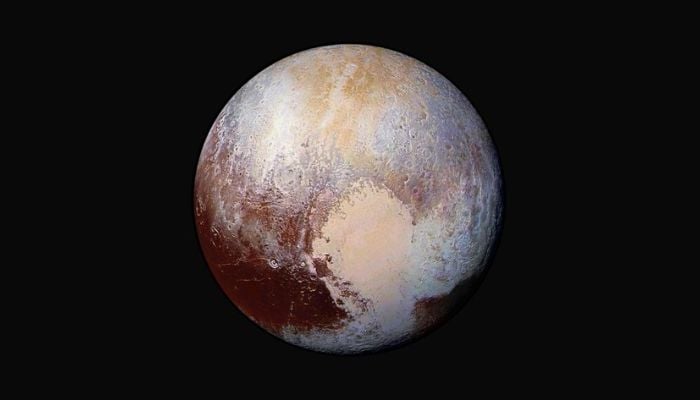
August marks 20 years since astronomers made one of the most controversial decisions in modern astronomy: Pluto was no longer officially considered a planet. The International Astronomical Union (IAU) changed Pluto’s classification from a planet to a dwarf planet today in 2006, reducing the number of officially recognised planets in our solar system from nine to eight.
Twenty years after that decision, we know much more about Pluto and its neighbouring planets.
Was Pluto’s demotion the right decision?
This debate was going on for several years before the IAU made its decision. In the 1990s, many other objects were found in the Kuiper Belt, which resembled Pluto. The discovery of Eris, which is one of the largest dwarf planet of the solar system, in 2005 became the final stage of this debate.
The distance of Eris from the sun and its size are roughly equal to those of Pluto. The addition of another planet to the list of planets in the solar system means that Eris was declared a planet.
Eventually, the IAU came up with the idea that a planet must orbit around the sun and must have enough mass so that its gravity will make it round and clear its neighbourhood of other objects. Pluto fulfilled the first two criteria but not the last.
However, not everybody thinks this was an issue that was sorted out by the definition. Planetary astronomer at Washington University in St Louis, Paul Byrne, maintains that Pluto remains a planet.
“Yes, Pluto is a planet,” Byrne said to Space.com. He maintains that Pluto shouldn’t be an exception because, for example, other dwarf planets, Ceres, Eris, Makemake and Haumea – may also be regarded as planets.
Byrne admits that in the end much of this discussion is about semantics. “Nature doesn’t care what we call Pluto,” Byrne stated. However, the very name can affect how people think about the science.