
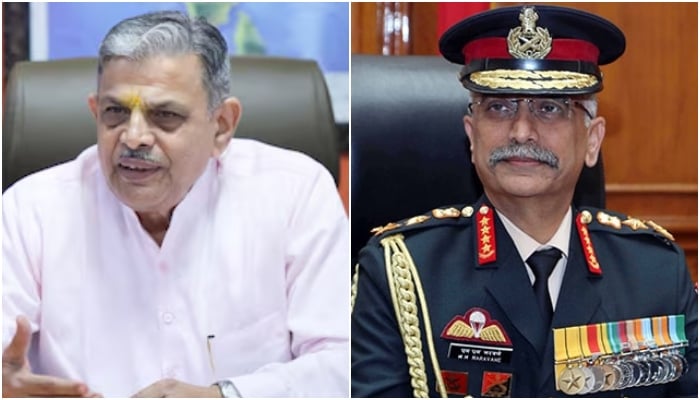
- Trade, visas, diplomatic ties should continue: RSS leader
- Cites Vajpayee’s Lahore bus visit as past outreach.
- Ex-army chief supports people-to-people contact.
A senior Rashtriya Swayamsevak Sangh (RSS) leader and a former Indian army chief have advocated maintaining open channels of dialogue with Pakistan, a stance that has drawn strong criticism from opposition parties, especially the Congress.
RSS General Secretary Dattatreya Hosabale, considered the organisation’s second-most senior leader, told news agency PTI that India should continue diplomatic engagement with Pakistan.
“India should always be ready to engage in dialogue with Pakistan. That is why diplomatic relations are maintained, trade and commerce continue, and visas are being given. So we should not stop these, because there should always be a window for dialogue.”
The RSS, also known as the Sangh, is a right-wing Hindu nationalist paramilitary organisation seen as the ideological guiding force behind the BJP.
Referring to past diplomatic efforts, Hosabale cited former Indian prime minister Atal Bihari Vajpayee’s outreach to Pakistan, including his Lahore bus visit, as an example of engagement despite tensions.
“Everything has been tried, but more such efforts should continue. Atal ji tried to engage them in dialogue. He went to Lahore by bus, and many things have happened. [Modi] also invited Pakistan at the time of taking oath,” Hosabale said.
Hosabale’s sentiments were echoed by ex-Indian army chief, Manoj Mukund Naravane, who told the media on Wednesday: “People-to-people connections and contacts are very important. Common people live on both sides of the border and face similar problems in daily life.”
Naravane said that when friendship develops between people of two countries, it helps improve relations as well.
India and Pakistan relations have remained largely frozen in recent years, with diplomatic engagement stalled. The two neighbouring countries have also experienced border skirmishes and a brief 87-hour conflict last year.
In May 2025, Pakistan, during the 87-hour conflict, downed eight Indian fighter jets, including four French-made Rafale, one Su-30 aircraft, one MiG-29 aircraft, one Mirage 2000 aircraft, and one “expensive” multi-role unmanned aerial system as well as dozens of drones.
The war between the two nuclear-armed nations ended on May 10 with a ceasefire agreement brokered by the United States.
Meanwhile, in February 2019, India violated Pakistan’s airspace, prompting a retaliatory response from Pakistan that led to the downing and capture of Wing Commander Abhinandan Varthaman, who was later returned to India.