
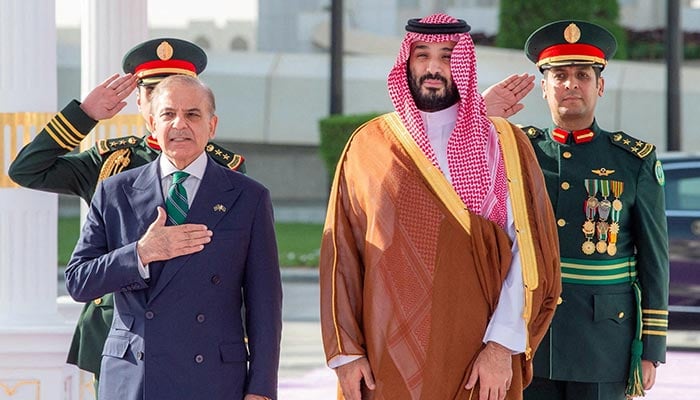
- Houthi attacks ‘pushed Islamabad’s frustration’ to new level.
- Pakistan signed mutual defence pact with Saudi Arabia last year.
- Pakistani soldiers deployed near Saudi border with Yemen: officials.
Pakistan has conveyed to Iran that Houthi attacks on Saudi Arabia would be considered strikes on Pakistan itself, a Pakistani official told Reuters, as this week’s missile strikes on the Kingdom heightened Islamabad’s concerns.
“Our top civil and military leaders have conveyed to Iran at the highest level that the attacks on Saudi Arabia are attacks on Pakistan,” a Pakistani official told Reuters. “It is our red line.”
Nuclear-armed Pakistan, which helped broker an interim deal last month in the war between Washington and Tehran, signed a mutual defence agreement with Saudi Arabia last year, committing both sides to treat any aggression against either country as an attack on both.
The Houthis fired missiles at Saudi Arabia after accusing the kingdom of bombing an airport under their control on Monday. The cross-border fire pierced a four-year truce but has so far been contained to a single incident.
The source and other Pakistani officials interviewed for this article spoke on condition of anonymity because they were not allowed to speak publicly.
“Pakistan wasn’t anticipating that the tensions will rise so suddenly,” said a security analyst.
Pakistani soldiers are deployed near the Saudi border with Yemen, two Pakistani officials said, increasing their direct exposure.
There are also concerns in Islamabad that a Houthi-led escalation could disrupt shipping in the Red Sea, an important trade route that Pakistan and many other countries depend on.
Another analyst said that for now “Pakistan’s top leaders are still engaged in appeasing all stakeholders.” But he cautioned that this could change “if the Houthis expand the radius of their attacks in Saudi Arabia”.
When Pakistan’s defence deal with Saudi Arabia was announced last September, it was widely seen as a sign that Gulf Arab states were growing increasingly wary about the reliability of the United States as a security guarantor and looking to Pakistan and other countries as a possible alternative.
But Pakistan is deeply reliant on Middle Eastern countries for oil and gas. The tensions around the Strait of Hormuz disrupted Pakistan’s supply routes, and the government imposed emergency measures including early business closures to prevent a fuel shortage.
Mediating between the US and Iran has been at least as much about reopening these supply routes as it has been about diplomatic influence, according to analysts and officials.
“Yes, there is frustration, but that doesn’t mean that we are abandoning this project,” one official said, referring to the mediation. “We have invested a lot in it, and we have an interest in keeping it afloat.”
Pakistan has rarely appeared closer to having to choose a side than this week, however.
“It’s in everyone’s best interest for the war to end,” said a different Pakistani source aware of the mediation. “But if Saudi calls us in, we will stand by them and there is no doubt about that.”