
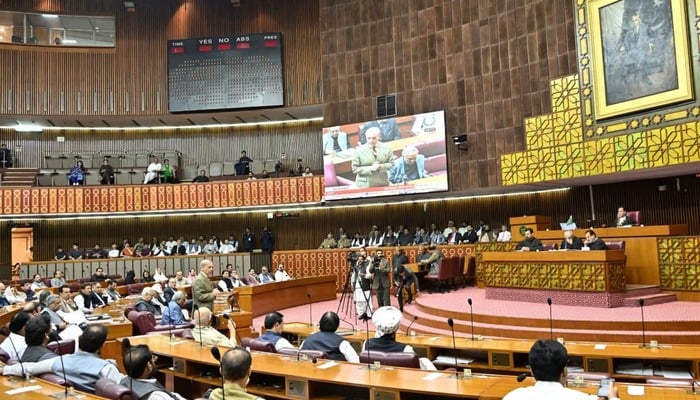
- Imported vehicle duty rates revised from July.
- FBR notice violations will draw heavy fines.
- Electronic tax returns made mandatory through Iris.
The National Assembly has approved Budget 2026-27, with the Finance Bill outlining revised duties on imported vehicles, stricter Federal Board of Revenue (FBR) compliance rules and electronic filing requirements.
According to the Finance Bill 2026-27, from July 1, imported vehicles from 2,000cc to 3,000cc will face 86% duty, while 3,001cc imported vehicles will be subject to 92% duty.
Duties and taxes on 1,800cc vehicles will be reduced from 156% to 74%, while the duty rate on vehicles above 1,500cc is being cut from 91% to 57%.
The Finance Bill says duties and taxes on imported vehicles from 1,000cc to 1,500cc will be reduced from 76% to 52%. Duty on 850cc imported vehicles will be brought down from 66% to 42%.
Under the new auto policy, special excise duty will not be imposed on vehicles up to 1,800cc.
The bill also proposes customs duty of 30% to 40% on the import of large electric vehicles. From July 1, imported EVs valued up to $75,000 will face 30% duty, while EVs valued above $110,000 will be subject to 40% customs duty.
A concessional sales tax of 10% will be imposed on children’s pencils, pens and sharpeners.
From July 1, a one-time fixed tax of Rs10,000 will be imposed in the federal jurisdiction on vehicles up to 1,000cc. Token tax on pre-2010 models of vehicles up to 1,000cc will be Rs20,000.
Vehicles from 1,001cc to 1,300cc will face a token tax equal to 0.3% of the total invoice value. The Finance Bill also says the token tax in the federal jurisdiction will be set at 0.25% of the total invoice value.
Separately, a token tax of Rs2,500 will apply to pre-2010 model vehicles, while Rs6,200 token tax will be imposed on post-2010 model vehicles. The bill says post-2010 vehicles were earlier subject to Rs1,500 token tax.
Amendments to Section 182 of the Income Tax Ordinance, 2001, have also been approved. The Finance Bill says either the tax imposed on taxable income or the higher tax from the previous three years will apply.
Laws relating to filers and non-filers will be further tightened, while those failing to comply with FBR notices will face heavy fines. The first violation of an FBR notice will carry a Rs1 million fine, while repeated violations may attract a penalty of up to Rs2 million.
From July 1, action will be taken over failure to install the electronic tax monitoring system. Disrupting the FBR monitoring system or electronic tax system may be punishable by up to five years in prison.
Factories, industrial units and shops may face punishment and fines for breaking or damaging the FBR monitoring system.
The first fault in the electronic system will carry a Rs1 million fine, while repeated faults in the FBR electronic system will carry a fine of Rs1 million each time.
The Finance Bill says the electronic system must be installed within the prescribed period. After installation, its proper use and maintenance will also be mandatory.
The FBR will provide a rebate of up to Rs30 million to those installing the electronic system. Legal action will be taken for making the tax monitoring system non-functional.
The procedure for action over system installation or faults will be issued on the FBR website on July 1.
From July 1, income tax returns will have to be filed only through electronic means. The bill says income tax returns must be submitted electronically through Iris.
Companies’ financial statements will also be submitted in machine-readable format, while returns will now have to be filed completely electronically.
Taxpayers accepting the algorithmic settlement mechanism will be allowed to file revised returns. Under algorithmic settlement, prior approval from the commissioner will not be required for revised returns.
Taxpayers opting for algorithmic settlement will not face a separate penalty or surcharge.
‘Sincere efforts’
Meanwhile, Prime Minister Shehbaz Sharif told the National Assembly that an MoU had been signed between Iran and the United States a few days ago.
He said Pakistan had made sincere efforts to reduce the distance between the two sides, adding that a joint statement was issued later.
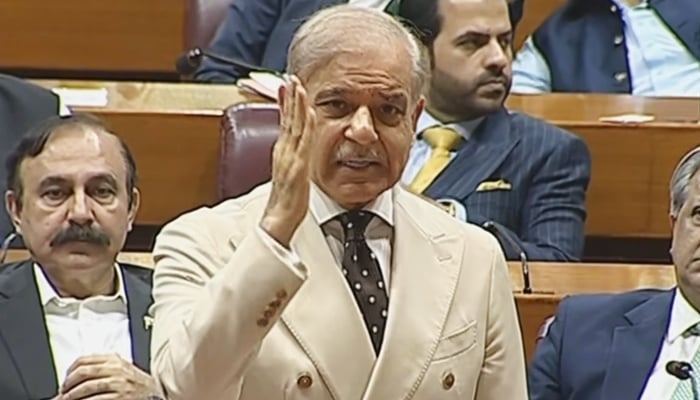
The prime minister said a ceasefire between the United States and Iran was now in place and technical matters between the two countries would be discussed over the next 60 days. He said he was fully hopeful that a durable peace would be achieved under the MoU.
The premier congratulated the House, all members and the people, saying Pakistan had played a key and historic role in the matter. He said Iranian President Masoud Pezeshkian was arriving in Pakistan today.
The prime minister said it was not a day to raise contentious issues, adding that preparations should be made to give the Iranian president a warm welcome.
Referring to domestic political matters, he said the 2018 elections could be investigated. “If that was a legal government, then this is also a legal government,” he said.
He said Pakistan’s progress could not be measured through the development of Punjab alone, adding that unless all four provinces joined the race for development, it could not be called Pakistan’s progress.
This is a developing story and will be updated with more details.