
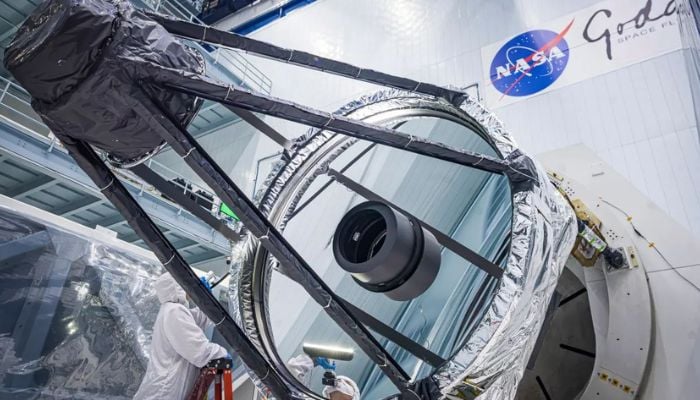
NASA’s Nancy Grace Roman Space Telescope has moved into one of the most consequential phases of its journey to space, with engineers now bolting the observatory to the hardware that will carry it into orbit.
In an update released this week, NASA said teams at Kennedy Space Center had begun integration operations with SpaceX launch hardware ahead of a targeted liftoff later this month.
Roman is now running nine months ahead of its original schedule, a rare feat for a flagship space mission. Technicians recently mated the observatory to its payload adapter and a specialised strut attachment fitting designed for large, heavy loads before lifting it onto the structure that will secure it to the upper stage of SpaceX’s Falcon Heavy rocket.
Roman will then be enclosed in the protective payload fairing of the rocket, providing protection from any aerodynamic loads and heating during its ascent into space prior to being moved to SpaceX’s integration facility at Launch Complex 39A.
_updates.jpg "NASA, SpaceX prepare Roman telescope for August 30 liftoff 8")
NASA and SpaceX have set their sights on launching Roman at the earliest on 30 August, and the targeted launch time is 7:26am EDT from Launch Complex 39A.
Roman reached Kennedy on June 21 after having undergone major testing at NASA’s Goddard Space Flight Center.
About 1,100 litres of hydrazine propellant were fuelled into the observatory on July 25 before its voyage to the Sun-Earth Lagrange point 2, which is about 1.5 million kilometres from Earth.
While Roman and Hubble share the same size of the 2.4-metre primary mirror, the former uses a Wide Field Instrument that can detect a much larger portion of the sky than the latter by up to 100 times through a camera that consists of about 300 megapixels and is designed for surveying the universe with infrared light.
This is done in order to enable scientists to explore dark energy, the force behind the universe’s accelerated expansion, dark matter, and thousands of other exoplanets.
Roman’s primary mission is planned to run five years, with the possibility of an extension once its Sun-Earth L2 orbit is established.