
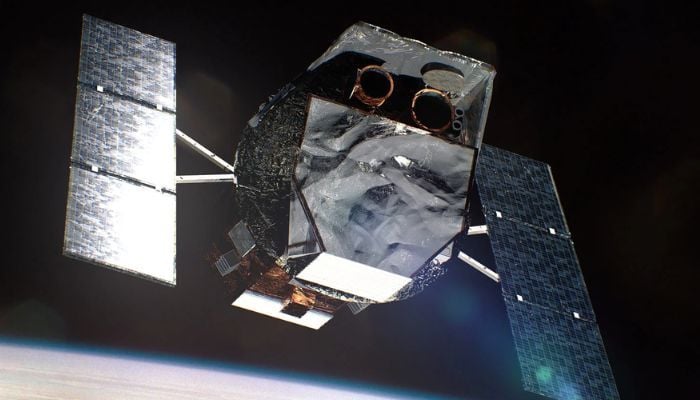
NASA has successfully launched a first-of-its-kind daring mission on Friday to save the falling Swift Observatory telescope after a software-based glitch forced the space agency to abort it on Thursday.
The rescue mission aims to save the aging space telescope, used to study high-energy cosmic explosions, including gamma-ray bursts. Neil Gehrels’ telescope is at the verge of losing altitude and burning into the Earth’s atmosphere due to atmospheric drag caused by increased solar activity.
Engineers had less than a year to launch a rescue before the telescope dropped below 186 miles, the point at which a rescue became physically impossible.
To pursue the mission, the space agency gave Katalyst Space a contract to capture the satellite in orbit and boost its orbit. The robotic spacecraft named LINK flew on the Northrop Grumman Pegasus launch.
Using three movable arms, the spacecraft will capture the falling satellite and tow it to an orbit roughly 300 km higher.
_updates.jpg "NASA launches first-of-its kind mission to rescue 3,200-pound falling space telescope 8")
Here is the full plan after its launch. After a few weeks of system checks and manoeuvring , LINK will circle the telescope and assess its condition prior to using the three arms to latch on.
Once it has been attached to Swift, the spacecraft will conduct “slow, graceful lift, using its thrusters to gently push the observatory back to its stable, original altitude of 373 miles.”
Speaking about the timeline, the recovery process is expected to take several months.
The scientific community is highly vigilant for this bold operation as it is fraught with various challenges and risks.
Dr Simeon Barber, a space scientist, has said it is “high risk”, adding, “But Nasa obviously thinks it’s worth a go. And the science community is hopeful about this because it’s an important telescope that enables us to study super high-energy phenomena that we have no other means to study.”
Though the unprecedented mission is risky, if proven successful, it is going to change the trajectory of orbital servicing and rescue missions, paving the way for saving crucial space assets in future, including the Hubble Space Telescope.