
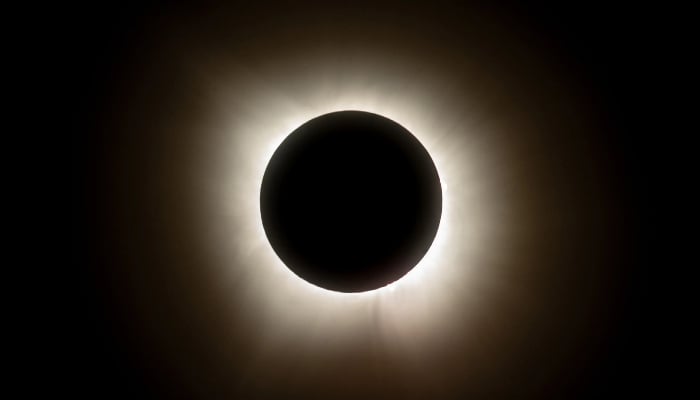
NASA scientists are preparing to chase Wednesday’s total solar eclipse aboard a high-altitude research aircraft in a mission designed to capture rare data about the sun.
The WB-57 aircraft will take off from Keflavik airport in Iceland before climbing to about 50,000 feet and flying towards Greenland, The Guardian reported.
As the moon’s shadow races across the Earth at more than 2,000mph, the aircraft will travel along the eclipse path at about 460mph.
This will extend the crew’s experience of totality from about two minutes and 18 seconds to nearly three minutes.
Four cameras installed in the aircraft’s nose will capture dozens of images every second at different wavelengths of light.
Scientists hope to observe solar prominences and powerful magnetic explosions known as nanoflares, which are normally difficult to study because of the sun’s glare.
“Solar eclipses give us an opportunity to do science we couldn’t do at any other time,” mission principal investigator Dr Amir Caspi told The Guardian.
Researchers hope the observations will improve understanding of the sun’s corona and space weather, which can affect astronauts, satellites, communications and power grids on Earth.
“Understanding space weather is critical for us as a technological species, and it starts with understanding the processes at the sun,” Caspi said.