
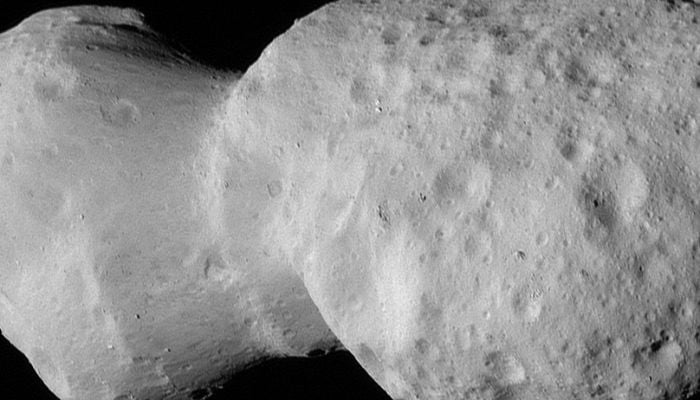
NASA’s Lucy spacecraft has discovered evidence of ancient water on asteroid 52246 Donaldjohanson (DJ), a finding that contradicts where the rocky body should have formed.
Lucy discovered iron phyllosilicates on the surface of the asteroid through a flyby mission conducted in April 2025. Phyllosilicates can only be found where there is liquid water.
However, DJ revolves in the inner asteroid belt between Mars and Jupiter, where it is too hot for water ice to remain from the early solar system period.
Planetary scientist Simone Marchi, who led the investigation from the South-west Research Institute, elaborated on this mystery. “Phyllosilicates indicate the presence of water in addition to an aqueous alteration stage,” he stated. Volatile-containing objects such as water ice normally form in the cold environment of the outer solar system.
The fact is that DJ does not belong in the asteroid belt since the spectral data proves that the object was subject to partial aqueous alteration. This process could have ceased due to exhaustion of radioactivity or lack of water.
The bi-lobed structure of the asteroid, two large spherical parts connected by a thin neck, suggests that the asteroid is the product of a catastrophic collision. It is a fragment of a larger body that disintegrated about 155 million years ago, resulting in the formation of the Erigone family of asteroids.
Bi-lobed bodies can be seen throughout the solar system: comets visited by spacecrafts, near-Earth asteroids analysed by Japanese and Chinese expeditions, and small satellites orbiting larger bodies.