
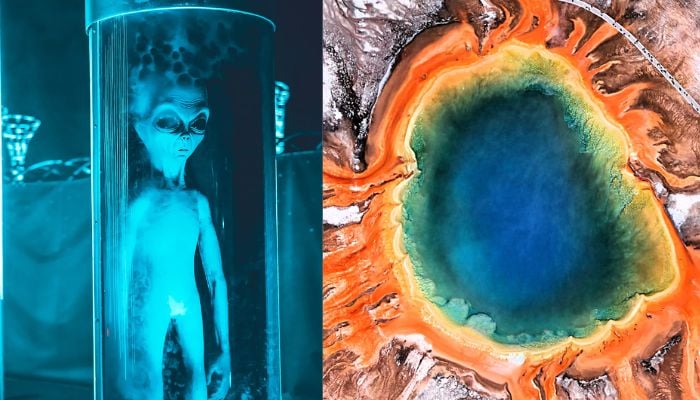
Arizona State University doctoral candidates Tanner Barnes and Vince Debes hike Yellowstone’s trails not as tourists, but as astrobiologists hunting for clues about life beyond Earth. Their Yellowstone samples could hold answers to humanity’s oldest question: Are we alone?
Both of these individuals perform research at ASU under Professor Everett Shock in the GEOPIG lab, which explores “life as a planetary process,” the interplay between geology, chemistry and biology that makes planets inhabitable.
Working with the same hot springs, however, each individual addresses unique questions relevant for exploring Mars and searching for extraterrestrial life forms.
Specifically, Barnes works with carbon isotopes. Employing special devices housed at ASU’s METAL Core facility, he determines if the carbon found in Yellowstone samples is alien in origin or if it was generated by microbes inhabiting the springs.
“Being able to identify the sources of carbon is important when looking at rocks in other extreme environments, from Earth to other planets, to determine whether the carbon is there by chance or was left behind by life,” Barnes said.
His research provides a reference point at which NASA can look back to when it starts to bring back Mars samples. If scientists detect carbon that matches Yellowstone’s biological makeup, then they will be sure that they have detected life on the planet.
While Debes explores this fascinating notion, he considers one even stranger still: microorganisms surviving without the sun or any organic material. Rather, these organisms feed off the energy released in chemical interactions within the water, much like how iron oxidises.