
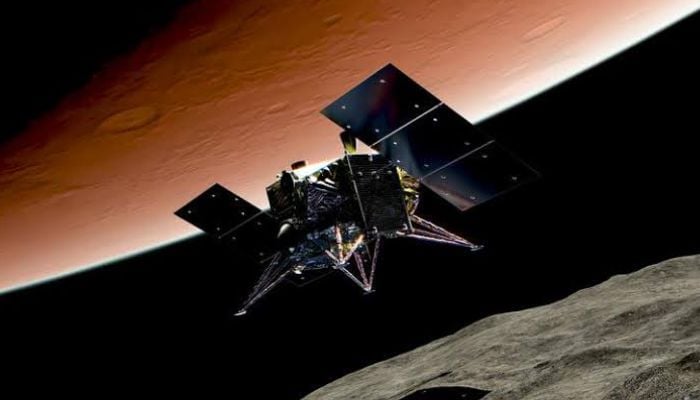
Japan in an ambitious space mission is going to Mars’ moons to retrieve samples aimed at unlocking the secrets of the Red planet and Solar system.
In the pursuit of this mission, the unmanned Martian Moons eXploration (MMX) is scheduled to lift off from Tanegashima Space Center in coming months. The spacecraft will stay in Martian orbit for around 3 years and will try to land on moon Phobos.
After landing, the spacecraft will collect at least 10 grams of samples from the surface of Phobos. At the same time, the IDEFIX rover will carry out surface observations.
Speaking about Mars’ other moon Demios, the spacecraft will only observe it without landing on it. After completing the mission, a return capsule will head back to Earth to land in Australia in 2031.
The Japan Aerospace Exploration Agency (JAXA) aims to uncover the formation history of Mars and its moons, offering crucial insights into the birth of the Solar System.
One prominent theory regarding the origin of the Martian moons, known as the “giant impact” hypothesis, suggests they were created in the aftermath of a massive celestial collision with Mars.
According to the capture hypothesis, the moons are asteroids from the outer Solar System that were captured by Mars’ gravity.
The determination of the correct origin hypothesis will disclose “how a habitable environment for life might have arisen on the terrestrial planets”, JAXA said.
Patrick Michel, a French astrophysicist working on IDEFIX, explained, “If Phobos and Deimos are indeed remnants of these early delivery systems, they may hold clues to the origins of life itself, or to be more correct, to the transport of the materials that were key to the emergence of life on rocky planets.”
According to the space agency, the mission will also lay the groundwork for humans’ ability to visit Mars.