
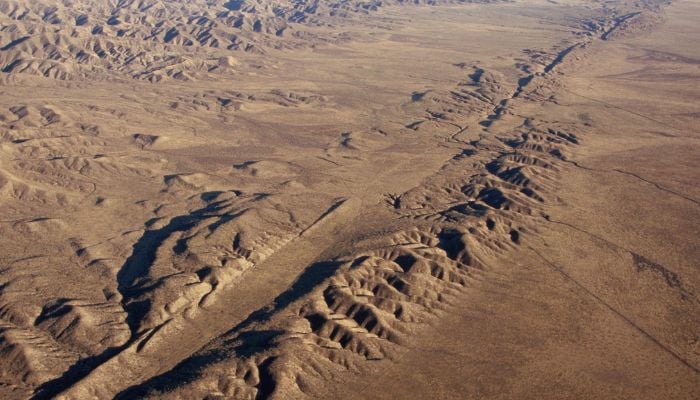
A recent research study led by the University of Hawaii at Manoa has provided updated analysis regarding the stress levels related to the San Andreas and San Jacinto fault systems and seismic risks posed by them.
According to researchers, the stress levels on multiple segments of the San Andreas and San Jacinto faults are critically above “their highest levels in the past 1000 years.”
As per findings published in the Journal of Geophysical research: Solid Earth, these unprecedentedly high levels allow the major rupture to build up as the system has not experienced a “big one” in 160 years.
As the stress is highly aligned across both systems, there is a possibility of a large, through-going rupture that involves both fault lines simultaneously.
Scientist Liliane Burkhard said that “the region may be capable of a large through-going rupture involving both fault systems.”
The researchers “also found that Cajon Pass may act as an ‘earthquake gate,’”, adding that this junction has been able to block a rupture from crossing between faults. Sometimes, the gate allowed them to pass through them, thereby facilitating a “major rupture.”
Burkhard said, “The conditions that determine whether the ‘earthquake gate’ at Cajon Pass opens or stays closed appear to be related to how closely the stress levels on the two fault systems are aligned with each other at the time of rupture. Right now, with stress at historically high levels across the region.”
Is California at the threshold of a major earthquake?
The scientists have reached these unsettling findings by using a computer model fed with 1000 years of earthquake history. It was reconstructed through radiocarbon dating of tree-rings and sediment record.
According to the lead author, we are unaware of when an earthquake will occur. But if it does, it will pose serious threats to major population centers, including Los Angeles, San Bernardino, Riverside, and the Coachella Valley.
“This is not a prediction of when an earthquake will happen,” Burkhard said. “However, studies like this are important contributions to national and global earthquake hazard research in that we are using rigorous, quantitative science to better understand the risk facing millions of people.
Earthquakes often strike without warnings, so the residents are advised to proactively prepare for major seismic events.