
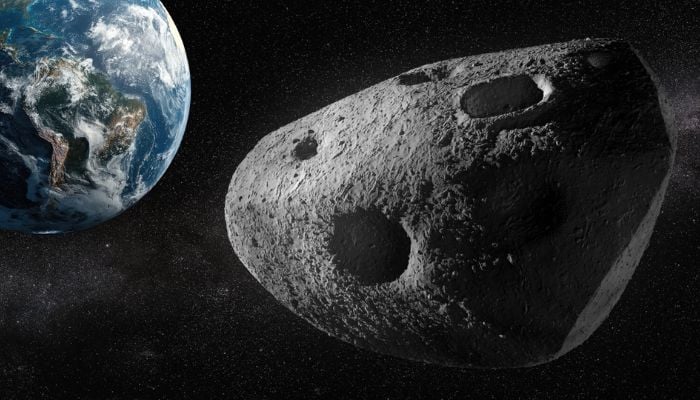
China has announced plans to build a coordinated “space-ground” monitoring network to detect near-Earth asteroids, though officials have offered few concrete details publicly.
Recent scientific papers and a 2025 presentation to the United Nations, however, point to specific technical options the country is weighing.
The China National Space Administration made the announcement on June 30, International Asteroid Day, describing a coordinated ground-and-space system for early warning, Space reported.
Li Mingtao, chief scientist at CNSA’s Asteroid Monitoring and Early Warning Research Center, told state media that while no known asteroid is currently on a collision course with Earth, many near-Earth objects remain undetected.
Li said the plan combines large-aperture optical telescopes at select ground sites with a space-based monitoring constellation designed to watch for threats approaching from the sun’s direction, a persistent blind spot for ground-based systems.
An asteroid that is coming towards earth from close proximity to the sun would not be easy to detect due to its being hidden behind the glare, an opening which had allowed the Chelyabinsk meteor of 2013 that fell on Russia to go undetected.
There have been more than 40,000 near-Earth asteroids catalogued so far, more than 95% of which have been of one kilometre in size or more, capable of bringing a global disaster. However, only about 45% of the asteroids of 140 meter size have been discovered so far.
In the June 2026 Journal of Deep Space Exploration paper written by Chief Designer of the lunar programme Wu Weiren, four potential o1140-metreations have been suggested for the space-based element, namely the Sun-Earth L1 Lagrange point, Earth’s leading/trailing orbit, Venusian heliocentric orbit, and a distant retrograde orbit companion to Earth.
The basic model of a system includes a single satellite located at L1 combined with ground stations, while the extended model consists of spacecraft distributed among all four aforementioned orbits.
It should be mentioned that China is also developing a test involving a kinetic impact on an asteroid located tens of millions of kilometres away from Earth. The test is planned in 2027 and resembles NASA’s DART mission.