
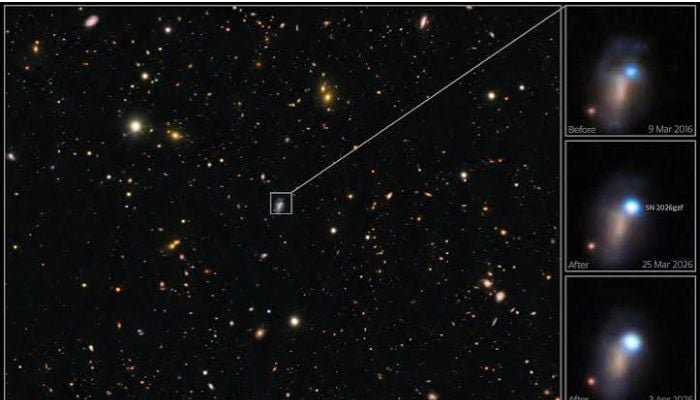
For the first time ever, astronomers have watched a massive star die from start to finish, uncovering a new mechanism for how this kind of violent event can occur in unexpected ways and explode into a brilliant supernova.
Monitoring started in March when China’s Einstein Probe space telescope detected an outburst. The flash was specifically caused by a high-pressure shock wave triggered by a core-collapse explosion breaking through the degrading stellar crust.
The rare discovery is called a shock breakout as it is thought to occur in every supernova but is vanishing quickly like vapor.
This marks one of the first discoveries since 2008 to be observed as researchers assembled an array of telescopes including the orbiting Chandra X-ray Observatory and a host of ground-based facilities to continue monitoring for almost three months until the supernova’s location passed behind the sun.
In this connection, astronomer Brendan O’ Connor said: “You can think of the shock like radar — as the shock plows through the star’s outer layers and any material in the vicinity, it leaves an imprint on the signal that we detect in X-rays. We can use these X-rays to give us an unprecedented, close-up view of the star at the brink of collapse,” stated astronomer Jillian Rastinejad, a NASA Einstein Fellow at the University of Maryland and lead author of the other study.”
Crucially, the star was located roughly 500 million light-years from Earth, a nearby galaxy that distance light travels in a year up to 5.9 trillion miles. On the contrary, the star was estimated to be around 30 times more immense than the sun before the supernova.
The blast is observed to have left behind a black hole-an object with infinite density and inescapable gravity so strong that even light can escape. It is crucial to note that this was a Wolf-Rayet star and massive star that had shed its outer layers of hydrogen and helium through powerful stellar wind before the explosion.
O’ Connor further said: “One possibility is that this jet was “choked” — prevented from surging into space — either by the surface of the star or by dense material that had surrounded the star in the final stages of its life.
“The existence of choked jets was theorized decades ago, but yet to be conclusively identified. The difference between a successful and choked jet is whether the jet is moving fast enough, or is powerful enough, to break out of the surrounding stellar material.”
Nonetheless, the finding shows that the most immense stars die in more ways than astronomers previously thought, furthermore these extreme supernovae serve as laboratories for cosmologists to study how the laws of physics behave in extreme environments.