
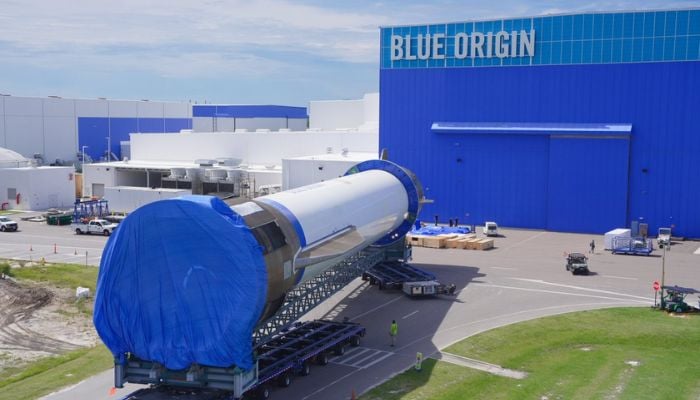
Reconstruction has begun at Blue Origin’s launch pad at Cape Canaveral Space Force Station in Florida, CEO Dave Limp confirmed Wednesday less than three weeks after an uncrewed New Glenn rocket exploded during a ground engine-firing test on May 28.
Limp said crews have been working around the clock to clear debris, with pad reconstruction formally starting on Tuesday. He added that the company expects to resume New Glenn launches before the end of 2026.
Bezos, who was appearing together with Limp at the Paris VivaTech conference, called the explosion “a gut punch for everyone in the company” but noted that further analysis showed how much worse the situation might have been.
The key infrastructure elements, such as the propellant storage facilities and those for storing hydrogen, natural gas, and oxygen fluids, came through unscathed, according to Bezos. These are some of the longest-lead items in the launch infrastructure, and their survival will reduce the time required to get everything up and running again.
Notably, no injuries were reported in the May incident.
However, the initial timeline for recovery received a conservative outlook from sources other than Blue Origin. According to CNBC, NASA administrator Jared Isaacman recently told CNBC that the damage at New Glenn would require “serious time” to fix, which was a slightly more pessimistic outlook than Limp’s end-of-year prediction made last Wednesday.
This disparity in opinion may be indicative of Blue Origin’s engineers discovering an improved scenario after removing all debris from the site.
Limp also confirmed that Blue Origin’s uncrewed Mark 1 lunar lander mission is now expected to fly in early 2027.