
PUBLISHED
February 01, 2026
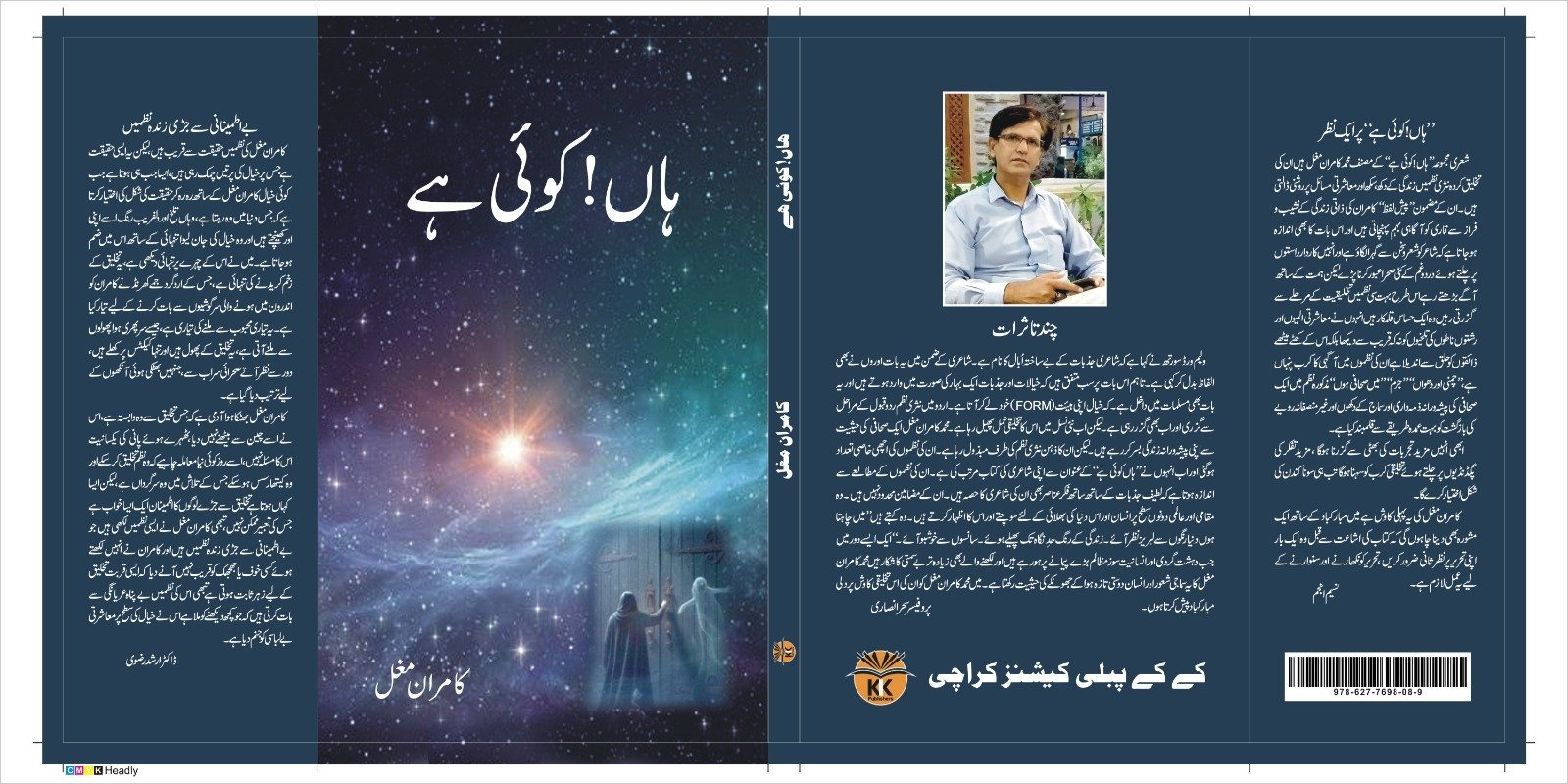
Kamran Mughal’s Haan… Koi Hai is a profound exploration of the human condition, acting as a bridge between the intimate struggles of the individual and the collective pulse of humanity. It does not retreat into the abstract; rather, it finds its strength in the “soil” of our lived experiences, ensuring that every line carries the weight of truth.
In the landscape of contemporary Urdu literature, it is rare for a first venture to arrive with the gravity of a seasoned masterpiece. Yet, Mughal’s debut collection does exactly that, bolstered by the rare and prestigious endorsement of twelve distinguished Urdu scholars. Their forewords serve as a gateway to a work that performs a meticulous thematic autopsy on the collective national soul and the private human heart. Writing with a fluid, “flowy” grace and an accessible, ordinary vocabulary, Mughal bridges the gap between the high-brow scholarly tradition and the visceral, lived experience of the modern citizen.
A first book of poetry is never merely a collection of verses; it is an unveiling of the inner life.
Divine submission
The book stands as a threshold between the poet’s inner universe and the world he bravely invites into its divine space anchored by the magisterial title poem, Haan…Koi Hai is a two-page spiritual manifesto that serves as the book’s philosophical heartbeat. In these verses, Mughal establishes himself not merely as a poet, but as a sensitive diagnostic observer of a divine system. He describes a Creator who “runs the system of life,” a presence that does not remain distant but actively teaches the weary traveller how to cross the rough terrain of existence.
The poet writes as someone deeply attuned to the idea of divine presence, a singular, all-encompassing power that governs not only human destiny, but the silent rhythms of nature, the instinctive wisdom of animals, and the unseen order of existence itself. His belief in one Creator is not rigid or dogmatic; rather, it breathes through his lines like light through leaves. At times, his poetry reads as devotion, a soft, reverent, and surrendered. At other moments, it feels like a conversation with the Divine, questioning, yearning, and seeking reassurance in a world that often appears fractured and unjust.
The debt of the homeland
At a certain point, poet’s gaze shifts seamlessly from the celestial to the terrestrial. In Aao Watan Tameer Karein [let us build the homeland], he adopts the persona of a humble debtor to his soil. He views national service not as a political choice, but as a moral repayment for the identity bestowed upon him by his country. His call to action is remarkably pragmatic; he urges his readers to cast aside mayoosi [despair] and embrace tadbeer—a term implying strategic wisdom and calculated efforts to “conquer the world” and usher in a new dawn.
The paradox of intimacy
What makes this collection compelling is the way Mughal balances faith with awareness. He does not retreat into spirituality as an escape from reality. Instead, he stands firmly within the world, observing it with open eyes and a wounded heart. His poems often carry the weight of social consciousness of pain witnessed, wrongs endured, and voices silenced. There is an activist’s pulse beneath his calm tone, a quiet resistance against cruelty, apathy, and moral decay
Despite his public calls for national reconstruction, Mughal’s most haunting work lies in his private reflections. In the poem Ajeeb Larki [strange girl], he displays a vulnerable, introspective persona. He paints a lyrical portrait of a woman defined by her “wandering mood” and unpredictability. The emotional core of the piece lies in a startling admission of human fallibility: the speaker confesses to frequent lying, yet he is undone by the girl’s absolute, “word-for-word” trust in him.
Witnessing the descent
His latest piece of work Karachi Jal Raha Hai, dedicated to victims and affectees of the Gul Plaza inferno. This poem, though not in the book, is a powerful, raw piece of “witness poetry.” It captures the tragedy of the Gul Plaza fire with a focus on human cost rather than just physical destruction. Karachi is burning— not just the buildings; but human dreams and hopes too. It wasn’t the walls of Gul Plaza that fell, but a mother’s prayers, the children’s long wait, and the labourer’s entire day of toil that came crashing to the earth.
Here Mughal feels deeply, and that depth translates into verses that are fragile yet resilient, personal yet universal. His words suggest a soul that absorbs the world’s sorrow and transforms it into reflection rather than bitterness. This sensitivity allows him to move seamlessly between the personal and the cosmic—from an individual’s grief to the vast intelligence governing existence. In doing so, he reminds readers that belief, pain, and responsibility are not separate experiences, but interwoven strands of being human.
Mughal’s “autopsy” of society becomes piercing when he addresses the breakdown of communal harmony. In the pained verses of Aman Ki Fakhta Kho Gayee [The dove of peace is lost], he documents a descent into societal madness. The poem is a chilling record of mob violence, where slogans of death echo through streets once known for peace. It is a brave piece of writing, where he captures the chilling silence of those who watched but did not stop the chaos, making the poem a diagnostic of a society’s moral health.
The sanctuary of innocence
The poem Masoom [Innocent] functions as a respite from the surrounding darkness. He expresses a desperate, almost childlike longing for time to stop and for a reality where every rival becomes a friend. This poem reveals a heart that seeks refuge in the dream of universal friendship, where butterflies converse with flowers and loneliness is permanently banished. It is an essential key to understanding poet’s personality, a man who feels the “loneliness of humanity” deeply and proposes “innocence” as a radical form of resistance against a harsh world.
The final journey
The collection eventually leads the reader to a confrontation with the unforeseen end of all things. In the stark, modern imagery of Nylon Mein Lipti Lash [The corpse wrapped in nylon], Mughal treats mortality with a clinical yet compassionate eye. He describes the body as a “traveller” whose journey has abruptly shifted into a new, silent dimension.
He suggests that death is not an ending but a transformation and advises the reader, “do not fear the unforeseen” is a testament to the spiritual fortitude established in his opening poems. Even when encased in synthetic nylon, the human spirit is treated as a traveller who has simply reached a new destination.
A love for all seasons
Mughal’s journey of emotion concludes with Mujhe Mausam Se Kya Lena [Why do I care for the season], a total surrender to the constancy of love. Mughal asserts that his internal world is dictated by the presence of his beloved, not the calendar. Whether the world outside is gripped by the chill of December or the heat of September, he finds “all the colours of spring” within the person he loves.
The writer’s strength lies in his many roles as a witness. In his poem Udaas, he highlights the plight of women through customs like Vanni and the commercialisation of the noble profession of teaching. It is a critique of the middle-class gaze, where one watches the exploitation of a mother and child through the safe window of a car, trapped in their own insensitivity.
The poet balances these heavy themes with the delicate beauty of Gajra, where the touch of jasmine petals against a cheek becomes a moment of reckoning. Here Mughal emerges as not just a critic of the world, but a participant in its beauty. Conversely, Tamasha Mere Agay offers a stoic, philosophical acceptance of betrayal, where the sorrow of life is greeted with a bitter but necessary gratitude.
As a first launch, this book carries the raw honesty of beginnings. There is no pretence of mastery, only sincerity. Mughal does not claim answers; he just offers questions shaped into poetry. His work invites readers to pause, to feel, to believe, and to reconsider their relationship with the Creator, with society, and with their own conscience. This collection is not just read—it is experienced. It leaves behind a lingering stillness, urging us to listen more closely to the world, to others, and to the divine echo within ourselves.
In welcoming Mughal’s poetry into the literary space, readers are not merely discovering a new poet; witnessing the birth of a voice that dares to be vulnerable, faithful, and awake.