
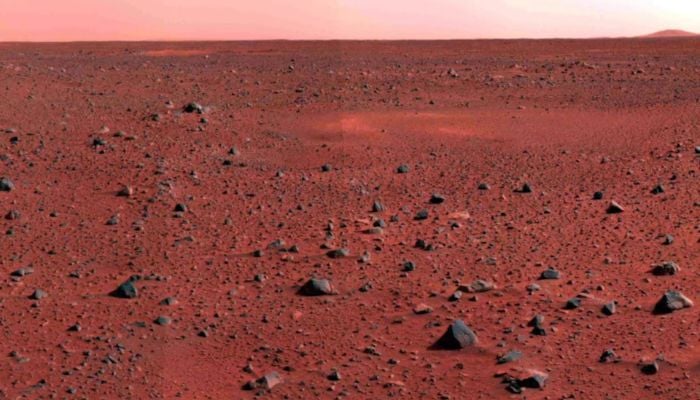
NASA’s Jet Propulsion Laboratory (JPL) has reported a new discovery from the Perseverance rover that could affect plans for future human missions to the Martian planet.
And this hidden threat could pose serious risks to astronauts’ health.
During the exploration over 1,645 Martian days, the rover detected fine and ultrafine Martian dust particles clinging to spacesuit material samples aboard the rover, as per the findings published in the Proceedings of the National Academy of Sciences.
While past measurements tracked dust down to about 3 micrometers, the rover’s PIXL instrument detected fine particles, less than 2.5 micrometers, and ultrafine particles~100 nanometers, or 700 times thinner than a human hair. It means they are small enough to penetrate deep into lungs.
The smallest particles stayed attached through years of driving and drilling, while larger “dust bunnies” shook off over time.
Composition of Martian dust & potential dangers
Martian dust is enriched in sulfur, chlorine, iron, and phosphorus, contains calcium sulfate and silica, and carries chemically reactive compounds like perchlorates, which can disrupt thyroid function and reactive iron.
Owing to their minute size, fine particles can penetrate deep into the lungs and enter the bloodstream. The ultrafine particles can travel from the nasal cavity to the brain.
Hence, the measurements and findings could help engineers improve spacesuit and habitat designs including suit ports and dual-chamber airlocks, set crew health standards, refine indoor dust-exposure limits, and develop dust-removal procedures.