
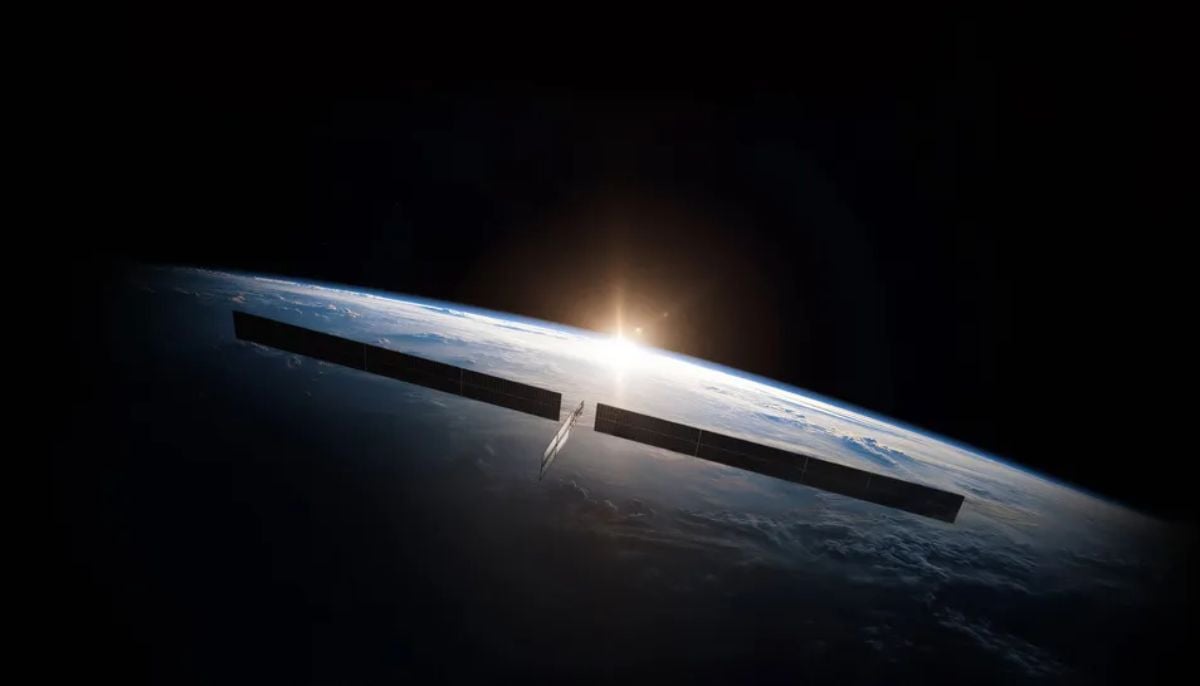
Elon Musk wants to move AI computing off the planet and says SpaceX already has most of the technology to do it. In a half-hour video posted to X on Monday, the SpaceX CEO laid out plans for a constellation of AI satellites that would function as orbital data centres, with a dedicated production facility expected to be operational by the end of next year.
The AI satellites would be equipped with solar cells for power, heat radiators for thermal management, onboard compute racks, and high-speed laser links to communicate with each other and with existing Starlink satellites.
Data would be transmitted to the ground via antennas or laser connections at low latency. Musk described the network as “racks of compute” distributed across orbit, interconnected in real time essentially a distributed supercomputer above the atmosphere.
Musk pointed to Starlink V3, the next generation of the company’s broadband satellites currently in development, as the technological bridge. “A lot of this technology, we’ve already made for the Starlink V3 satellites,” he said, adding: “We don’t think this is a super-hard problem, compared to things we already do.”
SpaceX’s experience managing large satellite constellations at scale is, in Musk’s view, a competitive moat no rival can currently match. “We are the only operator that has any experience of that scale,” he said.
The idea is based on an actual problem because Earth-based data centres face various constraints due to a lack of space, power requirements, and increasing community resistance to the excessive use of water and power required for huge data centres.
However, shifting computation into orbit eliminates these problems from the equation, at least theoretically. The problem is that orbital data centres have not been implemented yet; no company has ever succeeded in proving the viability of their concept.
SpaceX is planning to launch its own orbital factory, dedicated specifically to manufacturing AI satellites, before the end of 2026, according to Musk.